
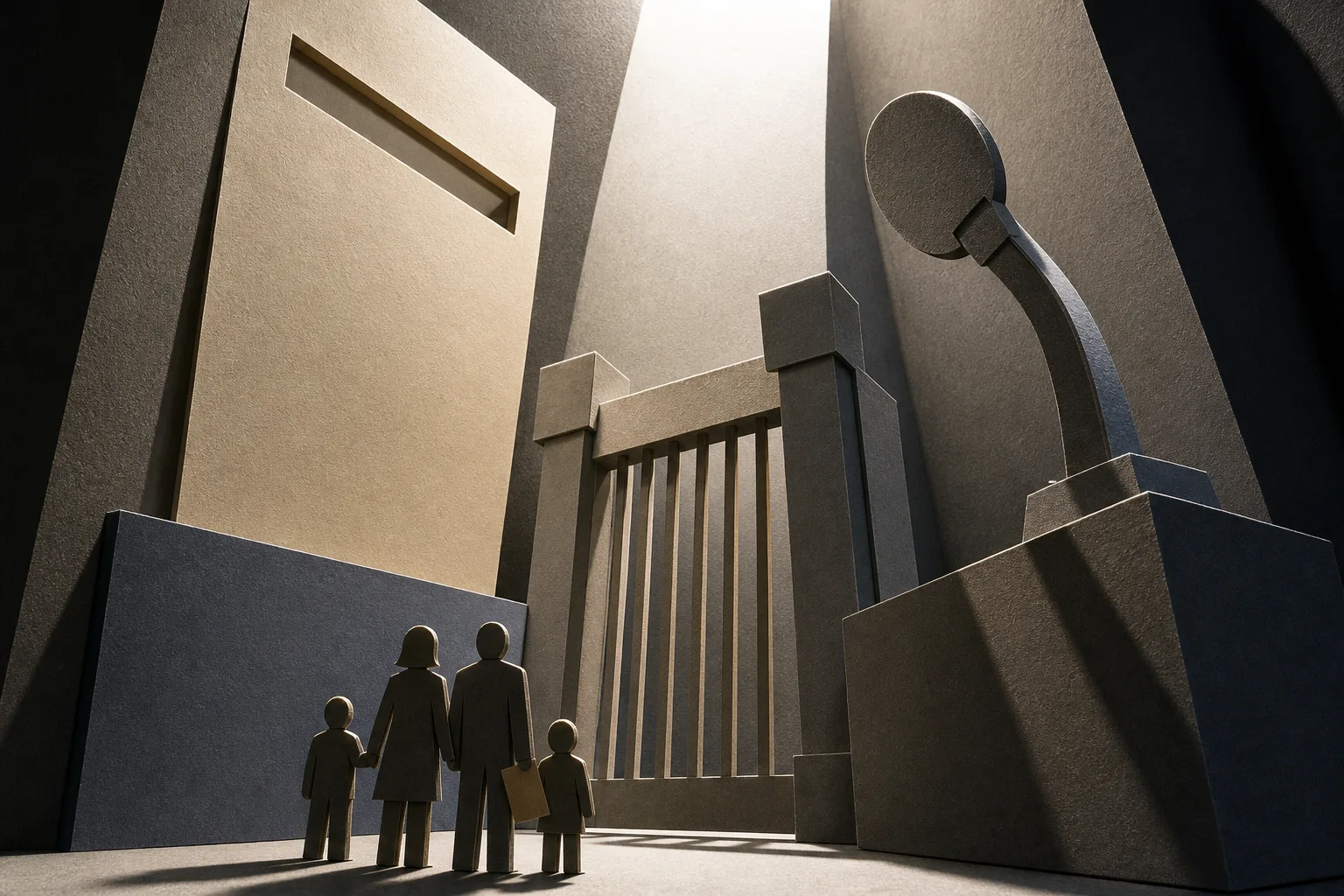
Homeschooling often feels most private at the kitchen table and most public at the counter where a form is due. The stories worth watching are not about curriculum. They are about the points where families meet public systems: a district office, a state licensing board, and a legislative hearing.
A child who can recite a position is not automatically a child who freely chose the burden of public advocacy.
For parents and co-op leaders, the lesson is practical. Keep clean records. Know who receives them. Prepare graduates to defend their credentials. And when children are asked to speak in public, treat consent as more than a permission slip.
A missing report became a home visit
In New York, homeschooling through one year typically requires families to send multiple required documents to the local public school superintendent’s office, HSLDA reported. For one Long Island family, a question about one document led a public school official to come to the family’s home at 7:30 a.m., according to HSLDA.
HSLDA reported that Dana Riccio had emailed her second quarterly homeschool report, but it never reached the superintendent’s office because she had sent it to the wrong email address. HSLDA also reported that Riccio said she had not received phone calls or emails before the visit, and that a certified letter arrived the same day.
HSLDA associate attorney Ralph Rodriguez contacted the district for the family, and HSLDA reported that officials said they did not intend to seek further legal action and wanted a copy of the missing report.
If your state or district requires recurring reports, this is the part to copy into your own routine: save proof of sending, verify the correct address, and do not assume silence means receipt. If a district changes personnel, ask whether the submission address or process has changed.
Graduate credentials can still be challenged
HSLDA reported that sisters Rachel and Hannah, whose names were changed for privacy, applied to a state-appointed board in Florida last December as the final step toward becoming licensed electrologists and were denied because they were homeschooled, according to HSLDA. HSLDA reported that the sisters later received their licenses after a delay of several months.
The sisters had been homeschooled from kindergarten through 12th grade, took courses through a local community college through Florida’s dual enrollment program, and each had earned 40 college credits by the time they finished high school, HSLDA reported. HSLDA also reported that Rachel later completed undergraduate work in communications and hospitality management, while Hannah completed nursing studies at the bachelor’s level.
HSLDA reported that the sisters completed a three-month course at a state-approved electrolysis academy, passed the state exam in December, and then received a January email from the Florida Electrolysis Council saying their diplomas did not “meet the requirement” for licensing. HSLDA Senior Counsel Tj Schmidt wrote to the council, and HSLDA reported that the sisters also submitted their own homeschool records, including district confirmation that they had finished high school under state law.
At the council’s April 8 meeting, members approved licenses for Rachel and Hannah about three months after they applied, HSLDA reported.
For homeschool parents, the judgment is straightforward: a diploma may be enough for many doors, but some boards may still ask for more. Build a graduate file before the graduate needs it. Include the diploma, transcript, proof of compliance with state law, dual enrollment records if they exist, and college records if they exist.
Children at hearings need a real exit
The Coalition for Responsible Home Education published an opinion essay arguing that children’s testimony in homeschool policy debates raises ethical questions about power and consent, especially when parents are also the child’s teachers and daily authority figures, according to CRHE. The author wrote that children can have a voice and still lack meaningful agency when adults set the expectation for participation.
CRHE described hearings where children spoke against homeschool-related bills, including a 7-year-old presented by parents as acting independently and a tween-aged child who sobbed through a personal story about anxiety while her mother coached her to continue.
CRHE’s position is not that children should be silenced. The essay argues that adults should create conditions where children may speak freely or choose not to speak at all, and that homeschool alumni can offer testimony with more independence from the parents who raised them.
If your family or co-op participates in policy advocacy, the practical question is not only whether a child can speak well. Ask whether the child can decline without consequence. Ask whether the story being told will remain public in a way the child may later regret. Ask whether an adult alumnus could make the same policy point without placing a minor at the microphone.
A child who can recite a position is not automatically a child who freely chose the burden of public advocacy.
Public trust is built before the conflict
These three stories point in different directions, but they meet at the same place. Read together, the stories can be seen as raising questions about fair treatment, proof, process, and persuasion.
If a district asks for paperwork, answer with organized records and documented communication. If a licensing board questions a graduate, answer with a complete file and the relevant legal history. If lawmakers hear from homeschoolers, make sure the children in the room are not carrying adult responsibilities they cannot freely refuse.
Worth watching: the families who fare best in these moments may be the ones who prepare before they are challenged. That preparation is not fear. It is stewardship of the freedom to teach your own children, and of the children themselves.