
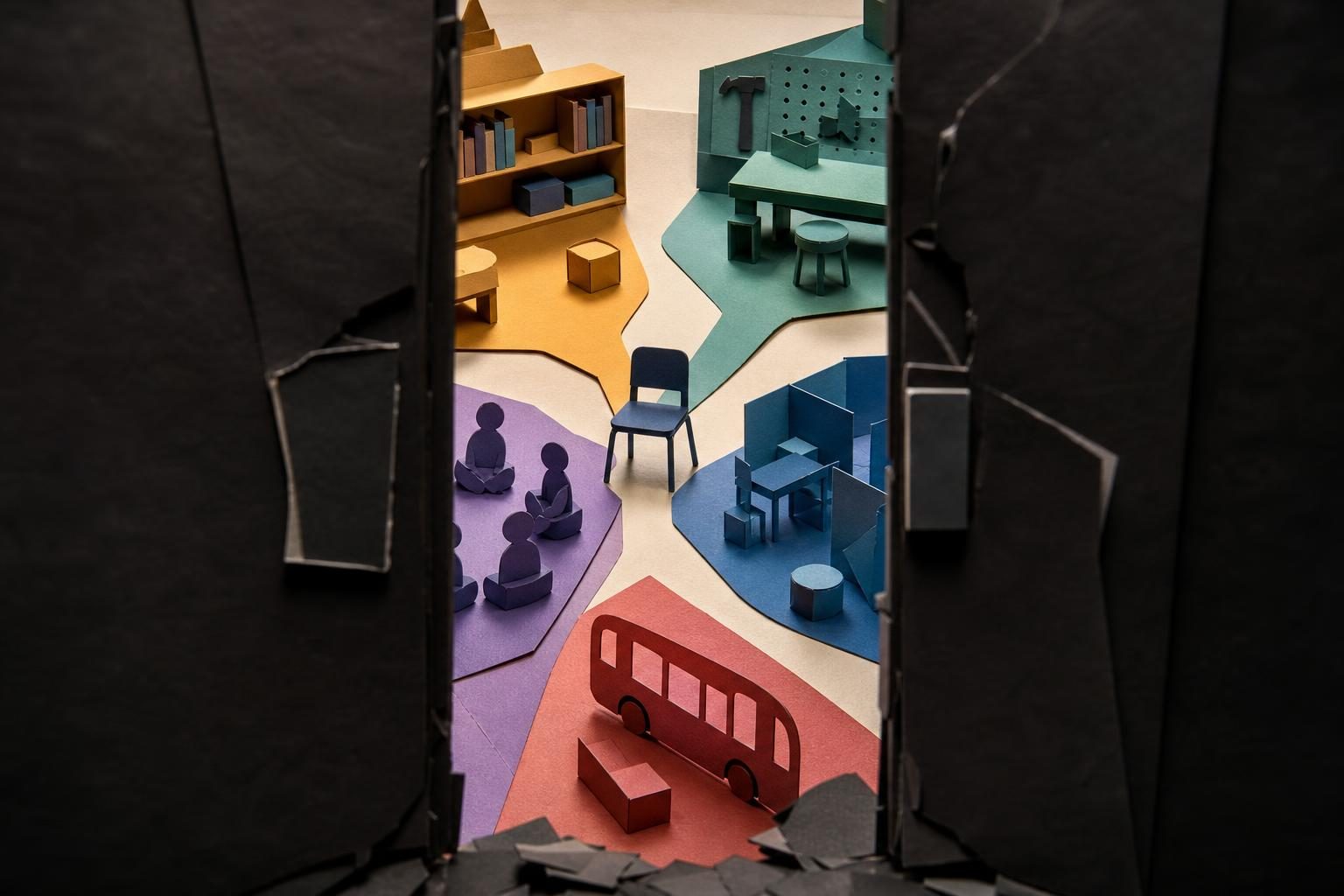
The work can feel impossible when the conditions keep changing. Supplies run short. A career pathway shifts under students’ feet. A teacher sees students’ interest in learning decline. A school model is redesigned around more flexibility. An integration program keeps operating decades after Boston’s 1970s busing fights.
The through line is not magic.
This week’s strongest stories do not offer easy inspiration. They offer something better: evidence that adults can rebuild the conditions around young people and get real results.
A free warehouse turns scarcity into possibility
In New York City, teachers can shop for free classroom materials at a 35,000-square-foot warehouse in Queens through Materials for the Arts, a city Department of Cultural Affairs program that is not open to the public but serves New York City public school teachers and some arts nonprofits without charging them, Chalkbeat reported.
The program matters because the official supply money has limits. Teachers can be reimbursed up to $220 this school year through the teachers’ choice allotment, and some teachers told The City Reporter that the money does not always stretch as far as students need, Chalkbeat reported.
The warehouse is not just paper and pencils. At a Williamsburg high school focused on architecture and design, teacher Alain Codio picked up tools for model making and laser engraving, PlayStation games, paint, and easels for school programs, Chalkbeat reported.
If you work in a place where teachers are still solving supply gaps one receipt at a time, the lesson is not that every district has a warehouse waiting. The lesson is that someone treated discarded materials as public infrastructure for classrooms.
A coding program changed when the job market changed
Launchpad Philly opened in 2022 to help high school students and recent graduates learn coding, build portfolios, get support and mentorship, and land jobs, Chalkbeat reported. Then AI changed the entry-level tech market while the program’s first cohort was still training, and the organization began overhauling its curriculum and adding more direct work experience, Chalkbeat reported.
The numbers are sobering. Launchpad graduated its first intensive cohort of 12 students last year; a year later, three were working full-time, two were in college, and the rest were piecing together freelance and part-time work, Chalkbeat reported.
The program did not pretend the old promise still held. Participants can now earn certifications in generative AI and project management along with coding, and the curriculum now puts more emphasis on helping nontechnical colleagues understand and use technical tools, Chalkbeat reported. Launchpad also created Launchpad Inc., a business side that lets local companies and nonprofits hire Launchpad as a developer, with program participants staffing projects for part-time work at $20 per hour, Chalkbeat reported.
A zombie scenario gave students a way into civics arguments
In Crothersville, Indiana, sixth graders in Jared Kempton’s Tinker class used a zombie apocalypse scenario to discuss how to rebuild society, weighing safety against liberty through the foundational documents of the United States, Chalkbeat reported.
In Tinker, students pick a theme for a semester project and Kempton builds lessons around it; this semester, he used a zombie virus to teach microbiology and zombie-proof armor to teach engineering, Chalkbeat reported. The class does not replace required science or civics classes, but reinforces concepts through projects, Chalkbeat reported.
If your students will argue about zombies before they will argue about rights, start there. The point is not the gimmick. The point is the doorway.
A public microschool made flexibility part of the design
At EDGE Microschool in Liberty, Missouri, students take about five courses inside the school-within-a-school and two in a comprehensive school, while still participating in extracurriculars such as band, football, speech, and drama, The 74 reported. EDGE enrolls 82 students in grades 9 through 12 and is run by a traditional public district inside Liberty High, The 74 reported.
Students help build their weeks with scheduling software, use “Flow” time for studying, conversation, and relaxing, and demonstrate learning mostly through competency instead of seat time or exams, with exceptions for Advanced Placement math and science classes, The 74 reported.
The model has early evidence behind it. EDGE students attend school more consistently than the larger school, 91.6% compared with 85.2%, and on Missouri’s most recent end-of-course tests, 75% of EDGE students reached proficient or advanced in English II, compared with 65% of non-EDGE students; in Algebra I, the comparable figures were 55% and 43%, The 74 reported.
Integration’s long arc produced measurable gains
A newly published study by Tufts University economist Elizabeth Setren found that Boston’s Metco program raised participating students’ test scores modestly and increased high school and college completion compared with similar students who applied but did not get in, Chalkbeat reported. College graduation rates rose from 26% to 38%, and the program increased students’ annual incomes by several thousand dollars as adults, Chalkbeat reported.
Metco sends a few thousand students, most of them Black and Hispanic, from Boston to mostly white suburban schools and is still operating, Chalkbeat reported. Setren told Chalkbeat that Metco students had smaller classes on average, higher attendance, lower suspension rates, more AP options in high school, and classes with much higher-performing peers overall, though they were also in lower-performing classes within their schools, Chalkbeat reported.
The through line is not magic. It is adults refusing to let the first barrier be the final design.