
Florida Jet Crash Puts Aviation Safety Work in Focus
A fatal crash shows how aviation jobs depend on weather judgment, radio discipline, data, and careful investigation.
Print it — all four files
The student packet has no answers in it. The teacher copy is the same pages plus a note on each question and the answer keys. Both languages carry the same story, the same picture and the same vocabulary.
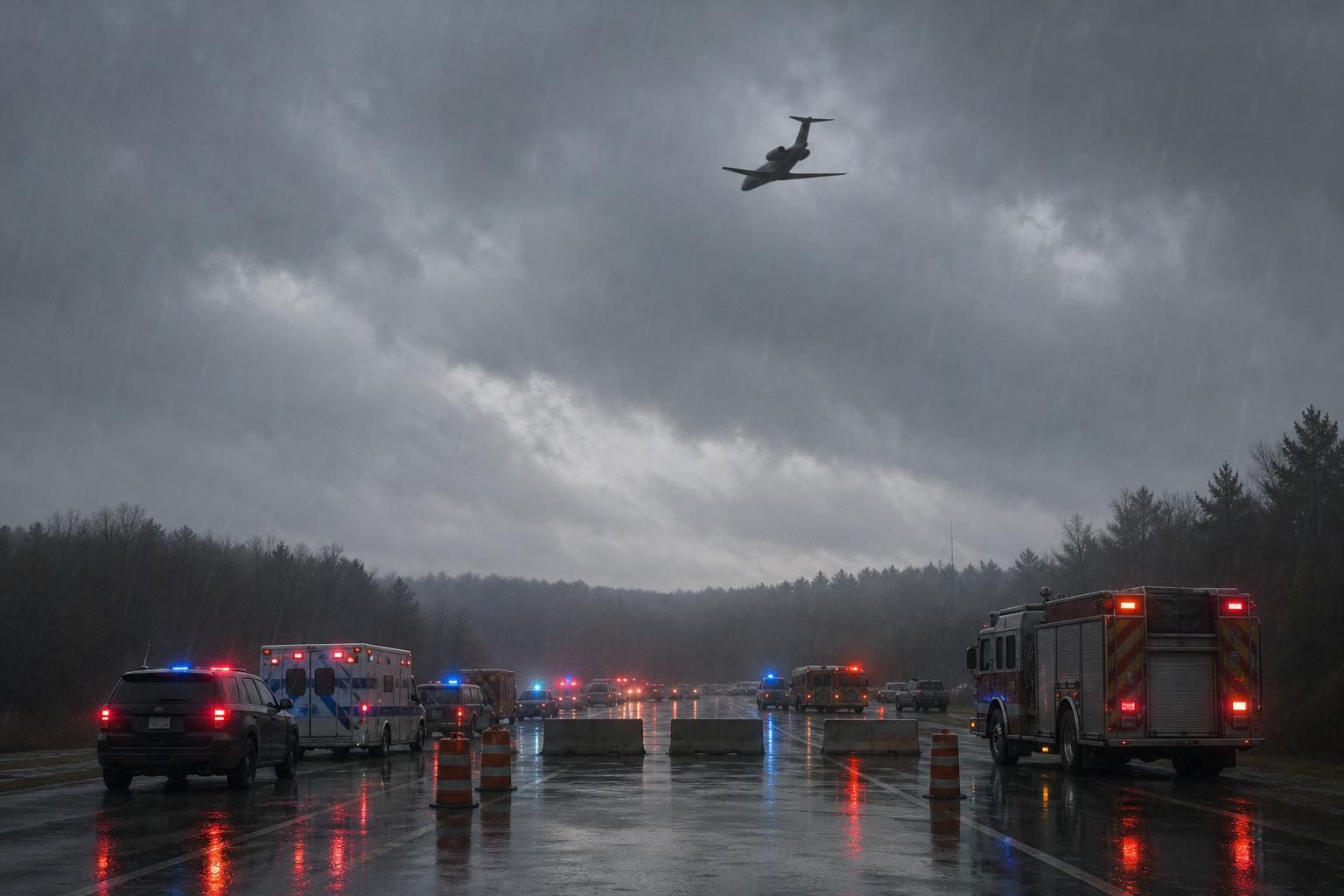
A business jet carrying nine people crashed Sunday in a South Florida neighborhood, killing everyone on board, according to reporting by PBS NewsHour and the Associated Press. The aircraft, a Learjet 60, had left Austin-Bergstrom International Airport in Texas and was headed to the Bahamas. Federal officials said it went down in Palm Beach County at 12:50 p.m. There were no immediate reports of anyone on the ground being injured or killed.
The crash matters beyond the tragedy because aviation is a system of connected trades and professions. A business jet is a smaller private aircraft often used for company or charter travel, not an airline flight with rows of passengers. Its safe operation depends on flight crews, air traffic controllers, airport staff, weather services, maintenance records, emergency responders, and federal investigators. When something goes wrong, the work shifts from transportation to evidence: What did the crew report? What was the weather doing? What did the aircraft’s path show? What can be learned before another crew faces a similar situation?
The source reports that rain was pounding the region, and a flood watch for excessive rainfall was in effect through Monday afternoon. Before the crash, the pilots reported turbulence, icing, and precipitation. Turbulence is rough, unstable air that can jolt an aircraft. Icing means ice is building up on parts of the aircraft, which can affect airflow and performance. Precipitation means water falling from the atmosphere, such as rain, sleet, or snow. None of those terms automatically explains a crash, but each one is information that aviation workers must recognize, communicate, and act on quickly.
The aircraft was flying east at 35,000 feet when the pilots asked to climb another 2,000 feet. Shortly after that, the jet entered a steep dive. Air traffic control recordings and flight tracking data showed the rate of descent increasing sharply, from 10,000 feet per minute to 20,000 feet per minute and then up to 30,000 feet per minute. Flight tracking data is digital information that shows an aircraft’s position, altitude, speed, and movement over time. An overspeed condition, also reported in the source, means the aircraft is moving faster than its design limits allow. In that situation, the crew is dealing with both altitude loss and structural limits at the same time.
For a CTE aviation pathway, one lesson is that technical skill is not only hands-on mechanical work. It is also communication. Pilots use short, standardized radio calls because there is no time for confusion. Air traffic controllers, the workers who guide aircraft from the ground using radar, radio, and procedures, need to understand what a crew is saying and what airspace options are available. A request to climb is not just a casual question; it is part of managing weather, altitude, traffic, and aircraft performance in real time.
Another lesson is that modern transportation work leaves a data trail. The article mentions air traffic control recordings, flight tracking data, and video recorded by people nearby. Investigators will not rely on one dramatic clip or one sentence from the radio. The Federal Aviation Administration, the agency that regulates civil aviation, is sending a team to support the National Transportation Safety Board, the federal agency that investigates major transportation accidents. An investigation is not the same as assigning blame on day one. It is a structured process for comparing physical evidence, recorded data, weather conditions, crew communications, and operating procedures.
That kind of work takes patience and accuracy. An investigator, aircraft technician, dispatcher, or safety manager has to be comfortable saying, “We do not know yet,” even when the public wants a fast answer. In many trades, especially transportation, a wrong early assumption can send attention in the wrong direction. The safer habit is to separate facts from possibilities. In this case, the known facts include the route, the time, the weather reports, the crew’s reports of icing and turbulence, the steep descent, and the loss of everyone on board. The cause was not immediately released.
The emergency response side is also part of the workforce picture. The jet crashed near a roadway and close to homes in Greenacres, a city southwest of West Palm Beach. County authorities closed the road and evacuated about 600 people from a nearby mobile home community while federal officials investigated. That shows how a transportation emergency can become a neighborhood operations job. Fire, law enforcement, public works, traffic control, and local emergency management all have to secure the scene, protect residents, and preserve evidence at the same time.
For someone preparing for aviation, public safety, or transportation careers, this story is a reminder that hiring is not only about wanting an exciting job. Employers need people who can read instruments, follow procedures, document what they do, communicate clearly under stress, and respect the limits of equipment and weather. The work can be highly technical, but it is also disciplined. In aviation, a single event may involve workers in the cockpit, in a control facility, at an airport, on a roadway, and later in an investigation room, all trying to turn a disaster into usable safety knowledge.
Written from reporting by PBS NewsHour, “All 9 people aboard a jet that crashed in Florida have died, transportation secretary says”.
Discussion questions
- When a crash happens in bad weather, how should investigators balance public pressure for quick answers against the need to avoid early assumptions?
- Which aviation skill seems most important in this incident: technical aircraft control, weather judgment, radio communication, or data analysis? Defend your choice.
- How could the same work habits used in aviation accident response apply to another CTE field, such as health care, construction, automotive technology, or firefighting?