
Tiny Protein Motion May Help Nature Sense Magnetic Fields
A new study points to lab techniques and simulations that could shape future biosensor work.
Print it — all four files
The student packet has no answers in it. The teacher copy is the same pages plus a note on each question and the answer keys. Both languages carry the same story, the same picture and the same vocabulary.
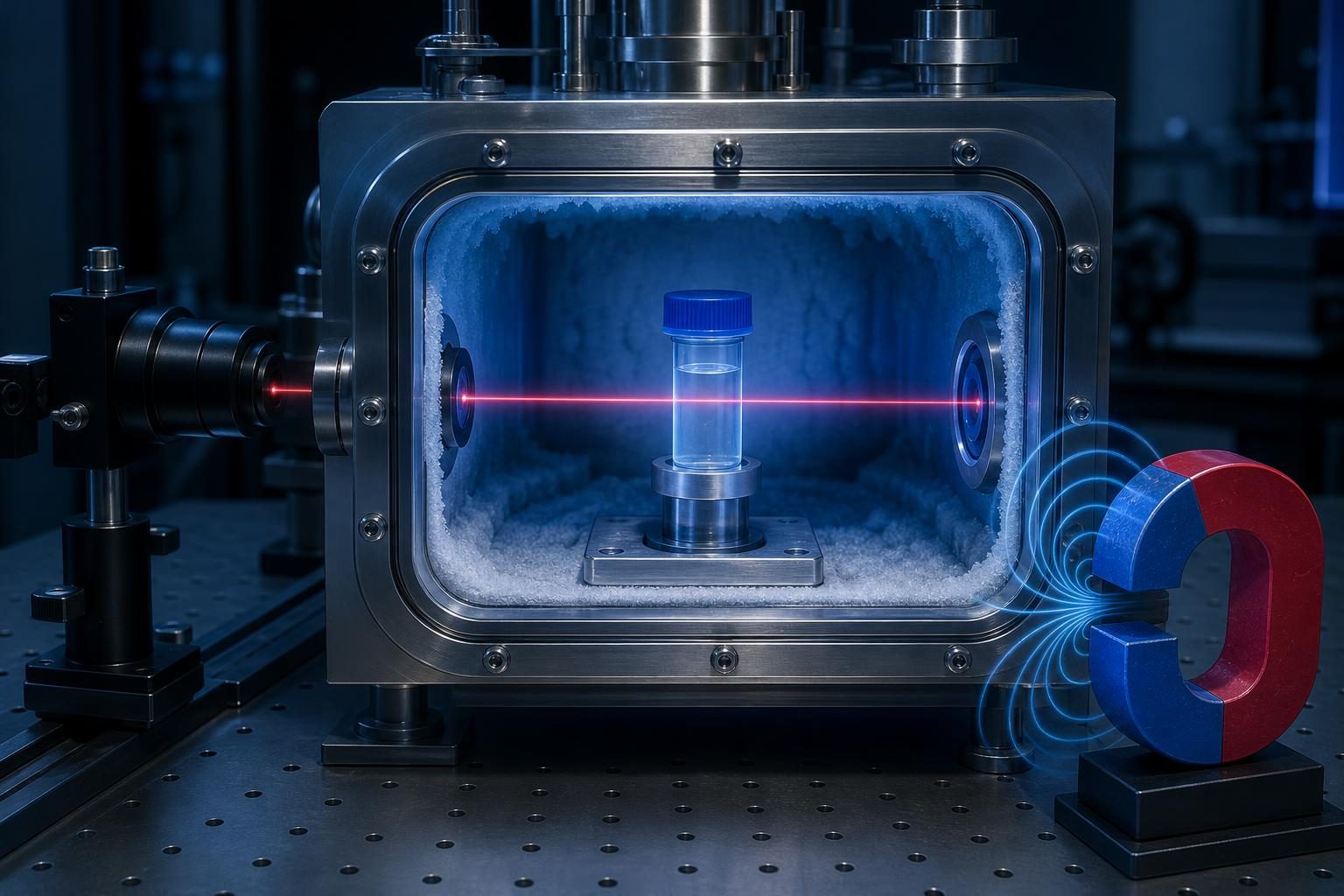
Researchers have identified a possible way that tiny motions inside a light-sensitive protein could strengthen an animal’s ability to detect Earth’s magnetic field. According to Phys.org’s report on the study, the work was led by Yasuhiro Kobori at Kobe University with researchers from several other universities, and the findings were published in The Journal of Physical Chemistry Letters.
The protein is called cryptochrome, a blue-light-sensitive protein that has been studied because it may be involved in magnetoreception, which means sensing magnetic fields. Migratory birds and other organisms are thought to use Earth’s magnetic field as one source of directional information. The new study does not prove that a bird, frog, or other living animal navigates this way. It focuses on what may be happening at the molecular level, where a protein’s shape, motion, and electron behavior can change the outcome of a chemical reaction.
That matters for CTE because this is not just an idea on paper. It is a look at the kind of technical work used in modern biotechnology, materials science, instrumentation, and sensor development. The people doing this work must understand samples, equipment, light pulses, temperature control, data quality, and computer modeling. In a lab like this, a good result depends on both scientific theory and hands-on control of a complicated test system.
The team studied a form of cryptochrome from Xenopus laevis, an African clawed frog often used in biological research. Cryptochrome contains flavin adenine dinucleotide, or FAD, a molecule that can absorb blue light. When FAD absorbs light, electrons move through nearby tryptophan residues. A residue is one building-block unit within a protein chain, and tryptophan is one type of amino acid, the chemical unit that proteins are made from.
When electrons move in this system, they can form radical pairs. A radical pair is a pair of molecules with unpaired electrons, and those unpaired electrons have a property called spin. Spin is not a tiny ball physically spinning like a wheel; it is a quantum property that affects how electrons behave in magnetic fields. The theory is that Earth’s magnetic field could slightly influence these spin states, which could then change the yield, or amount, of a chemical signaling product.
To observe what was happening, the researchers used time-resolved electron paramagnetic resonance spectroscopy, often shortened to time-resolved EPR. Spectroscopy is a set of techniques that study matter by watching how it responds to energy. EPR is a type of spectroscopy used to study materials with unpaired electrons. “Time-resolved” means the measurement tracks changes over extremely short moments after a trigger, in this case pulsed laser excitation, where a laser flash starts the reaction.
The experiments were done at very cold temperatures, from −153°C to −33°C, according to the report. Cold conditions can slow molecular motion and help researchers capture short-lived states that would be hard to measure at normal temperatures. For technicians and scientists, that means the work depends on safe cryogenic or low-temperature practice, careful calibration, and knowing whether the signal on the instrument is coming from the sample or from noise.
The key idea in the study is chirality-induced spin selectivity, or CISS. Chirality means a molecule has a handed shape, like left and right hands: similar, but not superimposable. Spin selectivity means that one spin condition may move or react more favorably than another. The researchers’ analysis suggests that a chiral rotating motion of a tryptophan residue could influence electron-spin polarization, which means the balance of spin states becomes uneven in a useful way.
Their modeling predicted that this effect could make the compass-like chemical response stronger. Without CISS, the predicted directional difference in reaction yield was about 0.3%. With a 6% CISS contribution included, the predicted directional difference rose to 1.6%. Those are still small numbers, but in precision sensing, small changes can be meaningful if they are consistent and measurable.
The study also used quantum-mechanical simulations, which are computer models based on the physics of very small particles such as electrons. The simulations included several interactions, including exchange coupling, electron–electron dipolar coupling, and hyperfine interactions. Those terms describe different ways electron spins can affect one another and be affected by nearby atomic nuclei. In practical terms, the modelers were trying to match the instrument data with a physical explanation that could actually happen inside the protein.
The most important limitation is also clearly stated in the report: this is a theoretical prediction based on spectroscopic analysis, not a direct demonstration of magnetic navigation in living animals. That distinction matters in technical fields. A lab measurement can be excellent and still not prove the whole real-world system. Before anyone can claim a full biological compass mechanism, researchers would need more tests showing that the molecular effect connects to a signal in living tissue or behavior.
For future work, the report says researchers want to test predicted reversals of spin-polarization signals and measure how molecular dynamics affect signaling yields. Molecular dynamics means the movement and shape-changing of molecules over time. If those tests hold up, the findings could inform biomolecular magnetic sensors, which would be devices that use biological molecules or biology-inspired designs to detect magnetic fields.
The hiring lesson is that future technical jobs will not always fit cleanly into one box. This project sits where biology, chemistry, physics, electronics, optics, and computing overlap. A person working on this kind of problem might prepare protein samples, operate an EPR instrument, maintain laser and temperature systems, write or run simulations, or analyze noisy data. Being employable in that space means being able to follow procedures closely, understand the purpose behind them, document results, and communicate uncertainty instead of overstating what the data proves.
Written from reporting by Phys.org, “Small molecular twists may strengthen nature's magnetic compass”.
Discussion questions
- If a company wanted to build a magnetic sensor inspired by this research, what should it treat as promising evidence and what should it treat as still unproven?
- Would you rather hire for this project from a biology background and train instrumentation skills, or from an electronics background and train molecular science? Defend your choice.
- How should a technical team communicate small effects, such as a change from 0.3% to 1.6%, so that the result is neither dismissed nor exaggerated?