
Moon Water May Support Outposts, Not Cities
New research says power may be easier than plumbing for future lunar settlements.
Print it — all four files
The student packet has no answers in it. The teacher copy is the same pages plus a note on each question and the answer keys. Both languages carry the same story, the same picture and the same vocabulary.
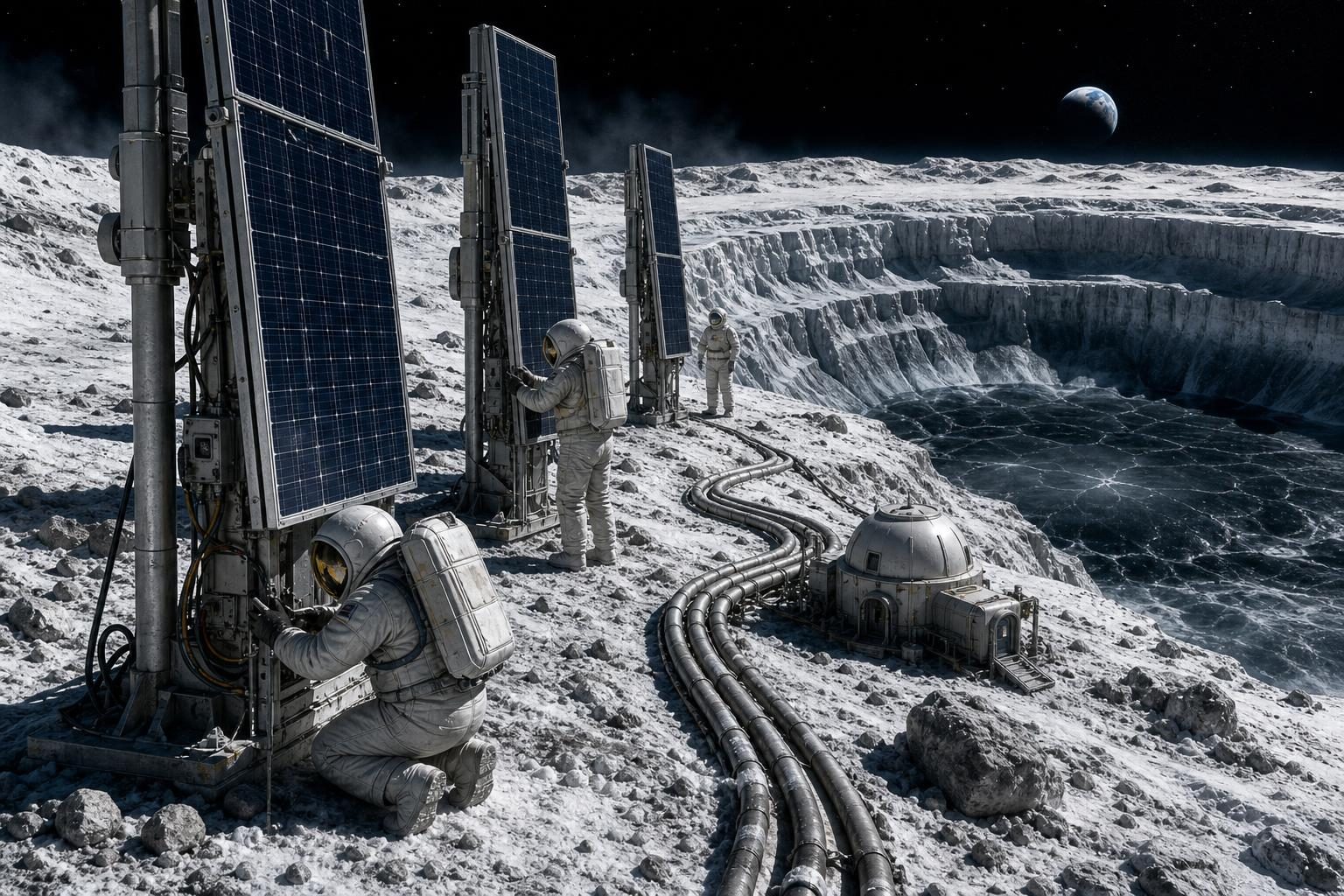
A new study argues that the moon probably has enough polar water ice to support small human settlements for a long time, but not enough for the giant lunar cities sometimes imagined by space entrepreneurs. According to Phys.org’s report on research published in Frontiers in Space Technologies, the basic problem is not getting electricity. It is keeping enough water in circulation for people, food production, and equipment without draining a limited supply.
The water is thought to sit near the moon’s poles, especially inside crater floors that have not received direct sunlight for about 4 billion years. These places are called cold traps, meaning areas so cold that water ice can remain frozen instead of sublimating, which is when a solid turns directly into a gas. Since 2013, moon-orbiting missions have mapped likely deposits in more detail. One generous estimate puts the total at as much as 1 billion tons, or 910 million tonnes, but the article notes that today’s best estimates are about 30 times lower.
That difference matters because water is not just drinking water. In a closed-loop life-support system, meaning a system designed to reuse air and water instead of constantly replacing them, water also connects to sanitation, food growing, cooling, and possibly fuel production. The International Space Station already recycles water at about 98% efficiency, according to the article. Even using that high recycling rate and the optimistic 1 billion-ton estimate, a lunar city of 1 million people would run out of water in just over a century. Using the lower current estimates, the timeline for larger settlements would shrink sharply.
Power looks less like the bottleneck. The rims of some polar craters receive almost constant sunlight, even while the crater floors stay dark and frozen. The study says 3 gigawatts of electricity could be generated using kilometer-tall towers covered with photovoltaic arrays, which are solar panel systems that convert light into electrical power. That amount of power raises the possibility of workshops, processing equipment, and even AI data centers, which are large computer facilities that need steady electricity and cooling. For a trade crew, though, that kind of plan would mean difficult installation work: tall structures, electrical distribution, dust control, inspection, and repairs in a vacuum.
The study changes the picture of what moon work would actually be. A movie version of settlement might focus on rockets and astronauts, but a working base would depend on technicians who can keep pumps, seals, filters, valves, tanks, wiring, solar arrays, and sensors operating. Water-recycling equipment would be critical infrastructure, not a convenience. A failed fitting or clogged filter would not be a small maintenance ticket; it could reduce the amount of usable water in the whole settlement. The skills would overlap with wastewater treatment, industrial maintenance, HVAC controls, solar installation, robotics, welding, and process technology, but the work environment would make every repair harder.
The article also points toward surveying and extraction jobs. Current water-surveying methods reach only a few meters below the surface, while the moon’s regolith, the loose rubble-like layer of broken rock and dust on top, can extend tens of meters down. If more ice is hidden deeper in cold traps, future crews would need better instruments to find it and equipment to remove it without wasting it. That is similar in principle to mining, drilling, and geotechnical work on Earth, where crews must understand material properties before choosing tools and safety procedures. On the moon, the added constraints would include low gravity, extreme cold, abrasive dust, and no outside air.
The research does not say humans cannot live on the moon. It says the scale matters. A village of 1,000 people, or even a town of 10,000, could be sustainable for several centuries or more under the assumptions described in the article. A million-person city is a different system with different material demands. The possible solutions are also technical rather than magical: recycle water better, reduce water use through methods such as vertical farming, import water from accessible asteroids, or find more lunar water. For anyone looking at the work behind the headline, the main lesson is that building off Earth is not only about reaching a destination. It is about whether the utilities can be designed, staffed, repaired, and supplied for the size of the community being promised.
Written from reporting by Phys.org, “No cities on the moon—there isn't enough water, scientists say”.
Discussion questions
- If a company proposed building a large lunar settlement, what evidence should regulators or investors require before treating the plan as realistic?
- Which trade or technical field on Earth seems most transferable to lunar settlement work, and what would still have to change for that job to function on the moon?
- Should future moon projects prioritize finding more water, using less water, or improving recycling first? Defend one priority while acknowledging its downside.