
Why the Brain’s Wiring Crosses the Body’s Center Line
A new neuroscience paper looks at why many brain circuits control the opposite side of the body.
Print it — all four files
The student packet has no answers in it. The teacher copy is the same pages plus a note on each question and the answer keys. Both languages carry the same story, the same picture and the same vocabulary.
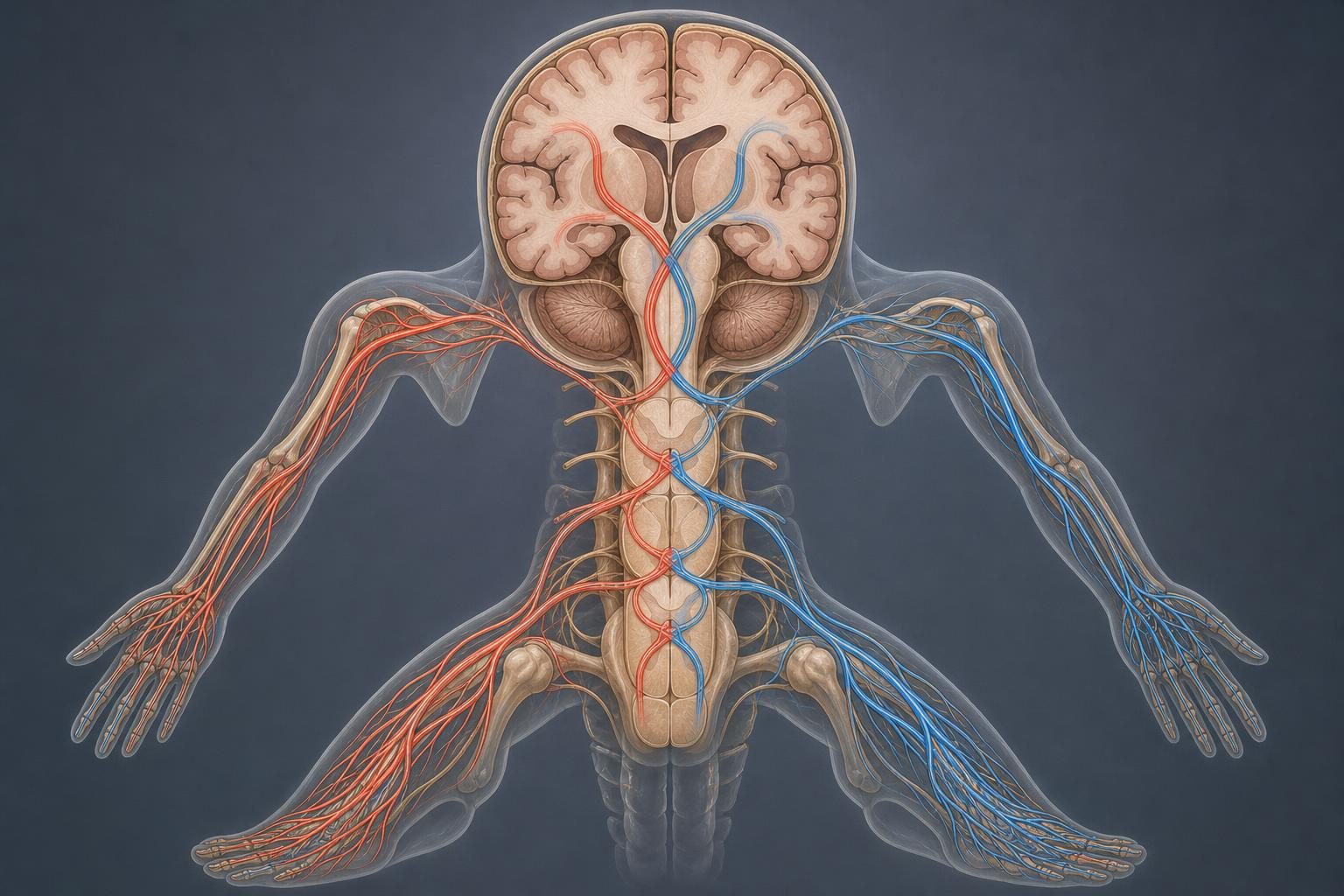
A new neuroscience article is taking on a basic but strange fact about the human body: in many important circuits, the right side of the brain deals with the left side of the body, and the left side deals with the right. According to Phys.org, neuroscientists Martin Wessendorf and Daniel Wang wrote a new article in Frontiers in Neuroanatomy that reviews several cross-wired circuits in four-limbed animals and proposes an explanation for how those circuits may have evolved.
That matters beyond a biology classroom because this is the wiring diagram behind real work in health care, rehabilitation, emergency response, and biomedical technology. A physical therapist helping a patient recover hand control, a radiologic technologist looking at a brain scan, or a medical assistant documenting weakness on one side of the body all depend on the same basic map: symptoms on one side may point to activity or injury on the other side of the nervous system. The paper does not change a treatment protocol by itself, but it shows why careful anatomy knowledge is not trivia. It is job knowledge.
The main idea is called contralateral organization. Contralateral means opposite-side, so a contralateral pathway is a nerve route that crosses the midline of the brain or spinal cord. The central nervous system is the brain and spinal cord, and its midline is the imaginary center line that separates left from right. In many pathways, nerve cells, called neurons, carry information across that center line before the information is processed or used to control movement.
The article begins with vision. The lens of the eye flips an image onto the retina, the light-sensitive tissue at the back of the eye. Information from the right side of what a person sees is routed toward the left side of the brain, and information from the left side is routed toward the right. The optic chiasm, a crossing point for visual nerve fibers, helps sort those signals. Some of that visual information goes to an old brain structure called the optic tectum, known in mammals as the superior colliculus. This midbrain structure helps generate fast responses to things a person sees.
The authors connect that visual system to body control. The optic tectum also receives sound and body-sensation information. Somatosensory information means signals about touch, body position, pain, or similar physical sensations. The tectospinal pathway is a route from the optic tectum down toward the spinal cord that can help turn the body toward a stimulus. If a person sees a car at the edge of the visual field and turns toward it, that kind of fast orienting response depends on circuits like these. In technical terms, the pathway sends motor commands to the opposite side of the spinal cord.
The paper also reviews two major sensory routes from the body to the brain. The dorsal column pathway carries light touch, vibration, and body-position information. It runs up the back part of the spinal cord and crosses the midline in the brainstem, the lower part of the brain just above the spinal cord. The spinothalamic tract carries pain, itch, and some touch information. Unlike the dorsal column pathway, it crosses in the spinal cord before rising toward the thalamus, a brain structure that helps process movement and sensation information.
For movement, the authors discuss several crossed pathways. The rubrospinal pathway starts in the red nucleus, a midbrain area involved in movement control, and is thought to help animals control their limbs. The corticospinal pathway is especially important in humans because it supports fine motor control, including skilled finger movement. Corticospinal means running from the cerebral cortex, the outer brain layer involved in higher functions, to the spinal cord. In primates, including humans, this pathway reaches spinal areas that control muscles, which helps explain why hand skill depends on precise nervous-system wiring.
The article also compares animals. Tetrapods are animals with four limbs, including mammals, birds, reptiles, and amphibians. The authors note that several crossed pathways are found across tetrapod groups, and some appear in cartilaginous fishes such as sharks and rays. That matters because shared wiring across distant animal groups can be evidence that a pathway is ancient in evolutionary terms. When a design appears again and again across related species, scientists ask whether it was inherited from a common ancestor or shaped by a similar body plan and survival need.
For career and technical education, the work points to how technical skill and scientific reasoning meet. Neuroanatomy is not only memorizing names. It is learning how a system is routed, what information each line carries, where signals cross, and what a problem in one location might affect downstream. The same habit shows up in electrical troubleshooting, automotive diagnostics, network cabling, and medical equipment repair: a technician has to know both the parts and the path. In health fields, getting hired and staying useful often means being able to use exact vocabulary, read diagrams accurately, communicate findings clearly, and understand when a pattern needs a licensed clinician’s attention.
Written from reporting by Phys.org, “Q&A: Why does the right side of the brain control the left side of the body?”.
Discussion questions
- In a health career program, how much time should be spent on deep anatomy like crossed brain pathways versus hands-on patient care skills? Defend a balance.
- The authors use comparisons across animals to think about how nervous-system wiring evolved. What makes that kind of evidence powerful, and what are its limits?
- Choose another technical field, such as automotive, electrical, or networking. How is learning a nervous-system pathway similar to learning a system diagram in that field?