
Storms Turn Holiday Travel Into Skilled Repair Work
Thanksgiving weather disrupted power, flights, roads, and coastal infrastructure, putting technical crews and dispatchers at the center of the response.
Print it — all four files
The student packet has no answers in it. The teacher copy is the same pages plus a note on each question and the answer keys. Both languages carry the same story, the same picture and the same vocabulary.
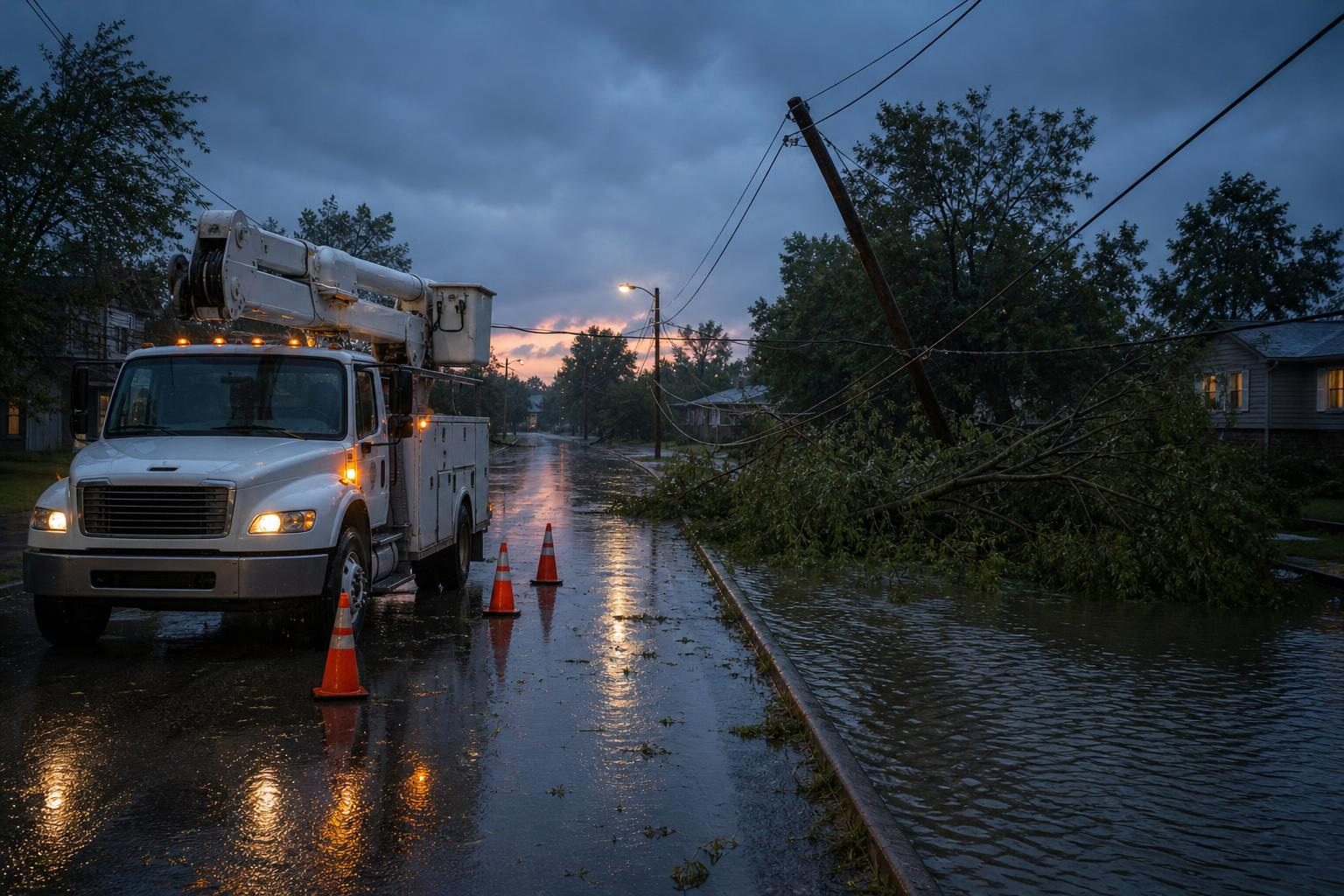
A stormy Thanksgiving hit both coasts with flooding, high winds, power outages, and travel delays, according to reporting by PBS NewsHour. By Thursday evening, more than 900,000 utility customers were without power in at least eight states; in utility language, a customer is usually a metered home, business, or account, not one individual person. Two storm systems affected the East Coast from Maine to Florida, while strong winds also struck the West Coast from Oregon to California. For many people, the holiday problem was a canceled plan. For workers in the field, it became an all-hands repair and safety operation.
The story matters because storms turn everyday systems into job sites. Electric distribution lines, airport runways, road drainage, seawalls, piers, and building roofs are all part of infrastructure, meaning the physical systems that let communities function. When those systems fail, the work is not abstract. A lineworker may be checking downed power lines, a public works crew may be clearing storm drains, an airport operations team may be inspecting pavement and lighting, and a building inspector may be deciding whether a damaged structure is safe to enter. Each task has a different trade pathway, but all require judgment under pressure.
PBS reported wind gusts up to 65 miles per hour in Ocean City, Maryland, where a roof was ripped off a building. In the Washington, D.C., suburbs, similar gusts knocked a tree into an occupied house, though officials said no one was injured. Those examples show why storm response is not just “cleanup.” A roof failure can involve carpentry, waterproofing, structural assessment, and insurance documentation. A tree on a house can involve arborists, utility crews, firefighters, and contractors who understand load paths, which are the routes that weight and force take through a structure.
Weather forecasting also shaped the response. PBS interviewed meteorologist Matthew Cappucci of MyRadar.com, who described a low-pressure system, which is an area where rising air can help create clouds, rain, and storms. He also pointed to a low-level jet, a fast band of wind above the ground that can transfer stronger winds downward during heavy rain or thunderstorms. That kind of forecast is not just for television. Emergency managers, airport dispatchers, utility control rooms, and highway supervisors use it to decide when to stage crews, close roads, delay flights, or warn the public.
Travel systems felt the impact quickly. By late Thursday afternoon, FlightAware reported more than 1,900 flight delays and more than 400 cancellations. In Miami, officials were investigating whether wind or rain played a role after a FedEx cargo plane skidded off a runway after landing; no one was injured, and the incident temporarily shut down all but one runway. Aviation maintenance technicians, airfield electricians, ramp workers, pilots, air traffic staff, and operations managers all depend on clear procedures when weather changes fast. A runway is not just pavement; it is a controlled work environment with drainage, lighting, markings, friction standards, and strict communication rules.
Coastal communities faced a different kind of damage. PBS reported that flooding nearly submerged downtown Stone Harbor, New Jersey, and that New Jersey and New York declared states of emergency, which are official actions that let governments use special powers and resources during a crisis. On the West Coast, king tides, unusually high tides that happen when the sun, moon, and Earth line up in ways that strengthen tidal pull, battered infrastructure. In Pacifica, California, a pier partially collapsed, and the town’s seawall faced extensive repairs. A seawall is a barrier built to protect land from waves and erosion.
Cappucci also said a super El Niño was worsening the situation. El Niño is a weather and climate pattern involving warmer-than-usual water in part of the Pacific Ocean, and it can influence storms and coastal water levels far from where it begins. For CTE pathways, that points to a change in the work itself: crews are not only fixing single failures after they happen; they are increasingly asked to prepare for overlapping problems, such as high tides plus wind plus heavy rain plus holiday travel demand. That requires workers who can read technical information, follow safety rules, document conditions, and coordinate with people outside their own trade.
Hiring into this kind of work depends on the specific career, but the storm shows a shared baseline. Employers need people who show up safely, use equipment correctly, communicate clearly on radios or work orders, and understand that public systems are connected. A delayed flight, a flooded street, a damaged pier, and a dark neighborhood may look like separate news items. On the job, they are linked by the same question: what has to be stabilized first so the rest of the repair can happen?
Written from reporting by PBS NewsHour, “Stormy Thanksgiving weather causes delays and damages for many Americans”.
Discussion questions
- When a storm damages several systems at once, how should officials decide whether power restoration, road access, airport operations, or coastal repairs come first?
- Do weather-related jobs now require more cross-training than they used to, or should workers stay highly specialized in one trade?
- What information is missing from a storm report like this if someone wanted to judge how well the response was managed?