
When Disaster Crews Forget Lessons They Already Learned
Queensland’s storm season shows why emergency work depends on memory, handoffs, records, and local knowledge—not just response speed.
Print it — all four files
The student packet has no answers in it. The teacher copy is the same pages plus a note on each question and the answer keys. Both languages carry the same story, the same picture and the same vocabulary.
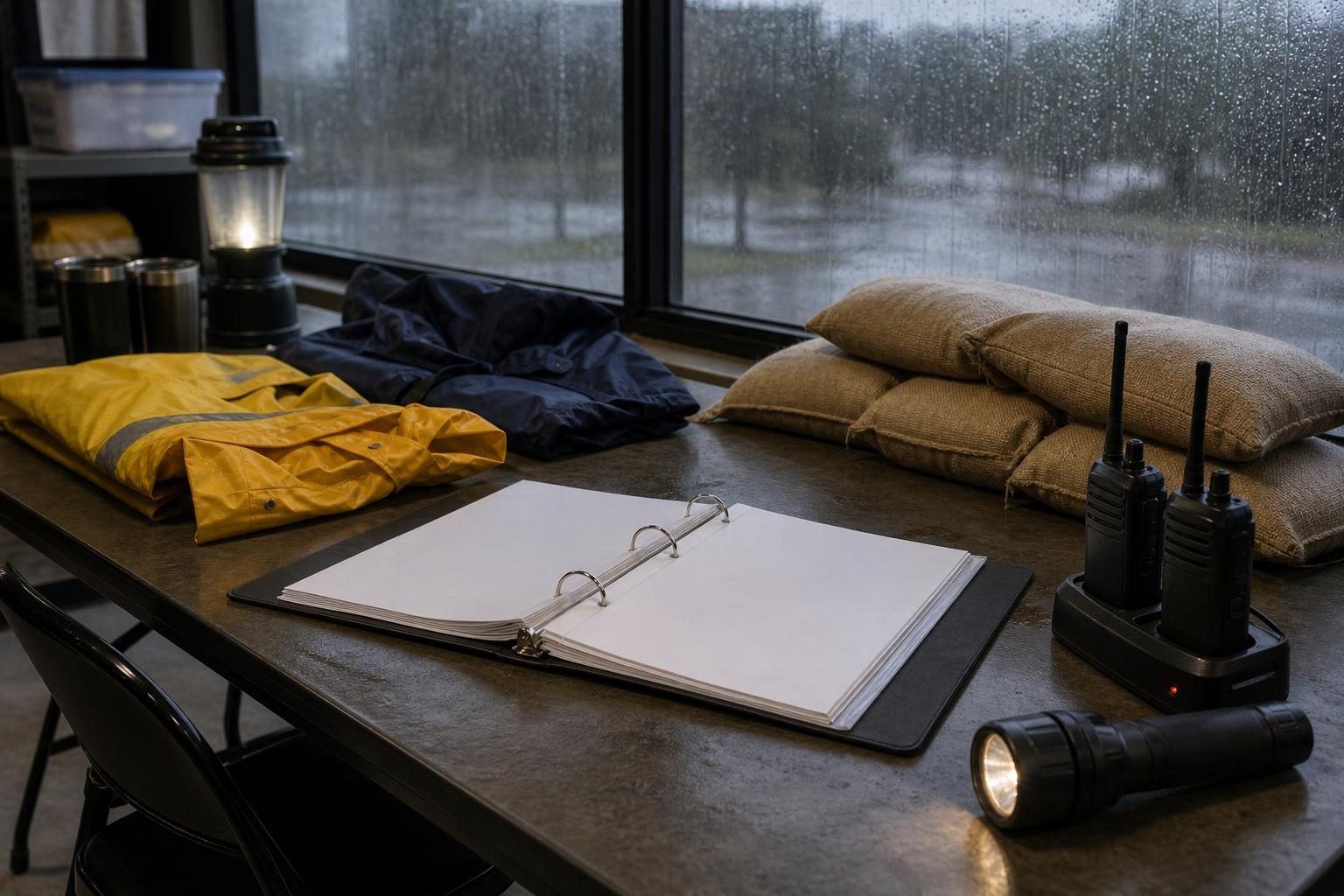
Queensland has already had severe storms and flooding early in its storm season, and agencies are again looking at how to prepare, respond, and review what happened. According to Phys.org, research on disaster management in Queensland shows a recurring problem: agencies often do learn from major disasters, but they do not always keep those lessons alive long enough for the next crisis.
That matters because disaster response is not only the moment when sirens go on and crews head out. It is also the work before and after: emergency services running debriefs, governments commissioning inquiries, researchers analyzing failures, and public servants turning lessons into procedures. A debrief is a structured review after an event, meant to identify what worked, what failed, and what should change before the next callout.
The article describes a pattern familiar in many workplaces: the same problems return over time. In Queensland disaster reviews, those problems include fragmented decision-making, poor communication between organizations, and weak engagement with communities. Fragmented decision-making means different teams or agencies are making choices without enough coordination, so the overall response can become slower or less clear even when everyone is working hard.
Researchers call one part of this problem institutional amnesia, which means an organization loses practical memory as people, priorities, or structures change. In disaster work, that can happen when experienced staff leave, when a government moves duties or resources from one office to another, or when records are stored without enough background for the next crew to understand them. The information may technically exist, but if no one can find it, trust it, or apply it under pressure, it is not useful job knowledge.
For a career and technical pathway, that point is important. In a shop, clinic, job site, or emergency operations center, skill is not only what one person knows. Skill is also how a team passes knowledge across shifts, seasons, and generations of workers. A new employee can be trained on equipment, but that does not automatically teach the unwritten lessons from the last flood, storm, failed evacuation message, or overloaded phone line.
Knowledge-management systems are one attempted fix. A knowledge-management system is a way to store, organize, and retrieve work information, such as reports, procedures, maps, photos, and after-action notes. The Queensland research suggests that large systems can still fall short if they preserve files without context. Context is the explanation that tells future staff why a decision mattered, what conditions existed at the time, and what warning signs people missed.
That changes what good disaster work looks like. It is not enough to write a report and move on. Agencies have to build records that a future employee can use under real conditions, when roads may be closed, power may be out, and several organizations may need to act together. The worker who can document clearly, communicate across departments, and ask what the next person will need to know is doing safety work, even if they are sitting at a desk.
The article also points out that communities can forget. Population growth, housing mobility, and changing work patterns mean many residents now live in places where they do not know the local flood history. A flood map is a planning tool that shows which places are more likely to flood, but it only helps if people understand what it means for their own home, job site, commute, or business. A warning that seems official and accurate can still fail if people do not connect it to lived local risk.
That creates a communication challenge for emergency managers and public agencies. They have to translate technical information into decisions people can act on, such as when to leave, what route is safer, or why a familiar creek can become dangerous. The article notes that during the 2010–11 Queensland floods, memories of earlier floods had weakened in some communities, and local knowledge about evacuation and severity was overlooked or dismissed.
The hiring angle is not just bravery or physical stamina, though those can matter in some emergency roles. This story points to professional habits that many employers value: accurate recordkeeping, plain-language communication, teamwork across agencies, attention to local conditions, and the discipline to learn from a review instead of treating it as paperwork. Disaster preparedness depends on people who can connect field experience to policy and policy back to the field.
There is also a trade-off. Governments and agencies often focus on the future: new systems, new structures, new priorities, and new technology. Innovation can be necessary, especially as storms and communities change. But if change wipes out the memory of why older procedures existed, the organization may end up solving the same problem again during the next emergency.
Queensland’s current storm season will likely produce another round of reviews when it ends. The question raised by the research is not whether responders can spot problems after a disaster. The harder question is whether agencies and communities can keep those lessons usable when the next storm arrives and the people on duty are not the same ones who lived through the last one.
Written from reporting by Phys.org, “Queensland keeps learning disaster lessons. So why do we keep forgetting them?”.
Discussion questions
- If an emergency agency has limited time and money after a storm season, should it invest first in new equipment, more training, or stronger systems for preserving past lessons? Defend your choice and address what your option does not solve.
- Who should carry the main responsibility for keeping local disaster knowledge alive in a fast-growing community: government agencies, schools, employers, neighborhood groups, or residents themselves?
- Think of a trade workplace where experienced workers leave and new workers take over. What would a good system look like for preventing the same kind of institutional amnesia described in the article?