
Webb Data Turns a Faraway Weather Blur Into a Worksite
A new method found organized weather on a brown dwarf 20 light-years away, showing how space research is becoming a data-analysis job.
Print it — all four files
The student packet has no answers in it. The teacher copy is the same pages plus a note on each question and the answer keys. Both languages carry the same story, the same picture and the same vocabulary.
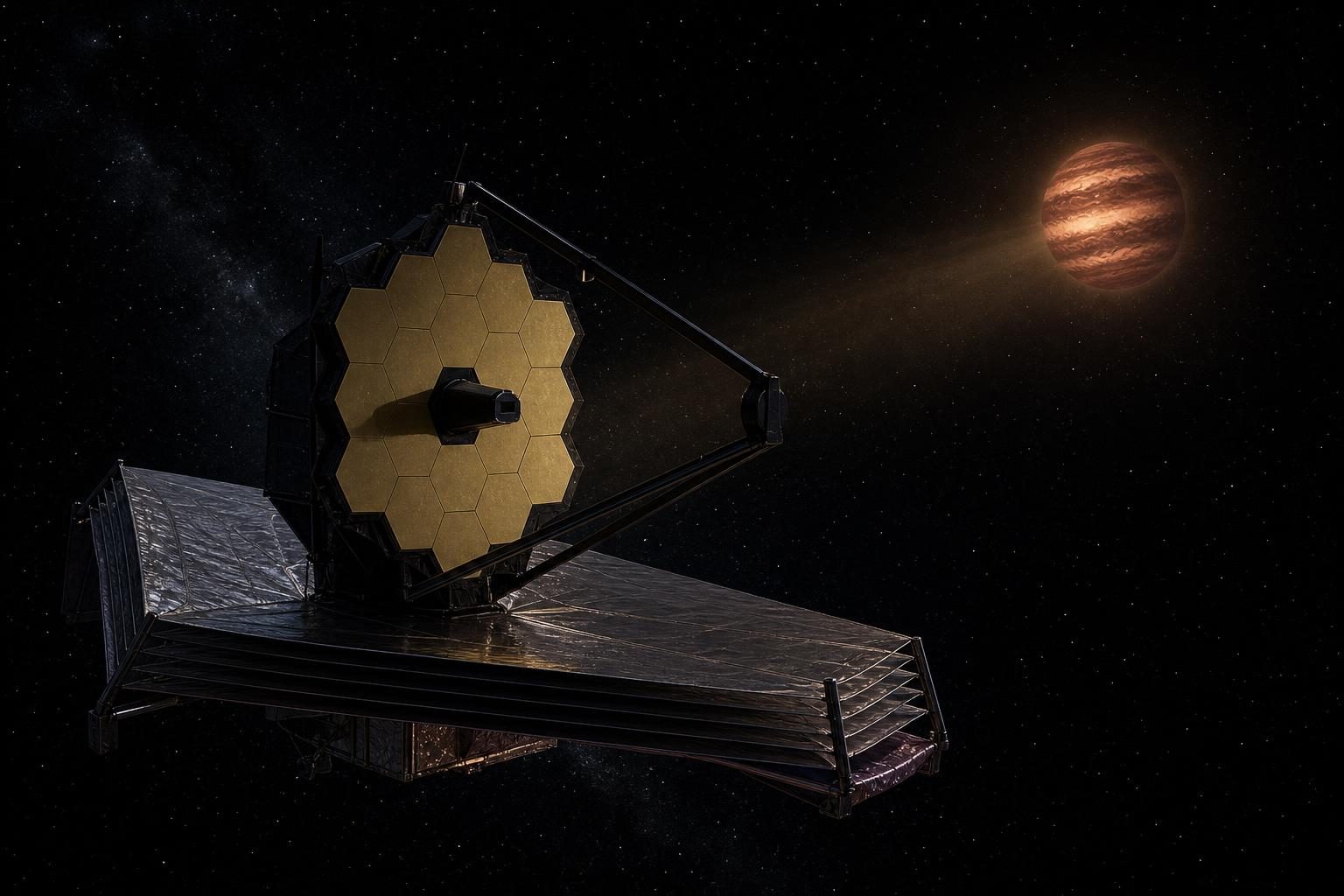
Scientists using NASA’s James Webb Space Telescope have found that the weather on a distant object called SIMP 0136 is more organized than it first appears, according to reporting by Phys.org. SIMP 0136 is about 20 light-years from Earth, meaning its light took about 20 years to reach us because a light-year is the distance light travels in one year. The object is a brown dwarf, which is larger and hotter than a gas giant planet but not massive enough to burn like a star. The new study says its changing brightness can mostly be explained by two main processes: temperature changes and the vertical structure of clouds.
That matters because this is not a normal weather report. Nobody is flying a probe through SIMP 0136’s clouds, and no telescope can take a regular photograph of its cloud tops. Astronomers are working from tiny changes in light as the object rotates. The job is closer to advanced diagnostics than sightseeing: collect a signal, separate the useful pattern from noise, test what the pattern could mean, and compare the result with what earlier methods found.
The research team, from Trinity College Dublin, used observations from the James Webb Space Telescope, often called JWST. Webb’s instruments are sensitive enough to detect minute changes in brightness from faraway objects. In this case, the changes happened as different parts of SIMP 0136 rotated into view. The atmosphere appears to have three repeating weather states: hotter areas with thinner clouds and cooler areas with thicker clouds that extend higher vertically. The study was published in the journal Astronomy & Astrophysics.
The key tool was principal component analysis, or PCA, a statistical method that reduces a complicated data set by finding the biggest patterns that change together. In a shop or lab setting, the basic idea is familiar: if a machine, circuit, or sensor system produces messy readings, the technician or analyst has to find which changes are real and which are random noise. Noise means variation that does not help answer the question, such as small measurement scatter or background interference. PCA does not explain everything by itself, but it can show which patterns are strong enough to deserve closer attention.
That is the important change in how this work is done. Older approaches to an atmosphere like this can require heavy modeling first. A model is a computer-based representation of a real system, built from equations and assumptions so researchers can test possible explanations. The new approach lets scientists identify the dominant patterns directly from the data before moving into more computationally intensive modeling. Computationally intensive means the work requires a lot of processing power or time because the calculations are large and complex.
For careers, the story shows that astronomy is not only about knowing the night sky. The people doing this work include a Ph.D. candidate, Merle Schrader, and an associate professor, Johanna Vos, both in Trinity’s School of Physics. Their work sits at the intersection of physics, statistics, software, instrument data, and scientific communication. A person hired into this kind of research environment would need to understand the science question, handle data carefully, know enough coding or quantitative analysis to use methods like PCA, and explain results in a way that other specialists can check.
The work also depends on trust in instrumentation. JWST did not deliver a colorful weather map with labels. It delivered measurements of light. The researchers had to infer the physical meaning from brightness changes across the object’s rotation and across the light spectrum, which means the light separated by wavelength. In technical careers, that kind of indirect measurement is common. Automotive diagnostics, medical imaging, nondestructive testing, robotics, and industrial sensors all require workers to make decisions from signals that stand in for something they cannot see directly.
The study also matters because brown dwarfs can help scientists learn about giant exoplanets, which are planets outside our solar system. Many exoplanets are difficult to observe directly, but brown dwarfs can be studied more directly, so they act as a natural laboratory for testing ideas about clouds, heat movement, and atmospheric circulation. Atmospheric circulation means the large-scale movement of gas that carries heat and material around an atmosphere.
There is a practical lesson in the workflow. The first result is not a final answer to every question about SIMP 0136. It is an efficient way to sort the data so later work can focus on the most important physical processes. That is a real workplace pattern: good analysis often starts by reducing a messy problem to the few variables that matter most. In this case, a distant world that once looked like a single changing point of light now looks like a system with repeating states, measurable structure, and a clearer path for the next investigation.
Written from reporting by Phys.org, “A world 20 light-years away reveals surprisingly organized, Jupiter-like weather”.
Discussion questions
- When a new data method gives faster answers than a more detailed model, when should a technical team trust the faster method, and when should it slow down?
- How could the same signal-versus-noise problem in this astronomy story appear in a CTE field such as automotive diagnostics, health technology, welding inspection, or robotics?
- If you were hiring for a junior role on a project like this, would you prioritize physics knowledge, coding skill, statistics, or instrument experience first? Defend your choice.