
AI’s Power Demand Can Dirty Air Far From Data Centers
A new MIT study says data-center electricity use can shift pollution and health costs across state lines.
Print it — all four files
The student packet has no answers in it. The teacher copy is the same pages plus a note on each question and the answer keys. Both languages carry the same story, the same picture and the same vocabulary.
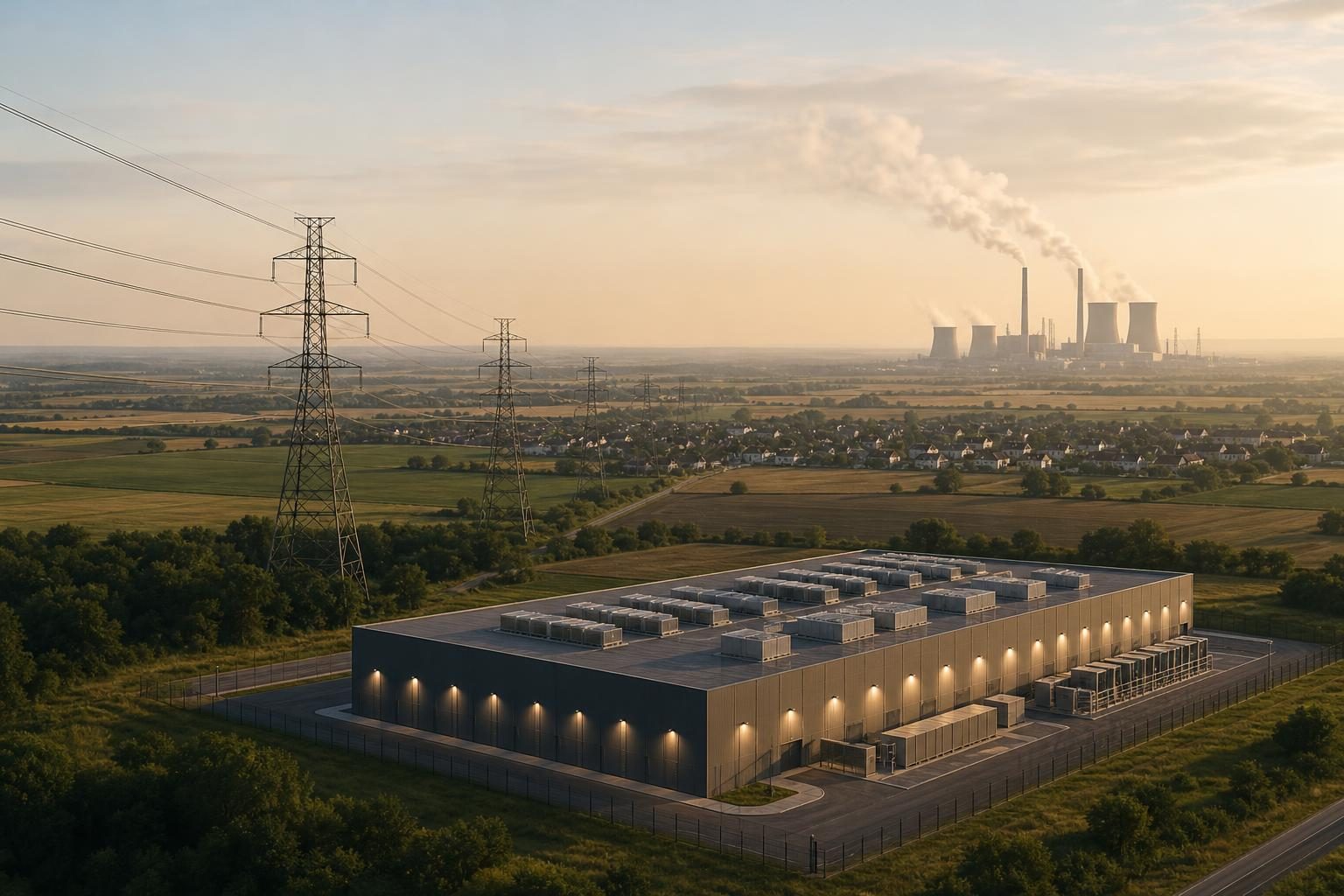
A new MIT study estimates that electricity used by U.S. data centers in 2023 created enough extra air pollution to contribute to about 650 premature deaths, according to reporting by Phys.org on research published in Environmental Research Letters. The surprising part is not just the number. The study says some of the health burden fell on people far from major data-center hubs, because the power grid connects demand in one place to generators in another.
Data centers are buildings filled with computers that store, move and process digital information. Artificial intelligence systems rely on large amounts of computing power, and that power has helped drive a rapid expansion of data centers. The study examined what happens when those facilities draw electricity around the clock. The answer, according to the researchers, is that the pollution does not necessarily stay near the data center.
The trade-off is easy to describe but hard to solve. More computing power can support AI tools, scientific research, business services and many everyday online activities. But electricity has to come from somewhere. If added demand is met by power plants that burn coal or natural gas, those plants release pollutants into the air. The communities breathing the dirtiest air may not be the same communities getting the data-center jobs, tax revenue or faster digital services.
To study that mismatch, the MIT researchers built a model of the interconnected U.S. power grid. An interconnected grid means electricity demand and supply are linked across large regions, so using more power in one state can cause a generator in another state to produce more electricity. The model estimated which power plants increased production hour by hour in response to data-center demand. It then connected those extra emissions to weather and atmospheric conditions that affect where pollution forms and travels.
The researchers focused on pollutants including nitrogen oxides and sulfur dioxide. Nitrogen oxides, often called NOx, can help form ground-level ozone, a major ingredient in smog. Sulfur dioxide and nitrogen oxides can also help form fine particulate matter, known as PM2.5, which means tiny particles in the air that are small enough to reach deep into the lungs. PM2.5 is linked to heart attacks, strokes and lung disease. The study then used existing epidemiological research, which studies patterns of disease and death in populations, to estimate premature deaths. In this context, a premature death is not a named individual identified by the model, but a statistical estimate of earlier deaths associated with extra pollution exposure.
The study estimated that data-center emissions contributed to about 650 premature deaths in 2023. Of those, 513 were linked to PM2.5 and 137 to smog. The researchers also said those deaths represented about 5.3% of the nation’s total electricity-related mortality. Lawrence Berkeley National Laboratory has estimated that data centers accounted for about 4% of total U.S. energy demand in 2023 and about 4.4% of the nation’s overall emissions. The Phys.org report notes that the share has likely grown as new facilities continue to be built.
One of the study’s most important findings is geographic. Much of the data-center electricity demand was concentrated in northern Virginia and Texas. But the highest estimated premature mortality rates per person were in Iowa, Nevada, South Dakota and Kansas. Virginia and Texas had estimated mortality rates only about half those in most Midwestern states. In other words, the places using a lot of electricity for data centers were not always the places facing the greatest health effects.
The researchers pointed to the Ohio Valley as one reason. When data centers in Virginia increase electricity demand, power plants that respond may be located elsewhere, including in places with older plants that burn coal and natural gas. Those emissions can then combine with atmospheric conditions that make fine particles more likely to form. That is why a local zoning decision about whether to allow a data center may not capture the full public-health picture. The building has an address, but the pollution pathway may stretch much farther.
The study does not say that data centers should simply disappear. It does suggest that judging them only by their local footprint misses part of the story. A community that hosts a facility may debate land use, noise, water demand or tax benefits. A different community may face added pollution from the power plants that meet the facility’s electricity needs. That raises a fairness question: when a technology’s benefits and harms are spread unevenly, who gets a say in whether and how it grows?
It also complicates the way people think about digital life. AI tools can feel weightless because they appear on screens, not as smoke from a smokestack. But the computers behind those tools need constant power. If that power comes from cleaner sources, the health effects may be different. If it comes from older fossil-fuel plants during hours of high demand, the costs may show up as dirtier air somewhere else. The argument is not just about whether AI is useful. It is about whether the systems that support it are being built in a way that accounts for people who live far from the server rooms.
Written from reporting by Phys.org, “Data centers damage air quality long-distance, study reveals”.
Discussion questions
- If a data center brings benefits to one region but pollution-related health costs to another, how should responsibility be shared among companies, utilities, local governments and state or federal regulators?
- Should communities judge data centers mainly by their local impacts, or should approval decisions include pollution created anywhere on the power grid?
- How should society balance the usefulness of AI and digital services against the health risks from the electricity needed to run them?