
U.S. chip limits test China’s AI ambitions
Washington wants to slow Beijing’s tech rise, but Chinese firms are learning to build around the barriers.
Print it — all four files
The student packet has no answers in it. The teacher copy is the same pages plus a note on each question and the answer keys. Both languages carry the same story, the same picture and the same vocabulary.
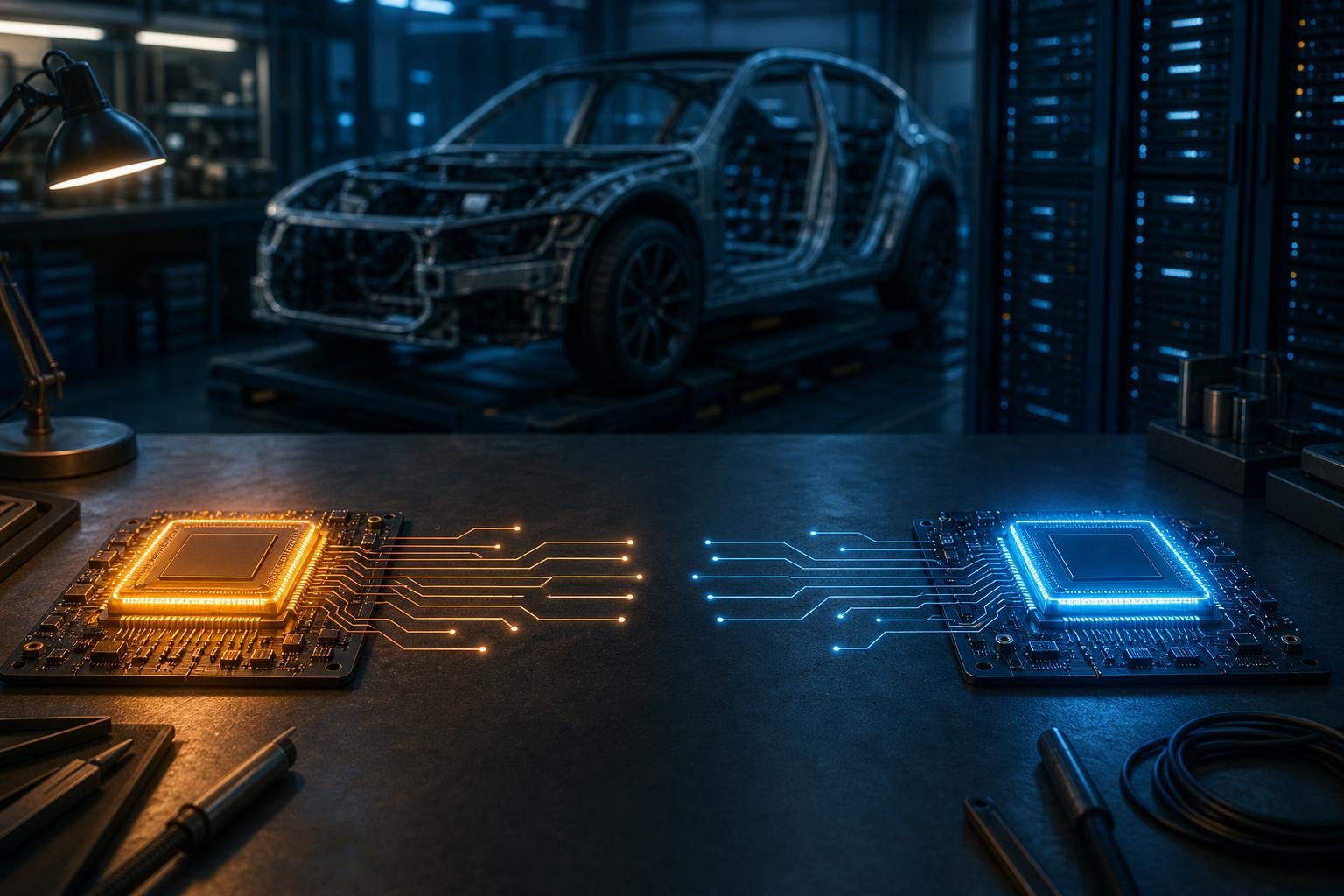
President Trump’s trip to Asia this week put one of the biggest U.S.-China disputes back in the spotlight: the race to lead in artificial intelligence, or AI, computer systems that can perform tasks usually associated with human thinking, such as recognizing patterns, writing text or helping guide vehicles. According to reporting by PBS NewsHour, the issue is especially visible in Shenzhen, China, a technology hub that is home to Huawei, one of China’s largest technology companies.
The basic conflict is easy to state and hard to solve. The United States has tried to limit China’s access to the most advanced American microchips, the tiny electronic parts that power phones, computers, data centers and AI systems. Washington argues that some technology can have military or surveillance uses, so selling it freely to a rival could create security risks. China argues, and its companies have acted as if, it cannot rely on foreign suppliers that may be cut off by U.S. policy. The result is a contest not just over who has the best tools now, but over who can build the supply chain for the future.
Huawei shows both sides of that contest. PBS reported that the Trump administration blacklisted Huawei in 2019 and, in 2020, labeled it a “national security threat.” The Biden administration later blocked Chinese companies from the most advanced chips and the most advanced machines used to manufacture them. These are known as export controls, government rules that restrict the sale of certain goods to other countries. In this case, the rules were designed to keep the most powerful chip technology out of Chinese hands.
Those limits hurt Huawei. PBS reported that after the U.S. restrictions, Huawei’s revenue dropped 30 percent. But the company has since returned to its 2020 revenue levels. It has also received billions from Beijing, China’s central government, and has leaned harder into designing its own chips and AI systems. Michael Frank, CEO of Radiant Intel, told PBS that Huawei is China’s national champion for AI computing and is more insulated from international technology shocks than it used to be.
That phrase, “national champion,” matters. It means a company is not just competing as a private business; it is also treated as strategically important by its government. Huawei’s research campus outside Shenzhen is enormous, covering 300 acres and employing about 30,000 people, mostly researchers, according to PBS. The company works on telecommunications, phones, chips, AI systems and vehicle technology. In other words, it sits at the center of many industries that governments consider important for economic power and national security.
The trade-off for the United States is sharp. If Washington allows advanced chips and manufacturing tools to flow freely to China, Chinese companies may become stronger in technologies that could matter in future conflicts or intelligence gathering. But if Washington blocks access, Chinese companies may respond by building their own alternatives faster. PBS described how Huawei, unable to use the best individual chips at the center of the AI race, has worked on connecting its own chips together to make them faster and more efficient. Restrictions may slow a competitor in the short term while pushing that competitor to become more self-reliant in the long term.
China has its own trade-off. Building a domestic technology base can reduce dependence on foreign suppliers, which is valuable when politics can disrupt trade. But doing so is expensive and difficult. It also can make Chinese companies more focused on their home market. PBS reported on a Huawei-backed autonomous car system, meaning a system designed to drive with little or no human control, aimed at Chinese consumers. The base model costs more than $100,000. At the same time, bills in Congress would close the U.S. market to all Chinese electric vehicles. Even a strong Chinese product may face political barriers abroad.
For other countries in Asia, the choice can be uncomfortable too. Many want trade and investment from both the United States and China. They may rely on Chinese manufacturing while also depending on the United States for security ties or advanced technology. When Washington warns against dependence on a single foreign supplier, it is partly pointing at China. But countries in the region also have to ask whether depending too heavily on U.S. rules and U.S. markets carries risks of its own.
The AI race is often described as a contest over invention, but this story shows it is also a contest over control. Who controls the chips? Who controls the machines that make the chips? Who controls the markets where finished products can be sold? A faster chatbot or smarter car may be the visible result, but underneath it are policy decisions about trade, security and trust.
Neither side has a simple winning move. The United States can restrict technology, but it cannot easily stop a determined rival with money, researchers and a huge domestic market from trying to catch up. China can pour resources into independence, but it still faces barriers to selling in some foreign markets and matching the most advanced global technology. The argument is not really over whether AI matters. Both governments clearly think it does. The argument is over how much openness is safe, and how much separation the world economy can handle.
Written from reporting by PBS NewsHour, “A look at China's technology industry amid AI race with the U.S.”.
Discussion questions
- Should the United States prioritize slowing China’s access to advanced chips even if that pushes Chinese companies to become more self-reliant? Defend your answer.
- When a company is treated as a national champion, how should other countries judge whether it is mainly a business competitor or a security risk?
- If you were advising a smaller Asian country, would you recommend closer tech ties with the United States, China or both? Explain the risks of your choice.