
When Fishing Boats Go Dark, Patterns Still Show
A new study says a small number of vessels account for many tracking gaps off West Africa, raising hard questions about enforcement at sea.
Print it — all four files
The student packet has no answers in it. The teacher copy is the same pages plus a note on each question and the answer keys. Both languages carry the same story, the same picture and the same vocabulary.
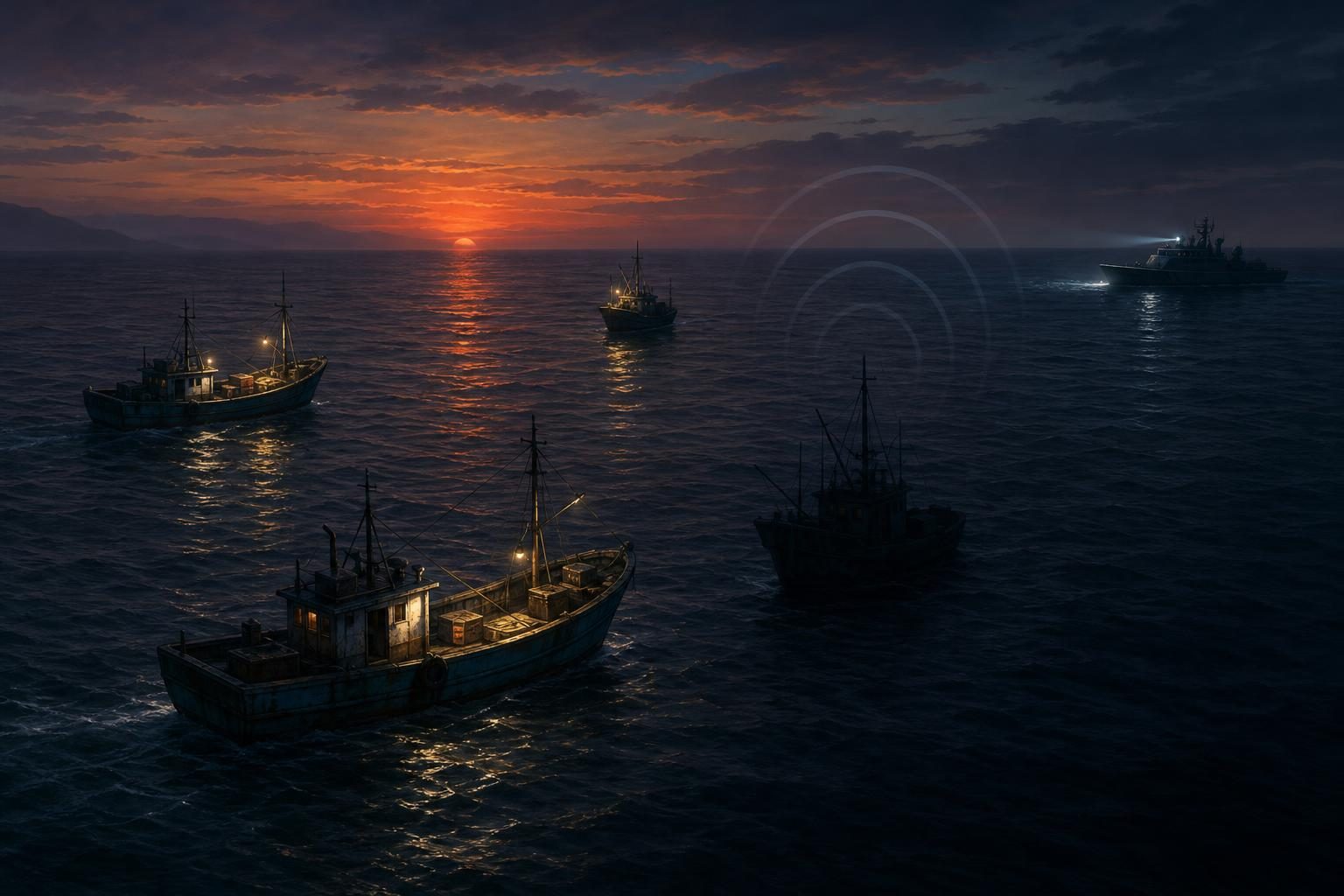
Researchers studying commercial fishing off West Africa found that a small number of vessels accounted for most of the times ships disappeared from public tracking systems. According to reporting by Phys.org on new research from Florida International University, 11 ships were linked to 73% of the untracked trips examined in the study. The researchers analyzed more than 3,600 cases over three years in waters off 23 West African countries, looking for patterns in where and when fishing vessels appeared to switch off location signals.
The issue matters because fishing is both a food source and a business, and the ocean is hard to police. Illegal, unreported and unregulated fishing can damage fish populations, hurt coastal communities that depend on them, and make it harder for legal fishing operations to survive. But the study also shows why enforcement is complicated: a missing signal does not automatically prove illegal fishing, and a suspicious pattern is not the same as evidence from an inspection.
The vessels in the study use automatic identification systems, or AIS, which are tracking devices that broadcast a ship’s location, speed and identity to help prevent collisions and make vessel movements visible. AIS gaps can happen for legitimate reasons, including technical problems. But researchers focused on cases that appeared intentional because the signals stopped and restarted in ways that formed repeated patterns, often near maritime boundaries.
The study, published in the journal Applied Geography, also examined vessels flying what are called flags of convenience. That means a ship is registered in a country other than the one where its owner is based, sometimes because registration is cheaper or rules are easier to meet. This practice is legal. The concern is that weaker oversight can make it harder to hold vessels accountable if they fish illegally or break labor and safety rules.
That is the central tension in the story. On one hand, the researchers argue that authorities with limited patrol boats, staff and budgets should not have to search the entire ocean blindly. If a few vessels repeatedly vanish in the same high-risk areas, enforcement agencies could focus attention there. On the other hand, using patterns to decide who deserves scrutiny can raise fairness questions, especially when the behaviors being tracked are not illegal by themselves.
The geography also matters. The researchers found many tracking gaps near the outer edges of countries’ exclusive economic zones, or EEZs. An EEZ is a stretch of ocean where a coastal country has special rights to manage resources, including fish, even though the water is not the same as land territory. Near those borders, responsibility can become blurry, patrol coverage may be thin, and fishing grounds may still be productive. Phys.org reported that nearly half of the untracked trips involving convenience-flagged vessels began or ended beyond an EEZ boundary.
For governments, the appeal of this research is practical. Instead of trying to monitor every vessel equally, authorities could prioritize ships that repeatedly disappear near sensitive boundaries. The researchers suggested tools such as geofencing, which uses digital boundaries to trigger alerts when vessels enter certain areas or turn off tracking signals. They also mentioned stronger consequences, including vessel confiscation or loss of insurance coverage, if illegal behavior is confirmed.
Those ideas are powerful but not simple. Targeted surveillance could protect fisheries and make enforcement more efficient. It could also create pressure to treat risk indicators as guilt, especially if a country lacks transparent rules for inspections or appeals. A fishing company might argue that a technical failure should not lead to costly delays or reputational damage. A coastal community might argue that waiting for perfect proof allows illegal fishing to continue until the fish are gone.
The study does not claim that every vessel with a tracking gap broke the law. Its point is narrower and more useful: disappearance can leave a pattern. In a place as large as the ocean, that pattern may help authorities decide where to look first. The harder question is what should happen next, when data creates suspicion but not certainty.
Written from reporting by Phys.org, “Now you see them: Researchers uncover patterns in vessels that vanish at sea”.
Discussion questions
- Should authorities be allowed to focus inspections on vessels that repeatedly turn off tracking near maritime boundaries, even if that behavior is not proof of wrongdoing?
- How should governments balance the economic importance of commercial fishing with the need to protect fish populations and coastal communities?
- What information is missing from this study that would help you judge whether the proposed enforcement responses are reasonable?