
Free activities › Middle school
A Remote Island Shows How Hard It Is to Undo an Ecosystem Mistake
NASA’s view of Resolution Island tells a story about native birds, invasive stoats, and the challenge of protecting wild places.
Print it — all four files
The student packet has no answers in it. The teacher copy is the same pages plus a note on each question and the answer keys. Both languages carry the same story, the same picture and the same vocabulary.
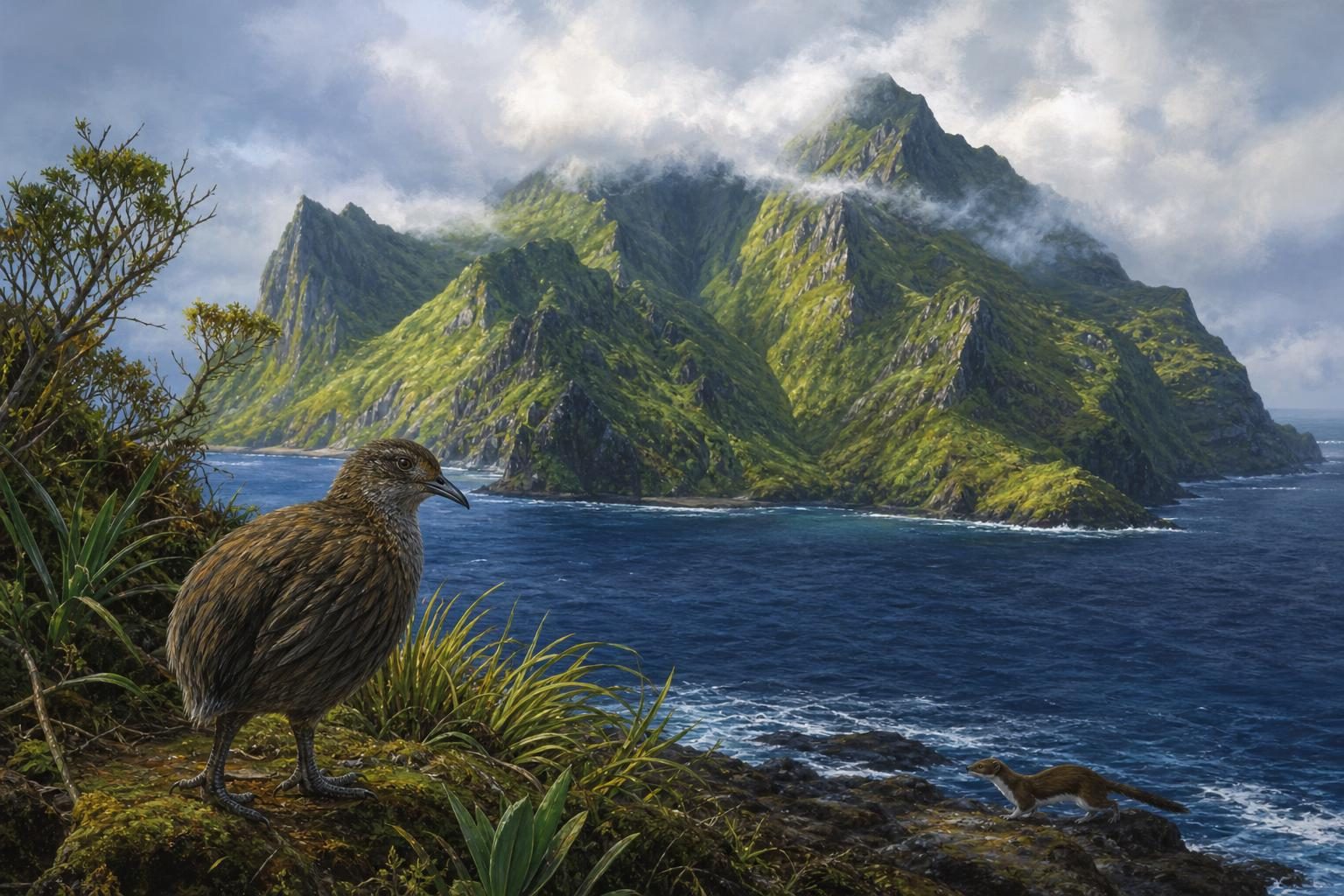
NASA has published a new satellite view of Resolution Island, a rugged island off the southwest edge of New Zealand’s South Island. The image comes from Landsat 9, a satellite, or machine that orbits Earth and collects data from above. According to NASA Earth Observatory, the island has long been seen as a possible safe place for native birds. Native species are plants or animals that naturally belong in a place. But the island’s story also shows how hard it can be to fix a human-made problem in nature.
The problem began in the late 1800s. People brought stoats to New Zealand to control other animals that had also been brought there. A stoat is a small, fast predator related to weasels. The plan did not work out as hoped. Stoats became a danger to birds such as kiwi and kākāpō. Many of New Zealand’s birds evolved, or changed over many generations, in a land with few mammal predators. Some could not fly well, or at all. That made them easy targets.
Conservationists, people who work to protect nature, thought islands could help. If an island had no predators, birds might survive there. Resolution Island seemed like a strong choice. It is uninhabited, meaning people do not live there, and it has many kinds of habitats, or places where plants and animals live. NASA’s article describes wetlands, forests, grasslands, steep valleys, and nearby protected ocean areas. A marine reserve is an ocean area where rules protect wildlife and habitats.
In 1891, Resolution Island became a reserve. A caretaker named Richard Henry worked for years to move more than 700 birds, mostly kiwi and kākāpō, by rowboat to Resolution and nearby islands. That was a huge effort for the time. It also shows an idea that still matters in science class: ecosystems are connected systems. Moving one species, removing one predator, or changing one habitat can affect many other living things.
Then came the surprise. Around 1900, people started seeing mustelids on Resolution Island. Mustelids are the animal family that includes stoats. The island was not as protected as people thought, because stoats could swim there. Henry tried trapping them, but he eventually left the project. More than a century later, the challenge is not over. NASA says a Department of Conservation program that began in 2008 aims to control stoats and strengthen native species on the island.
This matters beyond New Zealand. Invasive species are living things that spread into a place where they do not naturally belong and cause harm. They are a major issue in many countries, including the United States. Zebra mussels, kudzu, and some insects are examples often studied in U.S. classrooms. Resolution Island is a case study in unintended consequences, which are results people did not plan for. It also shows why scientists use tools like satellites. A view from space cannot trap a stoat or save a bird by itself. But it can help people study landforms, habitats, and change over time. Good conservation needs both big-picture data and close-up work on the ground.
Written from reporting by NASA, “Seeking Refuge on Resolution Island”.
Discussion questions
- When people brought stoats to New Zealand, they were trying to solve a problem. How should societies weigh possible benefits against possible long-term harm when moving a species?
- Is creating predator-free islands a smart conservation strategy, or does it avoid the harder work of fixing the larger ecosystem? Defend your view.
- What information would you want before judging whether the stoat-control program on Resolution Island is working?