
Free activities › Middle school
A Surprise Volcano Clue From the Deepest Ocean
Scientists found signs of an explosive eruption where they did not expect one: near the bottom of the Mariana Trench.
Print it — all four files
The student packet has no answers in it. The teacher copy is the same pages plus a note on each question and the answer keys. Both languages carry the same story, the same picture and the same vocabulary.
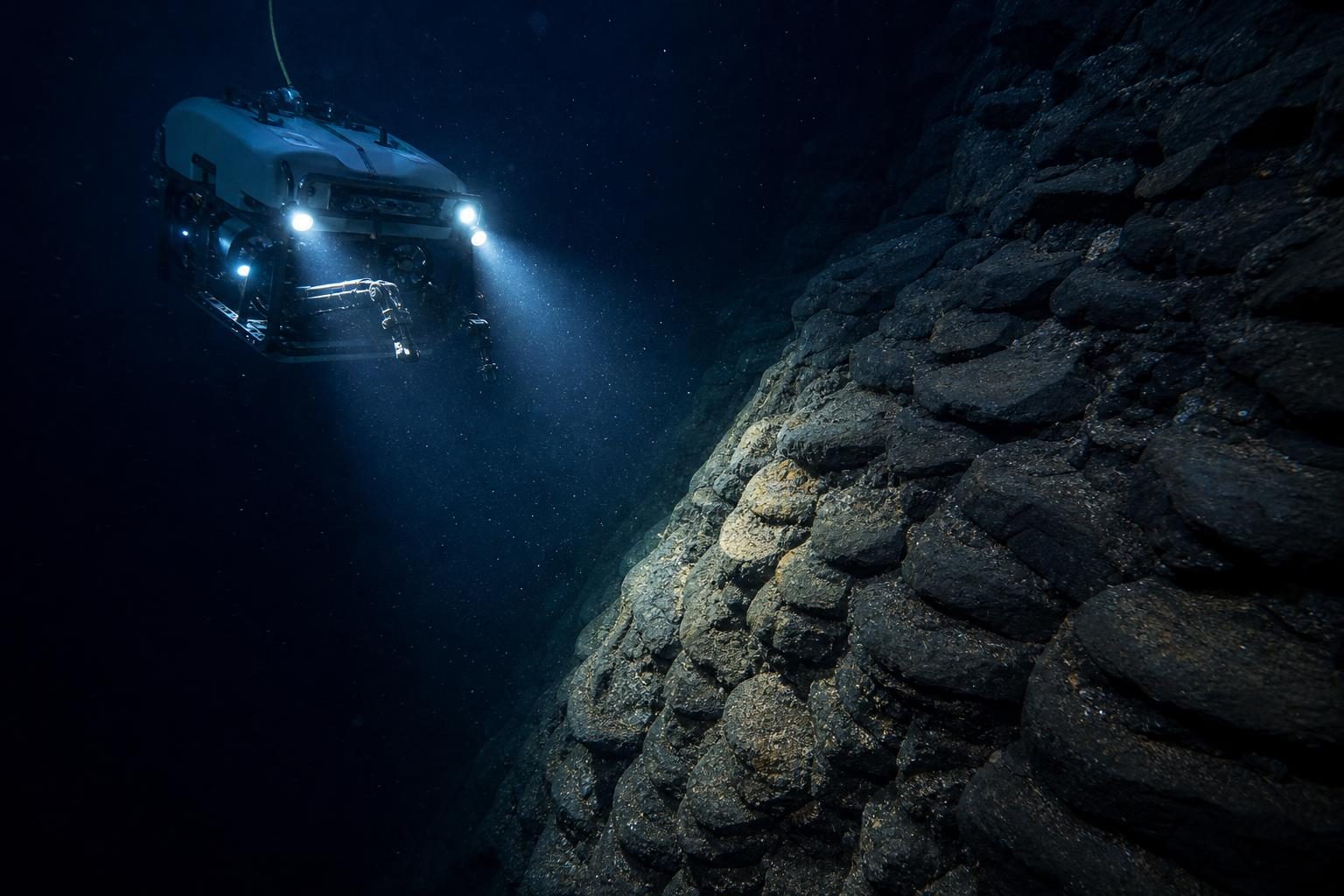
Scientists have found evidence of an explosive volcanic eruption near the deepest part of the ocean, in a place where many geologists did not expect volcanoes to act that way. According to reporting by Live Science, the discovery came from rocks and video collected in the Challenger Deep, the deepest known point of the Mariana Trench in the western Pacific Ocean.
The rocks were found about 20,000 feet below the ocean surface. That is so deep that the pressure from the water is enormous. Pressure is the force pushing on something, and at that depth it is equal to 592 Earth atmospheres stacked together. An atmosphere is the air pressure felt at sea level. Normally, that much pressure should make it hard for a volcano to explode. It should press down on gases in magma, which is melted rock underground, and keep them from expanding fast.
That is why the find surprised scientists. The rocks had the texture of a pyroclastic flow, which is a fast-moving mix of volcanic rock pieces, ash, and gas from an explosive eruption. On land, pyroclastic flows are some of the most violent volcano events. Under so much seawater, scientists expected any lava to ooze out more like thick paste, not blast outward in a churning flow.
The discovery was made using Jason/Medea, a remotely operated vehicle, or deep-sea robot controlled from a ship. During a mission in 2014, its cameras saw strange pancake-like rock shapes in three places along a 60-mile stretch of the trench wall. Samples brought back to the ship contained volcanic glass, which is rock that cooled quickly from lava. The researchers are still working to date the rocks, but one scientist told Live Science that volcanic glass usually wears away quickly in the ocean. That suggests the eruptions were fairly recent in geologic time, though not yesterday.
The location matters because of plate tectonics, the study of how giant slabs of Earth’s crust move. At the Mariana Trench, the Pacific oceanic plate is pushed under the Mariana oceanic plate. This process is called subduction. Trenches often form where one plate dives beneath another. Volcanoes can form nearby too, in a line called a volcanic arc. Mount St. Helens and Mount Rainier are part of one such arc in the Pacific Northwest.
But this part of the Challenger Deep does not have the kind of organized volcanic arc scientists would normally look for. Instead, the area was expected to be mostly quiet. Live Science reported that the new study, published in Frontiers in Earth Science, suggests that volcanism and magma may help explain why this part of the trench is shaped the way it is. The mission also found signs that the crust is stretching in two different ways, and scientists do not yet have a clear explanation for that.
One possible clue is a supercritical fluid, which is a strange state that is not quite a gas and not quite a liquid. Scientists think such a fluid might help magma behave differently under deep-ocean pressure. But for now, the main lesson is that even places scientists study carefully can still surprise them. The deepest seafloor is hard to reach, so each trip can change what researchers think they know about Earth’s moving crust.
Written from reporting by Live Science, “Impossible volcanic eruption spotted in deepest part of the ocean, perplexing scientists”.
Discussion questions
- When scientists find evidence that does not fit what they expected, should they treat it as a problem with the evidence or a chance to change the theory? Defend your answer.
- Deep-ocean research is expensive and difficult. What makes a discovery like this worth the effort, and what limits might still remain after one mission?
- How does this story show that Earth science is connected across different topics, such as oceans, rocks, pressure, and plate movement?