
Free activities › Middle school
Old Orca’s Teeth Tell a Nuclear-Age Story
Scientists used clues from atomic bomb testing to estimate the age of a male orca that may have lived past 65.
Print it — all four files
The student packet has no answers in it. The teacher copy is the same pages plus a note on each question and the answer keys. Both languages carry the same story, the same picture and the same vocabulary.
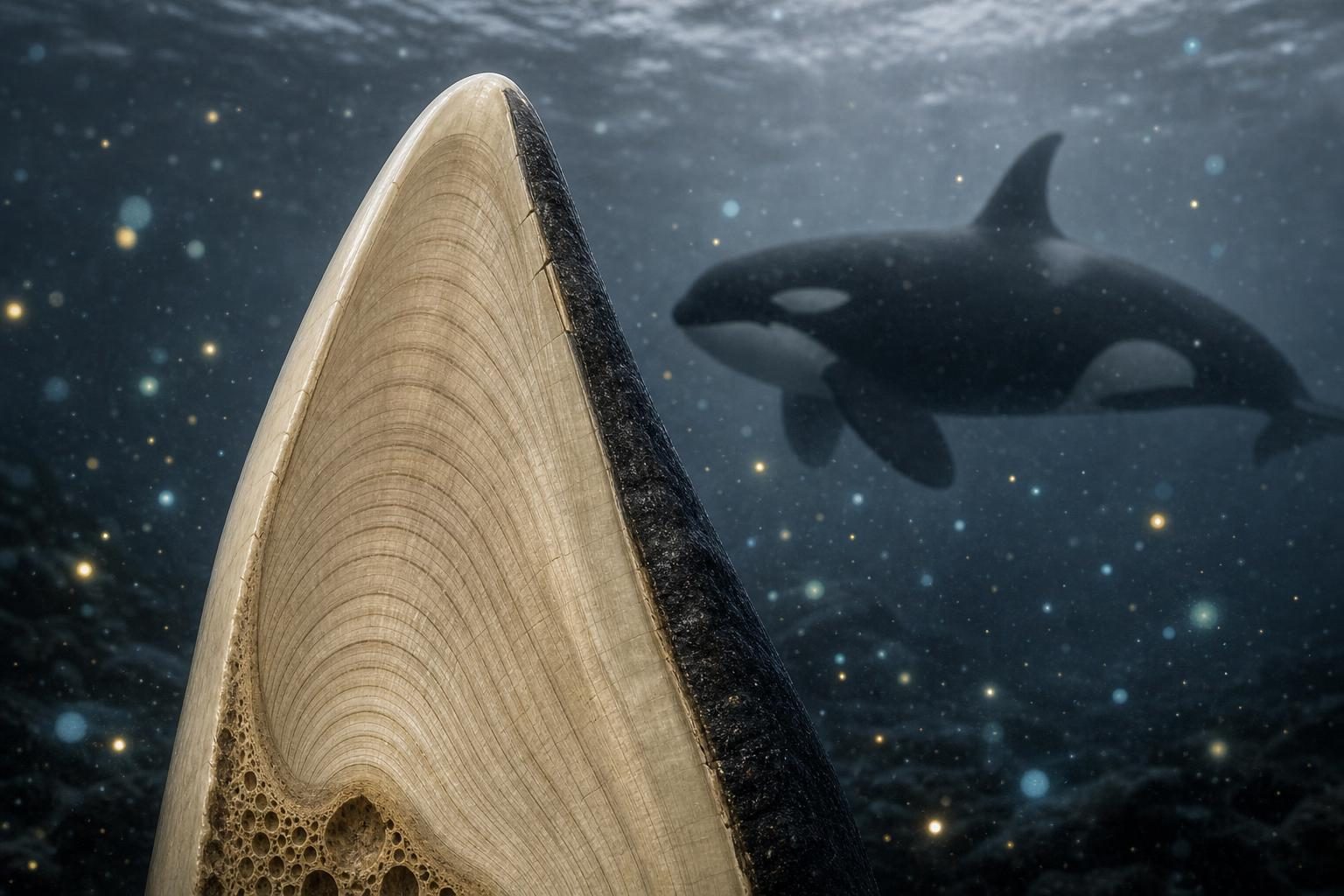
According to reporting by Live Science, scientists studying whale teeth in Scotland may have identified the oldest male orca ever recorded. The orca, named KW2, washed up on Uist, an island in western Scotland, in 2015. A new study says chemical clues in his teeth suggest he was at least 65 when he died. That matters because male orcas are usually thought to live no more than about 50 to 60 years. If the estimate is right, KW2 could change what scientists think they know about orca lifespans.
Orcas, also called killer whales, are cetaceans, the group of ocean mammals that includes whales, dolphins, and porpoises. Like trees, orca and sperm whale teeth have growth layers that researchers believe form each year. Counting those layers can help estimate age. But wild animals are hard to age exactly. Researchers cannot follow every whale from birth, and records for many orca populations are limited.
The study used an unusual time marker: atomic bomb testing from the middle of the 20th century. Those tests released radioactive material, meaning material that gives off energy as it changes form. One of those materials was radiocarbon, a type of carbon atom, or isotope, that scientists can measure. Bomb testing caused a sharp rise in radiocarbon in the environment. That rise entered the ocean and became locked into the teeth of whales. Scientists call this kind of signal a bomb pulse.
The team examined teeth from three orcas stranded between 1995 and 2016 and two sperm whales stranded in the 1990s. Stranded means the animals washed onto land and could not survive. In the sperm whales, the tooth layers matched the atomic-time evidence. That supported the idea that the layers formed once a year, at least in early and middle life. One orca also matched: its tooth layers and radiocarbon both suggested it died in its early 20s.
KW2 was different. His tooth layers suggested he lived into his 50s. But the radiocarbon evidence suggested he was at least 65. One possible reason is that his tooth stopped recording years clearly late in life. A researcher suggested the tooth may have run out of space for new layers. That does not give scientists an exact birthday for KW2. It does show why using more than one kind of evidence can matter.
The study also looked at Lulu, a female orca from Scotland’s West Coast Community. That group is genetically distinct, which means its members are related in a way that sets them apart from other orcas. Lulu’s age evidence was harder to read, partly because her tooth did not show a clear bomb-pulse signal. Chemical clues suggested she ate more marine mammals than the males, which seemed to eat more fish.
The West Coast Community is close to disappearing. It has not produced any calves during the decades researchers have studied it, and only two males are known to remain. KW2’s possible age record is interesting by itself. But the bigger lesson is about evidence. A tooth can hold clues about biology, history, pollution, diet, and extinction risk all at once. Science often moves forward when researchers compare those clues instead of trusting just one.
Written from reporting by Live Science, “Oldest male orca on record may have been identified thanks to historical atomic bomb testing”.
Discussion questions
- When tooth layers and chemical evidence point to different ages, how should scientists decide which evidence to trust more?
- Is it appropriate for scientists to use evidence left behind by harmful human actions, such as atomic bomb testing, to learn about nature?
- Should the possible discovery of a very old male orca change how people think about protecting small orca communities?