25x
25x: Personal Finance
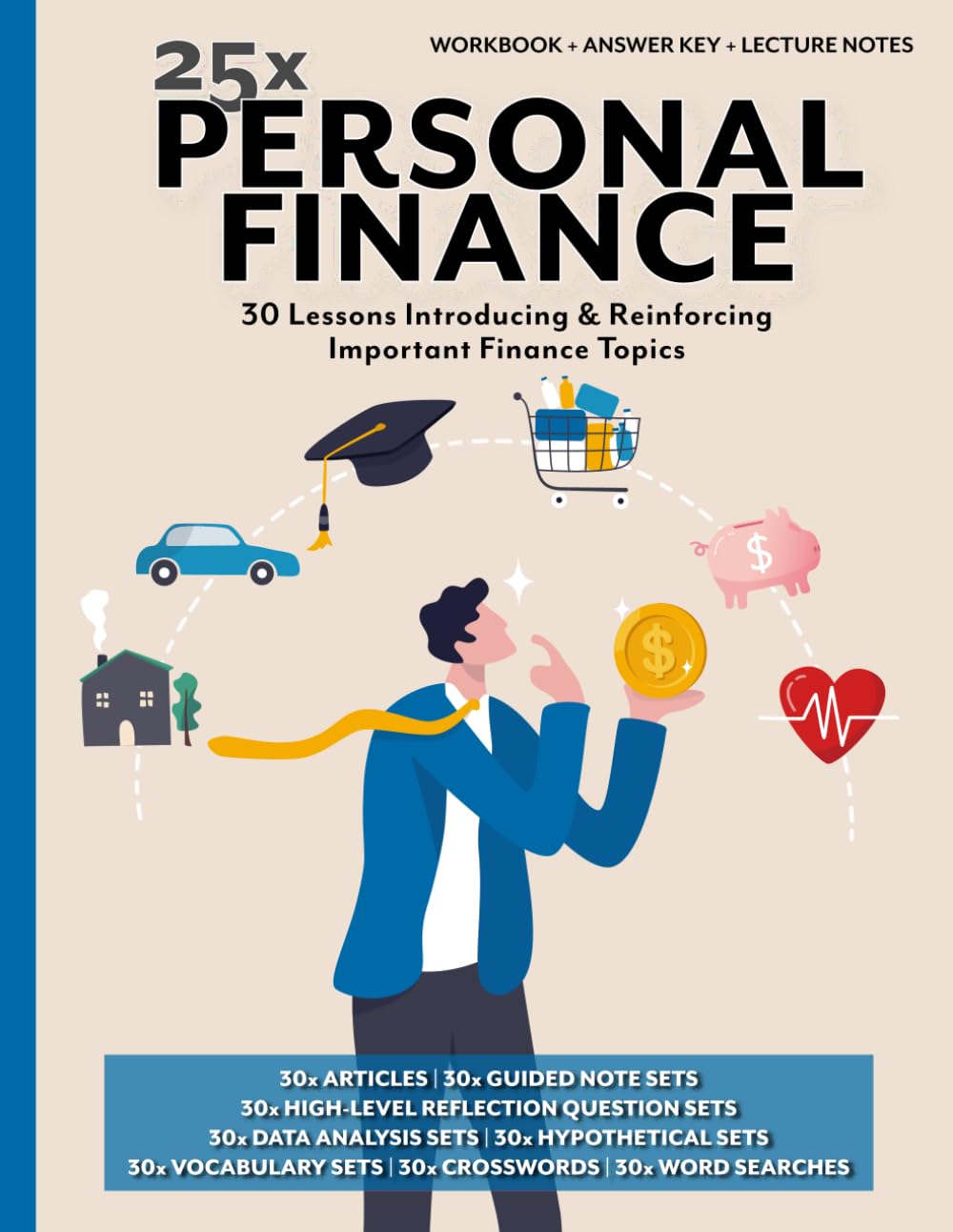
A complete high school financial literacy curriculum pairing real-world content with structured practice and comprehensive teacher support.
★★★★★ 5.0 · 5 reviews- 423 pages
- 10 units
- 12 pages to preview
- Published by 3andB
Instant download from TPT · Paperback on Amazon
Free — no sign-up
See inside before you buy
Everything below opens in a new tab and costs nothing.
What you get
- Comprehensive topic coverage takes students from financial psychology and budgeting through investing and long-term planning.
- Real-world scenarios and data analysis help students evaluate choices and interpret financial information.
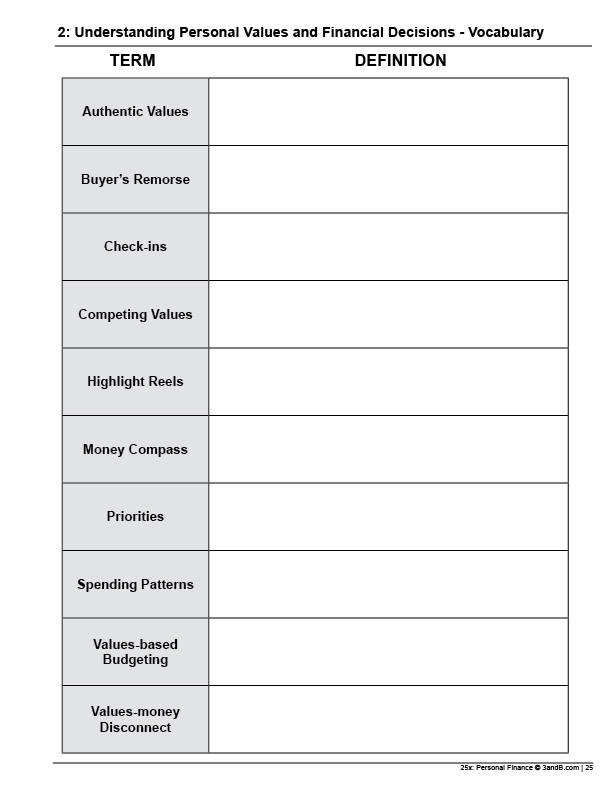
- Student-friendly articles, guided notes, and vocabulary support make financial concepts clear and usable.
- Knowledge checks, matching activities, and puzzles give students varied ways to practice lesson content.
- Teacher answer keys and lecture notes provide support for presenting and reviewing every lesson.
- Introductory videos and complete slide decks provide additional presentation support for every lesson.
Designed for grades 9–12, this academic curriculum supports high school personal finance instruction with student materials, teacher notes, answer keys, videos, and slides.
About this workbook
25x: Personal Finance is a 423-page financial literacy curriculum for grades 9–12, updated for 2026 and aligned to the Jump$tart Coalition’s National Standards in K–12 Personal Finance Education. The curriculum covers financial psychology, goal setting, budgeting, income, career planning, employee benefits, banking, emergency funds, credit, debt, insurance, investing, retirement, taxes, consumer rights, financial information, and comprehensive planning.
Lessons include student-friendly articles, guided notes, vocabulary support, knowledge checks, matching activities, real-world scenarios, data analysis, reflection and critical-thinking questions, crosswords, and word searches. Teacher answer keys and lecture notes are included, while introductory videos and complete lesson slide decks are available through YouTube and the 3andB website.
Students learn to evaluate financial choices, manage money and credit, assess risk, interpret financial information, and create a comprehensive financial plan.
The same shape, every time
In every lesson
A teacher can hand out any lesson in this book and know exactly what a student is getting.
- 1Student-friendly articles
- 2Guided notes and vocabulary support
- 3Knowledge checks and matching activities
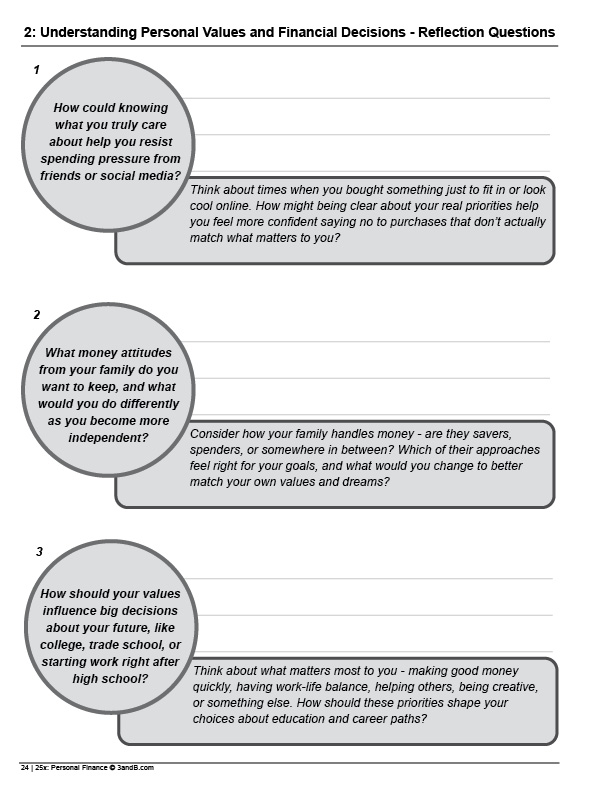
- 4Application, reflection, and critical-thinking questions
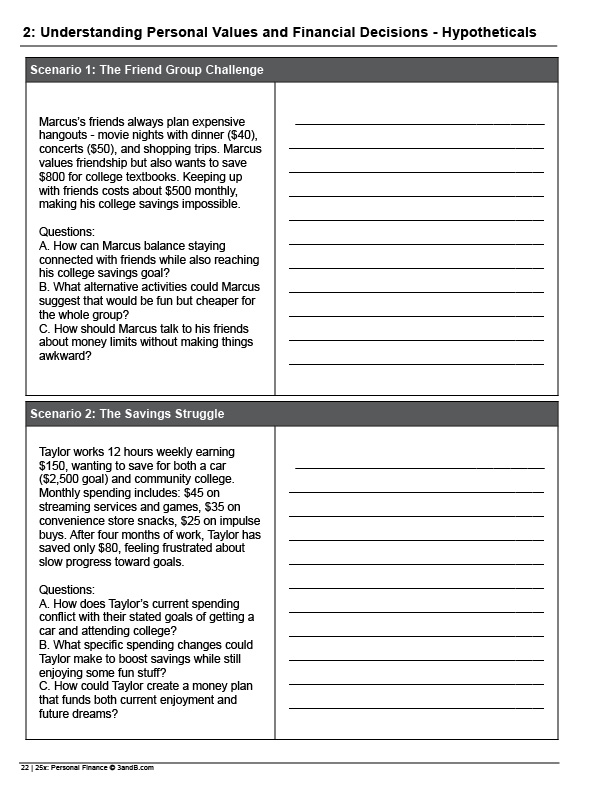
- 5Real-world hypotheticals and scenarios
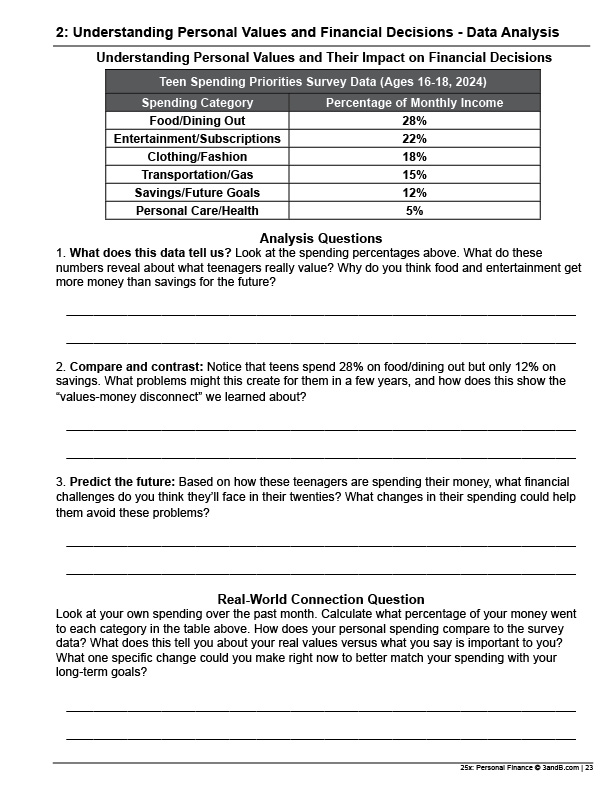
- 6Data analysis activities
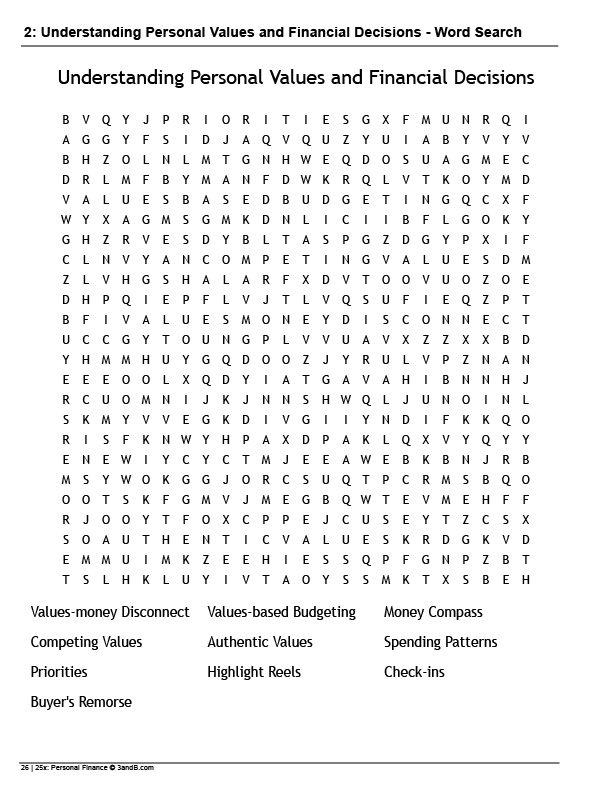
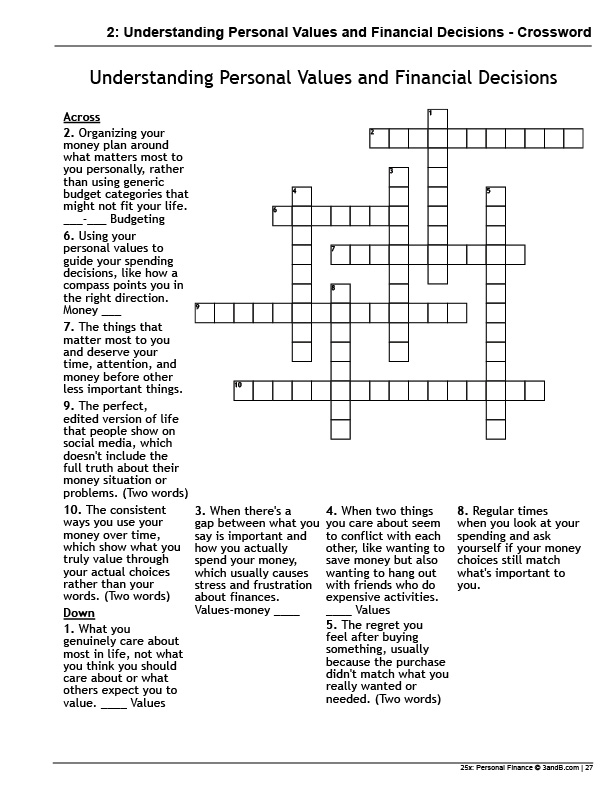
- 7Word searches and crosswords
- 8Teacher answer keys and lecture notes
What's inside
10 units, start to finish.
- Unit Theme: Understanding what personal finance is and exploring the psychology behind financial decisions.
- Lesson 1: What is Personal Finance?
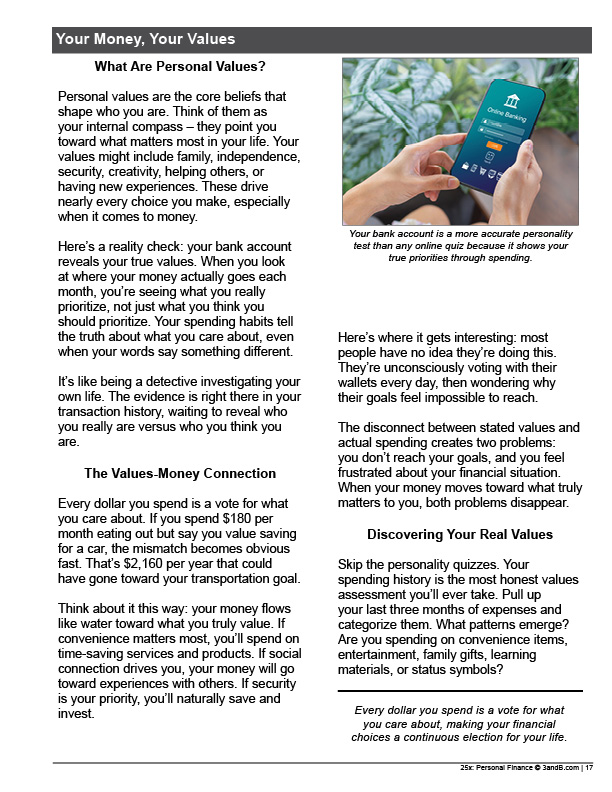
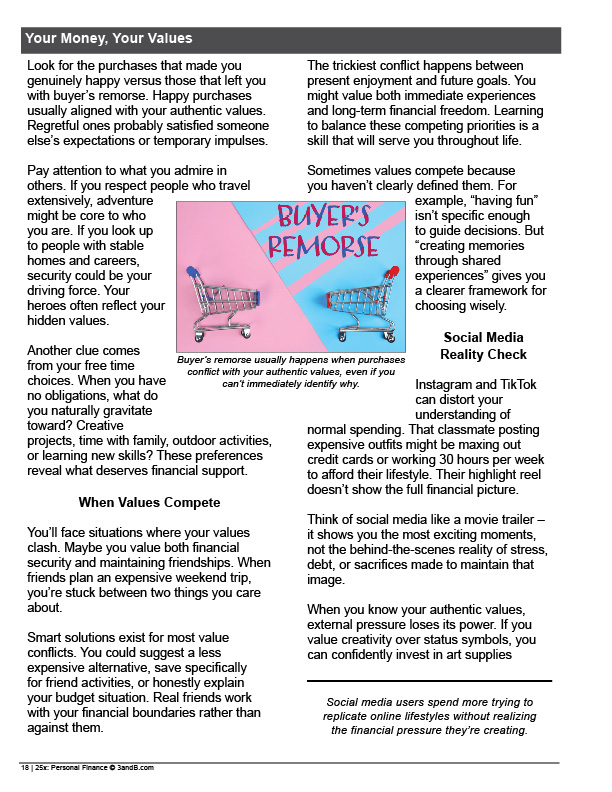
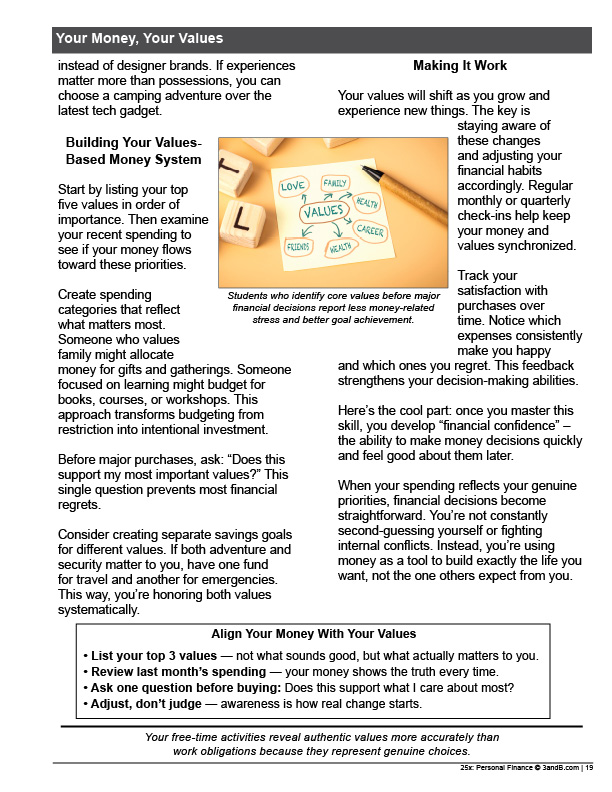
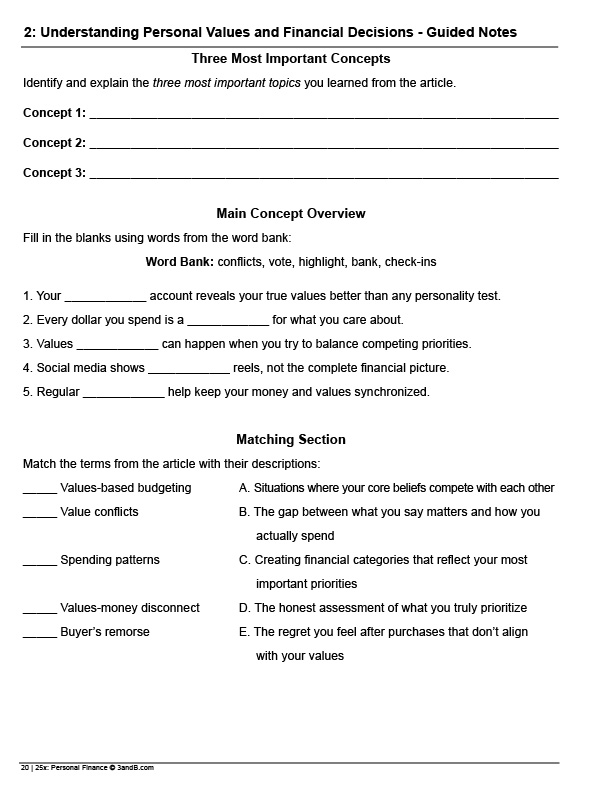
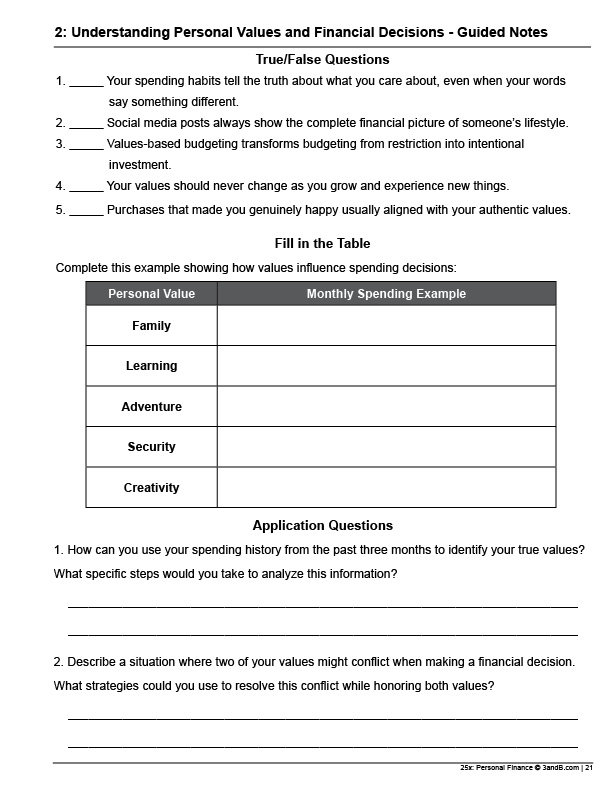
- Lesson 2: Understanding personal values and their impact on financial decisions
- Lesson 3: Behavioral Money Psychology
- Unit Theme: Setting financial goals and understanding the trade-offs in financial decision-making.
- Lesson 4: Setting SMART financial goals
- Lesson 5: Analyzing opportunity costs in financial choices
- Unit Theme: Creating and maintaining effective budgets while tracking financial progress.
- Lesson 6: Creating and using a personal budget
- Lesson 7: Tracking income and expenses
- Lesson 8: Digital Financial Tools and Fintech Safety
- Unit Theme: Understanding income sources and making strategic career decisions.
- Lesson 9: Understanding different types of income
- Lesson 10: Exploring career options and their financial implications
- Lesson 11: Reading and understanding a paycheck
- Unit Theme: Maximizing total compensation through understanding benefits packages.
- Lesson 12: Employee benefits and their value
- Unit Theme: Understanding banking services, operations, and building emergency funds.
- Lesson 13: Understanding and comparing banking services
- Lesson 14: Banking Operations and Account Management
- Lesson 15: The importance of emergency funds
- Unit Theme: Building and maintaining good credit while managing debt responsibly.
- Lesson 16: Understanding credit scores and reports
- Lesson 17: Responsible use of credit cards
- Lesson 18: Types of loans (student, auto, mortgage)
- Lesson 19: Strategies for managing and reducing debt
- Lesson 20: Avoiding predatory lending and financial scams
- Unit Theme: Understanding risk and protecting financial security through appropriate insurance coverage.
- Lesson 21: Understanding Risk and How Insurance Works
- Lesson 22: Basics of insurance (auto, health, life)
- Unit Theme: Building wealth through understanding investment principles and vehicles.
- Lesson 23: Introduction to saving and investing
- Lesson 24: Understanding risk and return in investments
- Lesson 25: Types of investment vehicles (stocks, bonds, mutual funds)
- Lesson 26: Basics of retirement planning
- Unit Theme: Developing critical consumer skills, understanding taxes, and creating financial plans.
- Lesson 27: Introduction to personal income taxes
- Lesson 28: Consumer rights and responsibilities
- Lesson 29: Evaluating financial information and advice
- Lesson 30: Creating a comprehensive financial plan
From teachers who bought it
What teachers say
I wish I had had something like this growing up.
I bought this as a gift for my friend's teenage son, and it turned out to be a really practical resource. The book breaks money topics into manageable, easy-to-follow lessons. They are short, clear, and practical. It focuses on real-life decisions teens will actually face. It also has some great worksheets/questionnaires and quizzes at the end of each section, as well as word searches and crossword puzzles related to each topic. This is a really nice idea to keep them engaged. Overall, a useful and thoughtful intro to personal finance for high schoolers. I wish I had something like this growing up!
Great info for building foundation
I bought this to help my 19 year old cousin learn more about how to manage his finances now that he’s working and the lessons we went over in this book helped us get a better foundation for his finances going forward. There’s a lot of information packed in, but they have it structured in a way that allows you to skip to chapters that may be more of a priority for you in the moment without feeling lost. It's a solid book.
A Student Friendly Path to Financial Literacy
What makes 25x Personal Finance a good book is its clarity. It isn’t trying to be an encyclopedic textbook; instead, it focuses on the one thing most struggle with: understanding why financial concepts matter in real life. Each lesson is short, digestible, and immediately tied to a real-world scenario. That structure respects your attention span while still building real financial literacy. It’s the kind of book that doesn’t overwhelm, but it empowers. Another thing I like is its consistency. Every lesson follows the same rhythm: a short article, vocabulary, reflection questions, and a puzzle. That repetition isn’t boring. It creates a learning environment where students can build confidence. For teachers or parents, that consistency makes it easy to integrate into a routine: warm‑ups, independent work, or quick reinforcement activities. It’s a book designed with actual classrooms and real students in mind. Personal finance can be scary and overwhelming, especially for young learners who are just beginning to understand money beyond allowance. This book breaks down topics like credit, taxes, budgeting, and insurance without talking down to you. It treats financial literacy as a life skill, not a math problem. It bridges the gap between school learning and adult reality. This book is a great tool because it’s practical. Students aren’t just memorizing terms; they’re asked to think and apply. Well-defined and put together.
Money skills are life skills
This book keeps money topics simple and actually useful. The short lessons explain why things like budgeting, credit, and saving matter in real life, not just in theory. It’s easy to read, practical, and perfect for anyone who wants a clear introduction to personal finance without feeling overwhelmed. A great reminder that money skills are life skills!
Practical and educationaland engaging,many HS students will benefit from this n book
I bought this book for a HS student who is a friend of the family. It has great information, practical exercises, provocative questions, and much more. Learn about banking and investments, financial planning, and savings. This is a well-organized and informative book; many readers will benefit from reading it. Overall, well done.
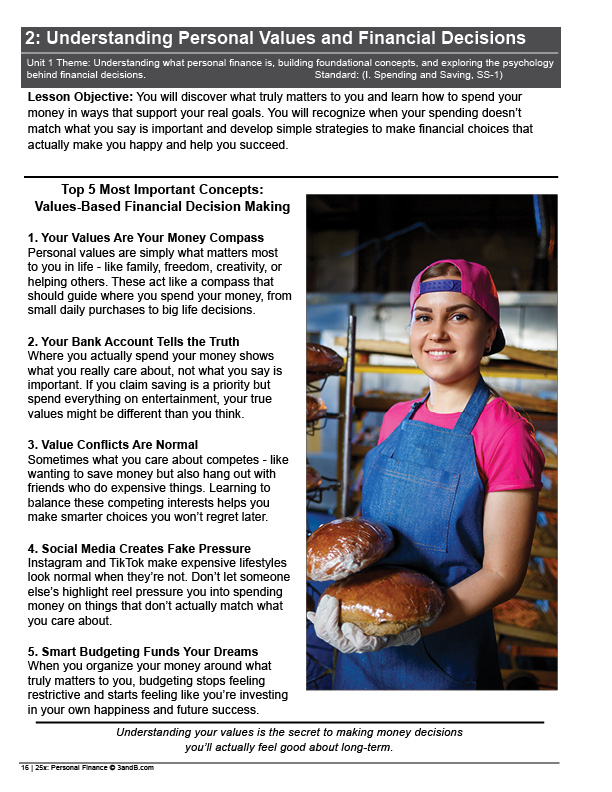
Sample pages
12 pages photographed from the book — open any one full size.
Questions teachers ask
What grade levels is this curriculum for?
This academic curriculum is designed for students in grades 9–12. The 423-page workbook has been updated for 2026.
What personal finance topics does the workbook cover?
The curriculum covers financial decision-making, goal setting, income, careers, taxes, saving, investing, risk management, credit, debt, financial planning, and consumer skills. It also addresses budgeting, banking, employee benefits, emergency funds, insurance, retirement, consumer rights, and financial information.
What teacher materials are included?
Complete teacher answer keys and lecture notes are included for every lesson. Introductory videos and complete lesson slide decks are also available through YouTube and the 3andB website.
What will students be able to do after completing the curriculum?
Students learn to evaluate financial choices, manage money and credit, assess risk, and interpret financial information. They also create a comprehensive financial plan.
What free materials can I view on this page?
Free materials include the student workbook, a chapter preview, and the answer key for that chapter. A video and slides are also available to view.
Ready for your classroom
25x: Personal Finance · 423 pages · High School
More like this
Other 3andB workbooks in Economics & Personal Finance.