
CTE-2100
CTE-2100: Medical Terminology
A practical medical terminology workbook combining healthcare-focused instruction with guided notes, reflection, and vocabulary practice.
★★★★★ 5.0 · 7 reviews- 301 pages
- 7 units
- 10 pages to preview
- Published by 3andB
Instant download from TPT · Paperback on Amazon
Free — no sign-up
See inside before you buy
Everything below opens in a new tab and costs nothing.
What you get
- Twenty-one accessible lessons develop terminology across assessment, diagnosis, treatment, specialty areas, and communication.
- Essential questions organize how medical terminology is structured and used in healthcare contexts.
- Healthcare-focused articles and guided notes make abstract medical concepts concrete and practical.
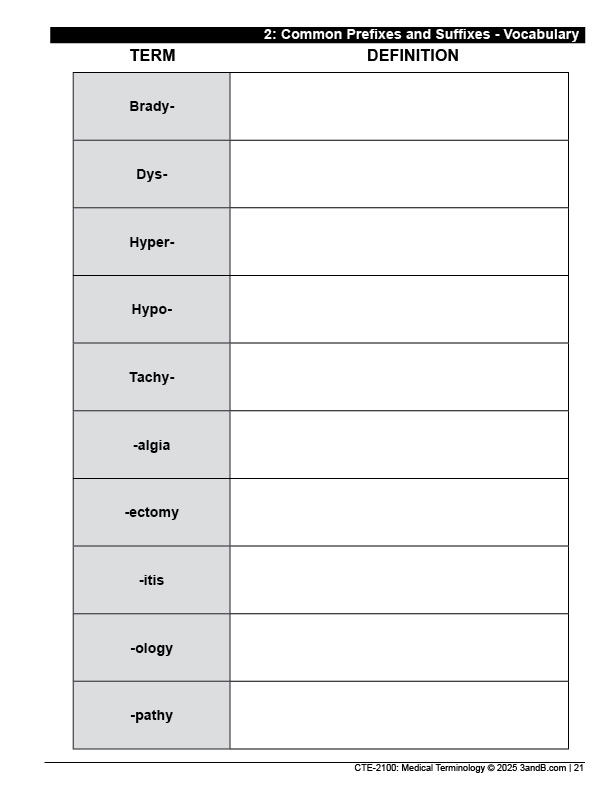
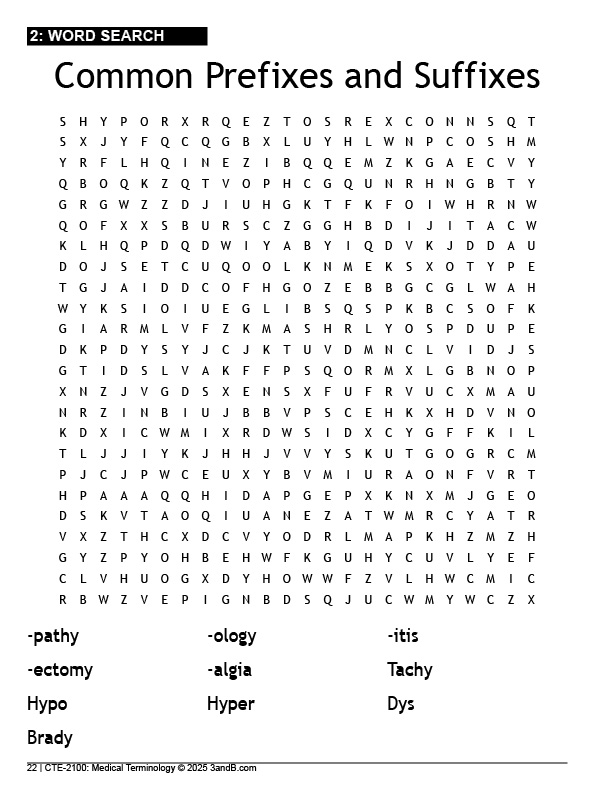
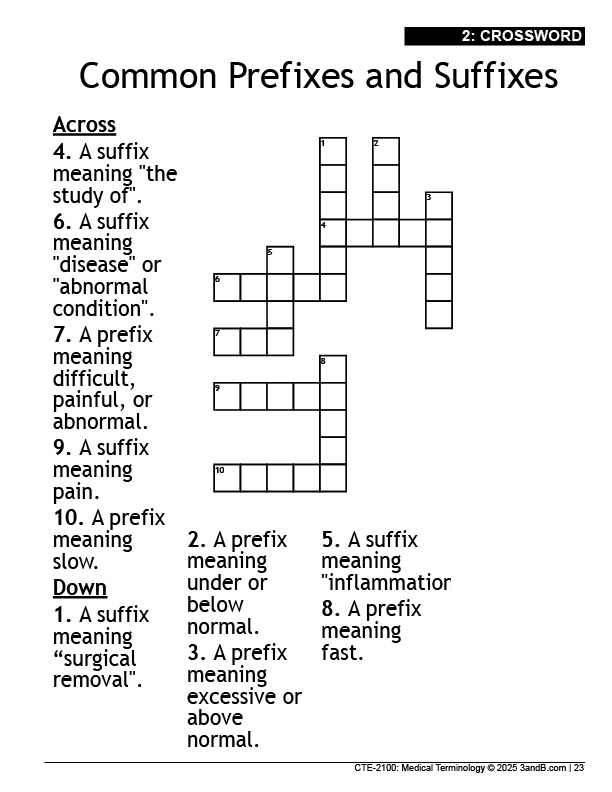
- Vocabulary sets, crosswords, and word searches reinforce core terminology through varied practice.
- Reflection questions and hypotheticals help students interpret and apply terms to healthcare concepts.
- Comprehensive coverage connects body organization, patient findings, procedures, equipment, and professional communication.
Designed for high school CTE learners in the Health Science pathway, this workbook supports students building a practical foundation in healthcare terminology.
About this workbook
CTE-2100: Medical Terminology is a 301-page 3andB workbook that builds a practical foundation in healthcare terminology for CTE learners. Its 21 lessons cover word building, prefixes and suffixes, abbreviations, anatomical language, body systems, movement, vital signs, patient assessment, documentation, diseases, symptoms, diagnostic procedures, treatments, medical equipment, care procedures, emergency care, mental health, special populations, and professional communication.
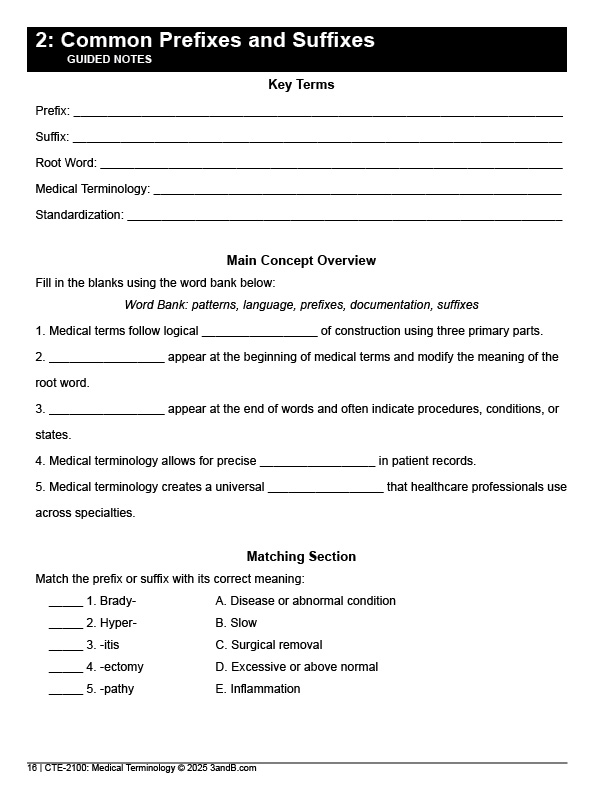
Aligned with CNA competencies and healthcare professional standards, each lesson provides a professional article, guided notes, reflection questions, hypotheticals, vocabulary sets, a crossword, and a word search. Essential questions organize the material around how terminology is structured and used across body organization, assessment, diagnosis, treatment, specialty areas, and verbal, written, and electronic communication.
Students learn to recognize, interpret, and apply medical terms when describing healthcare concepts, patient findings, procedures, and professional communication.
The same shape, every time
In every lesson
A teacher can hand out any lesson in this book and know exactly what a student is getting.
- 1Professional article
- 2Guided notes
- 3Reflection questions
- 4Hypotheticals
- 5Vocabulary sets
- 6Crosswords
- 7Word searches
What's inside
7 units, start to finish.
- Essential Question: How are medical terms structured and used?
- Lesson 1: Word Building Basics - CNA Standard MT 1.1: Basic Word Structure
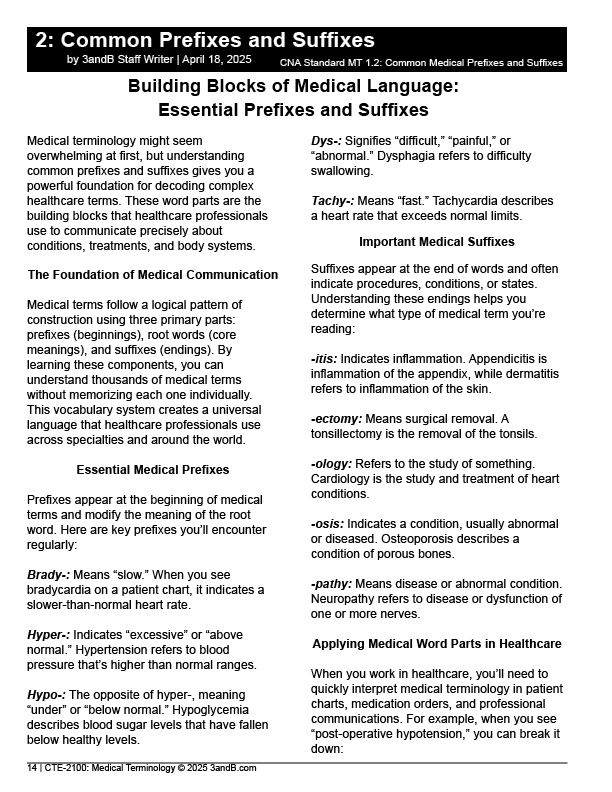
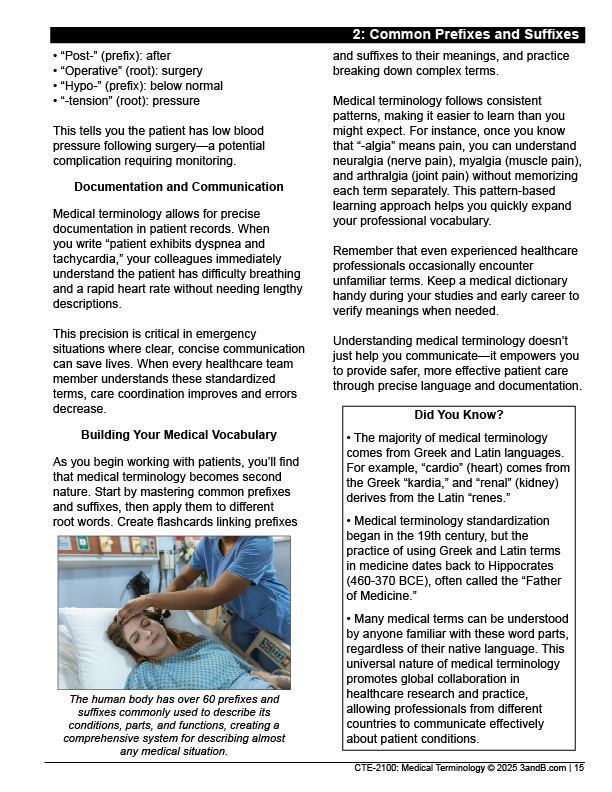
- Lesson 2: Common Prefixes and Suffixes - CNA Standard MT 1.2: Common Medical Prefixes and Suffixes
- Lesson 3: Abbreviations and Symbols - CNA Standard MT 1.3: Medical Abbreviations
- Essential Question: How do we describe body structures and locations?
- Lesson 4: Anatomical Terms - CNA Standard MT 2.1: Anatomical Terminology
- Lesson 5: Body Systems Overview - CNA Standard MT 2.2: Body Systems Terminology
- Lesson 6: Position and Movement Terms - CNA Standard MT 2.3: Movement and Positioning
- Essential Question: How do we describe patient assessment findings?
- Lesson 7: Vital Signs Terminology - CNA Standard MT 3.1: Vital Signs
- Lesson 8: Assessment Terms - CNA Standard MT 3.2: Assessment Terminology
- Lesson 9: Documentation Terms - CNA Standard MT 3.3: Documentation Terminology
- Essential Question: How do we describe medical conditions?
- Lesson 10: Disease Terms - CNA Standard MT 4.1: Disease Terminology
- Lesson 11: Symptom Description - CNA Standard MT 4.2: Symptoms and Signs
- Lesson 12: Diagnostic Procedures - CNA Standard MT 4.3: Diagnostic Terminology
- Essential Question: How do we describe medical interventions?
- Lesson 13: Treatment Terms - CNA Standard MT 5.1: Treatment Terminology
- Lesson 14: Equipment and Supplies - CNA Standard MT 5.2: Medical Equipment
- Lesson 15: Care Procedure Terms - CNA Standard MT 5.3: Procedure Terminology
- Essential Question: How do specialty areas use medical terminology?
- Lesson 16: Emergency Terms - CNA Standard MT 6.1: Emergency Terminology
- Lesson 17: Mental Health Terms - CNA Standard MT 6.2: Mental Health Terminology
- Lesson 18: Special Population Terms - CNA Standard MT 6.3: Special Population Terminology
- Essential Question: How is medical terminology used in professional communication?
- Lesson 19: Verbal Communication - CNA Standard MT 7.1: Professional Communication
- Lesson 20: Written Communication - CNA Standard MT 7.2: Written Communication
- Lesson 21: Electronic Communication - CNA Standard MT 7.3: Electronic Communication
From teachers who bought it
What teachers say
Fun way to learn!
This is a great book for review if you're just starting out in medical terminology. I wish I'd had something like this when I started in nursing over thirty years ago. The puzzles were great fun and and an easy way to learn!
Umfassender und praxisnaher Leitfaden für medizinische Terminologie
Das Buch von JH bietet eine strukturierte und leicht verständliche Einführung in die medizinische Fachsprache. Mit klar gegliederten Lektionen deckt das Workbook zentrale Themen wie Wortbildung, Anatomie, Vitalzeichen, Diagnostik und professionelle Kommunikation ab. Besonders hilfreich fand ich die vielfältigen Übungsformate – von Kreuzworträtseln über Reflexionsfragen bis hin zu hypothetischen Fallbeispielen. Dadurch gestaltet sich der Lernprozess abwechslungsreich. Mit den enthaltenen Lösungen kann man sich gut selbst kontrollieren. Ich persönlich bereite mich zwar nicht auf eine Prüfung vor, aber ich studiere gerade verschiedene medizinische Konzepte und da hat es enorm geholfen, die Konzepte der medizinischen Sprache zu verstehen.
Good intro to medical terminology
This is a well-structured introduction to medical terminology, especially for those entering the healthcare field ... like a coders, or assistant, or a scribe. The two-page overviews at the start of each section are especially useful. While the worksheets can feel lengthy, the detailed answer key in the back is helpful. Overall, pretty good for anyone new to medical vocabulary or systems.
fun!
I honestly loved this book. It makes learning medical terminology fun and entertaining. I loved the exercises, word searches, and variety of activities that make learning a breeze. If you want to know medical terminology quickly and easily, this is a great place to do it. Great!
Puzzles at the end of the chapter helped reinforce the learnings
I loved the overall structure and formatting of the book with interesting ways to reinforce the learnings from the chapters. The word finder was the novelty. The structure made the book interesting to read and didn't feel like a boring textbook.
Comprehensive!!
What an amazing resource!! There are so many ways to help the student learn - articles, note sets, question sets, vocabulary, crosswords and even word searches. The information is comprehensive, on point, and a valuable addition to the library of anyone wanting to enter a myriad of healthcare professions.
Great mix of activities to help remember the vocabulary.
This medical workbook makes learning tough terms easy and fun! The answer key helped me check my work, and the lecture notes cleared up confusing parts. I loved how the activities mixed up word puzzles with writing tasks, which helped the terms stick in my brain. The layout is clean and not scary, even with all the complex medical words. Anyone wanting to learn medical terms should definitely grab this workbook!
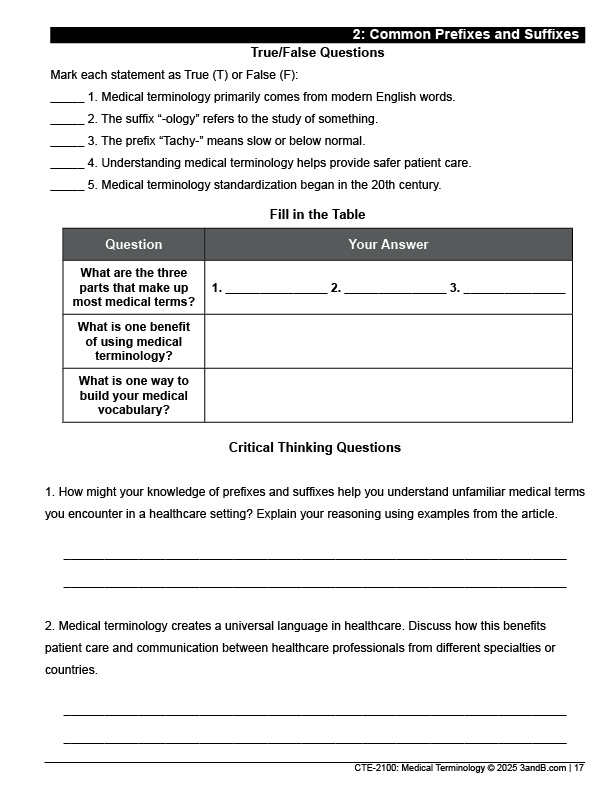
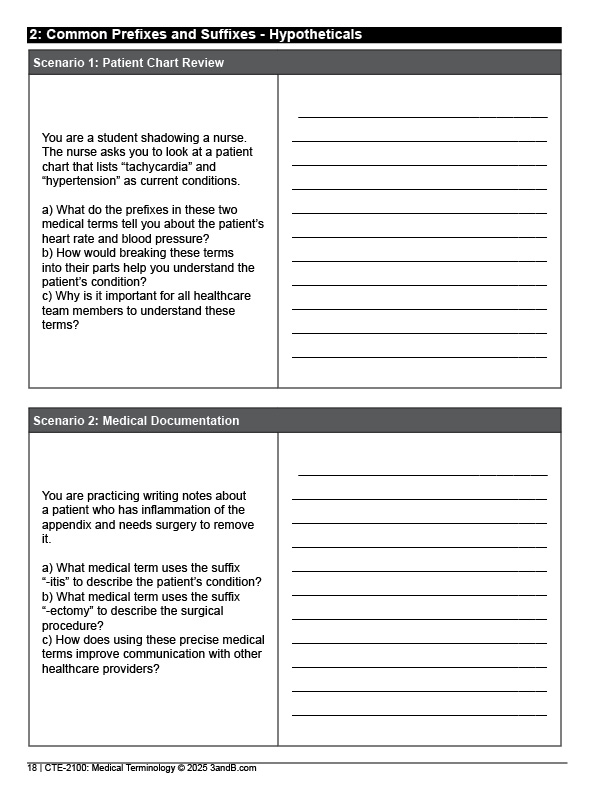
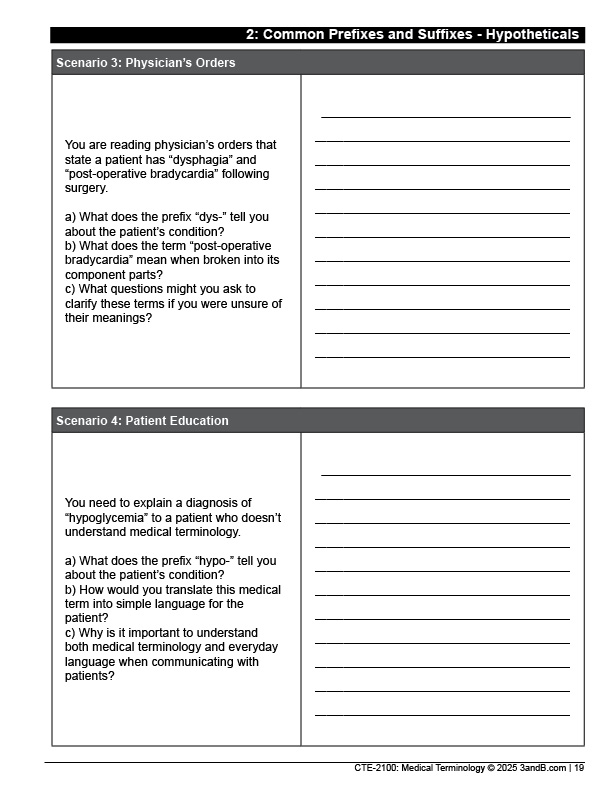
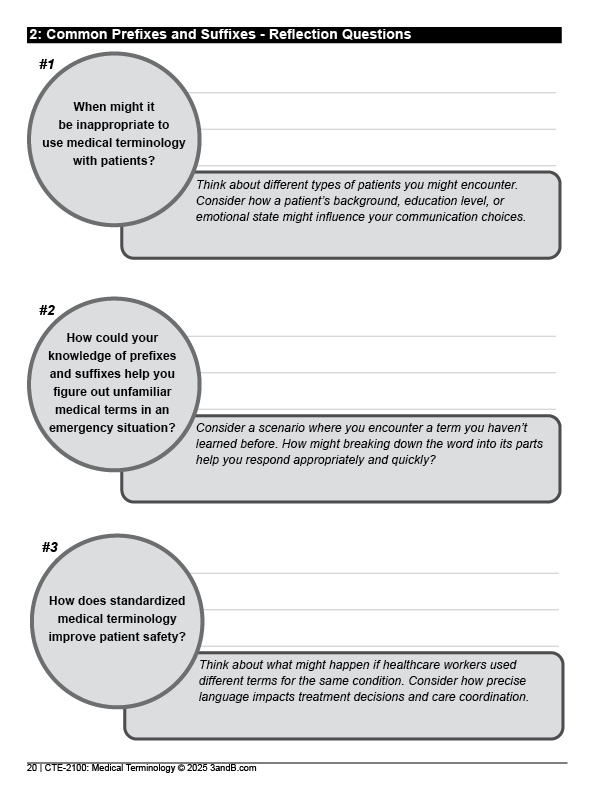
Sample pages
10 pages photographed from the book — open any one full size.
Questions teachers ask
How many pages and lessons are included?
The workbook is 301 pages and contains 21 lessons. The sequence begins with word building, prefixes, suffixes, and abbreviations, then extends through assessment, diagnosis, treatment, specialty terminology, and professional communication.
What topics does the workbook cover?
The workbook covers medical word structure, anatomical language, body systems, movement, vital signs, patient assessment, documentation, diseases, symptoms, diagnostic procedures, treatments, equipment, and care procedures. It also addresses emergency care, mental health, special populations, and verbal, written, and electronic communication.
What will students learn to do?
Students learn to recognize, interpret, and apply medical terms. They use that terminology to describe healthcare concepts, patient findings, procedures, and professional communication.
What free materials are available on this page?
The free materials are the student workbook only, a chapter preview, and the answer key for the chapter. Both the chapter preview and its answer key are available on the product page.
Ready for your classroom
CTE-2100: Medical Terminology · 301 pages · High School