
A Deep-Sea Robot Finds Clues Beneath Challenger Deep
New rock evidence may help explain why the ocean’s deepest spot is so unusually deep.
Print it — all four files
The student packet has no answers in it. The teacher copy is the same pages plus a note on each question and the answer keys. Both languages carry the same story, the same picture and the same vocabulary.
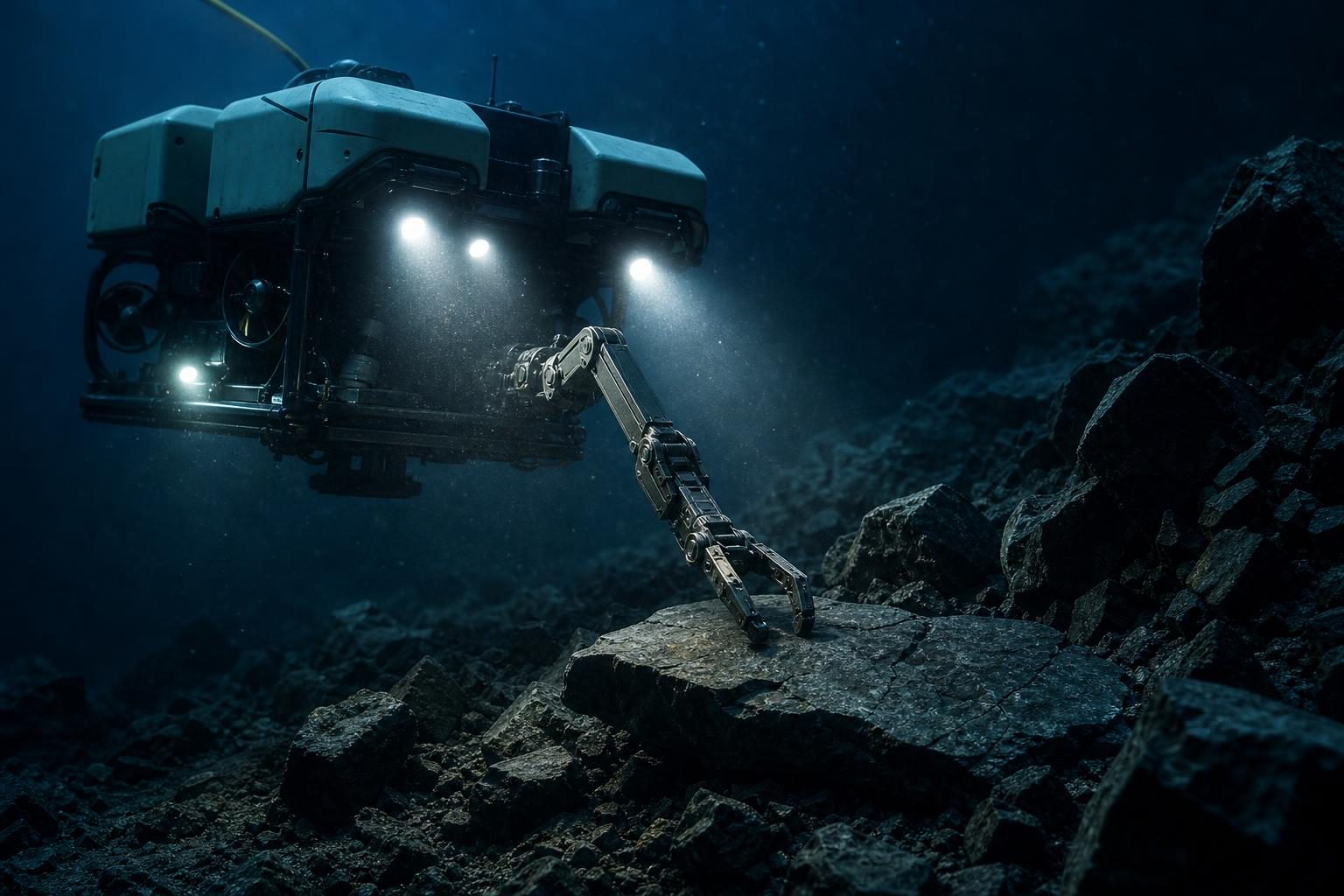
Scientists studying Challenger Deep, the lowest known place in the ocean, have found new evidence that may help explain why it is so deep. According to Science News, a research team used a remotely operated vehicle, or ROV, called Jason/Medea to explore the seafloor near Challenger Deep, which lies inside the Mariana Trench in the Pacific Ocean east of the Philippines. The ROV descended to more than 6,000 meters, while Challenger Deep itself drops to roughly 11,000 meters below sea level.
The big find was not a sunken object or a new animal. It was rock. The researchers found pyroclastic deposits, which are rocks made from material thrown out or broken apart during a volcanic eruption. These deposits included flat, plate-shaped blocks that may show separate pulses of eruption, along with lobe-shaped rocks where volcanic flows appear to have stopped and cooled quickly. The team reports that these are the deepest pyroclastic deposits ever found on Earth.
That matters because Challenger Deep is part of a subduction zone, a place where one tectonic plate slides beneath another. A tectonic plate is a massive slab of Earth’s outer shell. In this case, the Pacific plate is diving under the Mariana plate. As it bends and sinks toward the mantle, the hot layer below Earth’s crust, it helps form the Mariana Trench. All subduction zones can be deep, but Challenger Deep is extreme even by that standard.
The new rock evidence points to a possible explanation: the Pacific plate may be bending especially sharply as it dives downward. In a more typical subduction zone, the sinking plate heats up and partly melts, producing magma, which is molten rock below Earth’s surface. That magma rises through the plate above it and may feed volcanic island arcs hundreds of kilometers from the collision zone. Near Challenger Deep, the volcanic deposits were found much closer to the trench, about a hundred kilometers or so away. A steeper plate angle could help explain why volcanic material appears so close to the deepest part of the trench.
There is another puzzle. Explosive volcanoes are easier to understand on land, where gases in magma can expand rapidly as pressure drops. In the deep ocean, the pressure from all the water above is enormous, so gases should not expand the same way. That makes deep-sea pyroclastic deposits unusual. The scientists are considering whether water coming out of the magma may have been in a supercritical fluid state, meaning it was under conditions where it behaved unlike ordinary liquid water or ordinary steam. That process might produce fragmented, dense volcanic rock without the kind of explosion seen at Earth’s surface.
For a career and technical education classroom, the discovery is also a look at how deep-ocean work actually happens. No person simply walks around a trench that deep with a rock hammer. The work depends on a team that can plan a mission, operate a specialized robot, interpret camera views and sensor information, handle samples or observations carefully, and connect what is seen on the seafloor to the physics of pressure, heat, and moving rock. The ROV is not just a camera on a cable; it is a work platform for places where human divers cannot go.
The job roles behind a mission like this overlap. Geoscientists ask the research questions and interpret the rock record. ROV pilots and marine technicians keep the vehicle working in a harsh environment where a small failure can end a dive. Engineers and electronics specialists help make sure the vehicle can survive pressure, communicate with the ship, and move precisely. Data technicians and researchers turn video, images, navigation records, and samples into evidence that can be checked by other scientists. The article does not give hiring requirements for these jobs, but the work shown here clearly rewards people who can combine hands-on troubleshooting with science reasoning.
The careful part is that the discovery is not being treated as a finished answer. The researchers have a hypothesis, which is a testable explanation, that the sharp bend of the Pacific plate helps make Challenger Deep so deep and helps put volcanic deposits unusually close to the trench. They also have an idea for how pyroclastic rocks could form under deep-sea pressure. But the source makes clear that more work is needed to evaluate these ideas. In technical fields, that is normal: a strong finding often changes the next work order rather than closing the job.
Written from reporting by Science News, “Motion under the ocean explains the depth of the world’s deepest spot”.
Discussion questions
- If you were planning the next mission to test this hypothesis, would you prioritize collecting more rock samples, improving seafloor imaging, or measuring plate motion more directly? Defend your choice.
- Deep-ocean research depends on both scientists and technical crews. Which role seems most critical to the success of a mission like this, and why?
- Should a discovery based on unusual evidence, like possible deep-sea pyroclastic deposits, be presented to the public as a breakthrough or as a promising but uncertain lead?