
AI Tutor Changes How Programming Practice Gets Checked
A TU Graz platform gives code-specific hints, checks results, and leaves the problem-solving to learners.
Print it — all four files
The student packet has no answers in it. The teacher copy is the same pages plus a note on each question and the answer keys. Both languages carry the same story, the same picture and the same vocabulary.
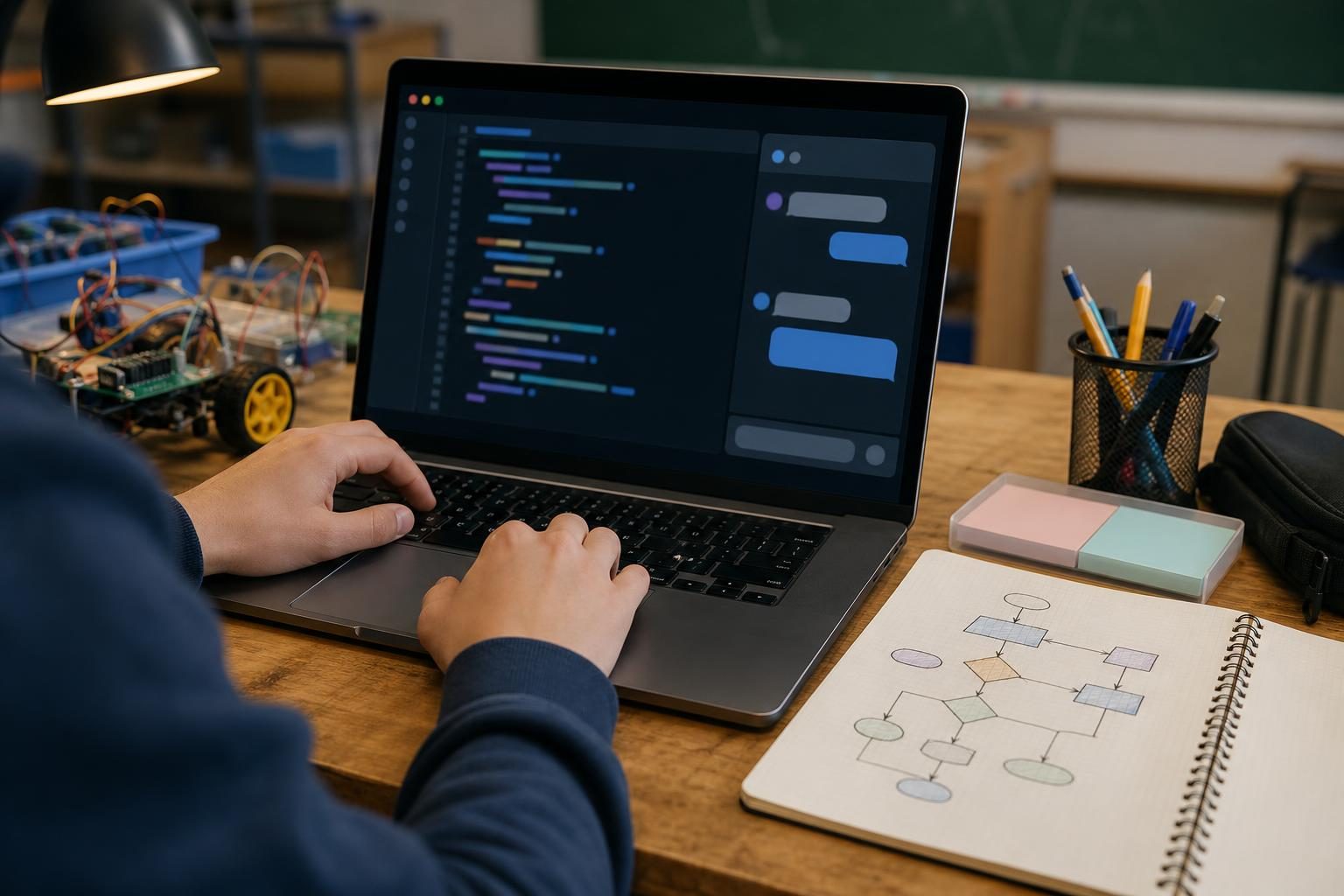
A university team in Austria has built an AI-supported programming platform meant to help people learn to code without simply handing them finished answers. According to reporting by Phys.org, the platform, called computor, is already being used in teaching at Graz University of Technology, or TU Graz, and is available to the public. Its main feature is an AI tutor named Lena that works inside the same programming environment where the learner writes code. A programming environment is the software workspace where a person writes, runs, and fixes a program.
The problem behind the project is familiar in technical training: artificial intelligence can now write whole programs, but a person entering a technical field still needs to understand what the program is doing. In programming, knowing the answer is not the same as knowing the work. A technician, engineering aide, data analyst, or future software developer may need to read someone else’s code, identify why a result is wrong, and make a change without breaking the rest of the system. That kind of troubleshooting, often called debugging, is the process of finding and fixing errors in a program.
Lena is designed to see the assignment and the code already written, so its help can be specific to the task. That is different from asking a general chatbot for a solution because the tool is built into the lesson. But the system is also designed not to provide ready-made solutions. The goal is guided practice: enough help to get moving, not so much help that the learner skips the thinking. That matters for job preparation because many workplaces now expect people to use AI tools, but also expect them to notice when an AI-produced answer is incomplete, unsafe, inefficient, or just wrong.
Computor also checks whether a program produces the expected results. In the source article, one example comes from plasma physics courses, where learners write programs to calculate physical processes before they are allowed to do certain laboratory experiments. Plasma physics is the study of charged gases, such as those found in some high-energy lab and space environments. The platform can compare a program’s output with the expected output and help locate errors. In workplace terms, this is close to automated testing, where software checks whether a system behaves the way it is supposed to before people rely on it.
That automatic checking changes the instructor’s job, too. The platform includes a central administration interface, which is a control panel for creating courses, managing assignments, and viewing learner progress. Teachers can see patterns such as how many attempts it takes to solve a problem, whether work is spread out over time or rushed near a deadline, and whether someone completes many tasks unusually quickly. Those data points do not prove understanding by themselves, but they can help an instructor decide when to step in, ask questions, or give targeted support.
For CTE classrooms, that shift is important. In many trades and technical careers, an instructor or supervisor cannot stand beside every worker all day. A good training system has to build independence while still catching mistakes early. Computor’s design suggests one possible model: the AI handles some immediate feedback, while the human instructor spends more time discussing solutions and judging whether the learner actually understands the process. That division of labor is similar to many modern shops, labs, and offices, where software monitors routine outputs but a trained person is still responsible for judgment.
The platform is browser-based, meaning it runs through a web browser instead of requiring special software to be installed on each computer. Phys.org reports that anyone can visit the computor site and use the programming environment without additional installation. The source code is open source, which means the underlying code is made available for others to inspect, use, or adapt under its license. The team has also made three Python data science courses available as free learning resources, with 70 exercises total. Python is a common programming language, and data science means using code to organize, analyze, and draw conclusions from data.
The platform is aimed especially at people who need programming for natural sciences, engineering, or data analysis. That detail matters because not everyone learning to code is trying to become a full-time software developer. Some people need coding as one tool in a larger job, the way a machinist might use measurement software, an HVAC technician might use diagnostic tools, or a lab worker might use instruments and spreadsheets. The employment skill is not just typing commands; it is understanding a problem well enough to choose the right tool, test the result, and explain the decision.
The open question is how much help is too much. If an AI tutor gives only hints, some learners may struggle longer, but they may build stronger troubleshooting habits. If it gives complete answers, work may move faster, but the person may not be ready when the problem changes. Computor is one attempt to draw that line inside the training tool itself. For technical education, the larger issue is not whether AI belongs in the room. It is how to use it so that the worker still learns the work.
Written from reporting by Phys.org, “computor: AI tutor as a programming learning aid”.
Discussion questions
- Should a training tool block AI from giving complete answers, or should learners be allowed to use AI the same way they might on the job? Defend your position.
- If an instructor can see how many attempts a learner made and when the work was done, what are the benefits and risks of using that data to judge progress?
- How could a similar AI tutor-and-checking system be useful in a non-programming trade or technical field, and what would it need to measure carefully?