
Flooded Roads Put Infrastructure Crews on the Clock
Heavy rain in Florida and California shows how weather turns design, maintenance, and emergency jobs into public safety work.
Print it — all four files
The student packet has no answers in it. The teacher copy is the same pages plus a note on each question and the answer keys. Both languages carry the same story, the same picture and the same vocabulary.
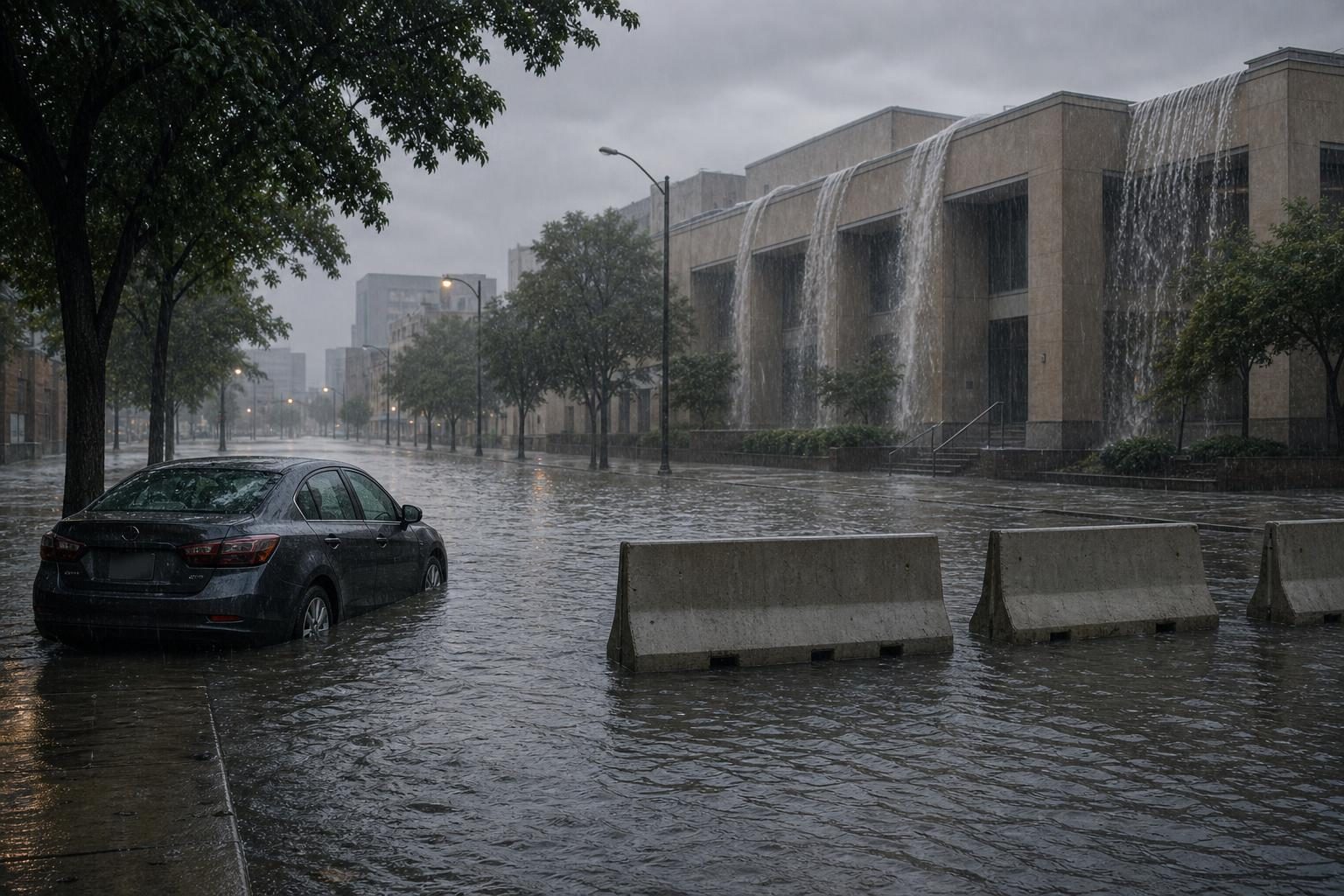
According to Associated Press reporting published by PBS NewsHour, a slow-moving storm system dumped heavy rain on South Florida, flooding roads, submerging cars, closing parts of the Florida Turnpike and Interstate 95, and causing the roof of Temple Sinai in Hollywood to collapse. No injuries were reported. Preliminary National Weather Service figures showed 15.3 inches of rain fell in parts of Broward County during a 24-hour period ending Wednesday. Hollywood declared a state of emergency, and officials in Broward and Miami-Dade counties announced that schools would be closed Thursday.
The weather was not just a local inconvenience. The National Weather Service warned that Florida’s Atlantic Coast could see more rain through Friday, with an additional 12 inches possible. The Florida Division of Emergency Management warned of flash flooding, which is flooding that rises quickly enough to trap vehicles and people before they can react, along with dangerous surf and beach erosion. A low-pressure system, an area where rising air can help clouds and storms form, was also expected near the northern Bahamas and could develop into a subtropical or tropical storm near the Southeast and mid-Atlantic coasts.
A meteorologist with the National Weather Service in Miami said El Niño helped set up the pattern. El Niño is a natural warming cycle in the Pacific Ocean that can shift storm tracks and rainfall patterns far from where the ocean warming begins. In Florida, it disrupted the usual dry season and helped steer low-pressure systems toward the southeastern United States. That matters for planning because “normal” weather is what roads, drains, roofs, schedules, and staffing plans are often built around. When the pattern changes, crews find out fast where the weak points are.
The same broad stormy period affected the West Coast. In San Francisco, heavy rain and high winds grounded planes, canceled ferries, and flooded areas near the Ferry Building after waves came over flood barricades. San Francisco set a daily rainfall record with 2.28 inches. In Napa, Marin, San Mateo, and Santa Clara counties, highways were blocked by flooding or debris, according to transportation and highway patrol officials. A 47-mile stretch of Highway 1 near Big Sur was closed because of debris-flow risk, which means mud, rocks, water, and burned soil can rush downhill after rain.
For CTE pathways, the work behind this story is not abstract. A flooded road is part transportation problem, part drainage problem, and part public safety problem. Public works crews, highway maintenance workers, equipment operators, utility workers, and traffic control technicians have to decide which lanes to close, where to place barricades, and how to keep stalled vehicles from becoming hazards. Stormwater technicians deal with the system that moves rain off streets, including inlets, pipes, ditches, pumps, canals, and outfalls, which are the discharge points where water leaves the system.
The roof collapse and hospital roof damage point to another set of trades. Building maintenance staff, roofers, inspectors, and structural engineers all deal with loads, meaning the forces a structure must carry. Rainwater adds weight fast when it ponds on a roof instead of draining away. On flat or low-slope roofs, drains, scuppers, gutters, and downspouts are not decoration; they are safety equipment. After a storm, the job may include checking for leaks, blocked drains, sagging roof sections, damaged ceiling systems, wet electrical areas, and mold risks.
Emergency management work connects all of these crews. Dispatchers handle calls for service. Police and fire departments respond to stranded drivers and flooded buildings. School districts decide whether buses and campuses can operate safely. Airport and ferry operators weigh wind, water, visibility, and equipment limits. Meteorologists supply forecasts, but local agencies still have to turn those forecasts into work orders, closures, staffing, and public warnings.
Getting hired into this kind of work depends on the role, but the useful skills are easy to see in the storm response. Employers need people who can read site conditions, follow safety procedures, communicate on radios, document damage, and work around moving traffic and energized equipment. Some jobs may require a commercial driver’s license to operate large trucks, heavy-equipment experience, basic surveying or mapping skills, or knowledge of building codes. More technical roles, such as meteorology, civil engineering, and structural engineering, require more math, science, and formal education, but they still connect back to the same field conditions.
The storm also shows a trade-off that communities face before the water rises. Oversizing every drain, raising every roadway, hardening every shoreline, and upgrading every roof would be expensive and disruptive. Waiting until after repeated floods is also expensive, and sometimes dangerous. The work is to decide which risks are most likely, which failures would hurt people or shut down key services, and which fixes should come first. When the rain arrives, those earlier design and maintenance choices become visible on the street.
Written from reporting by PBS NewsHour, “Rainfall supercharged by El Niño causes road flooding, synagogue roof collapse in South Florida”.
Discussion questions
- If a city has limited money before the next major storm, should it prioritize road drainage, building inspections, emergency equipment, or public warning systems? Defend your choice.
- How should transportation agencies decide when to close a road that is flooded but still passable for some vehicles?
- What skills from a trade or technical program would transfer best to storm response work, and what training would still be missing?