
Scientists Use Planets and Stars as Dark Matter Detectors
A new study shows how Earth, the sun, Jupiter and white dwarfs can help test ideas about one of physics’ biggest unknowns.
Print it — all four files
The student packet has no answers in it. The teacher copy is the same pages plus a note on each question and the answer keys. Both languages carry the same story, the same picture and the same vocabulary.
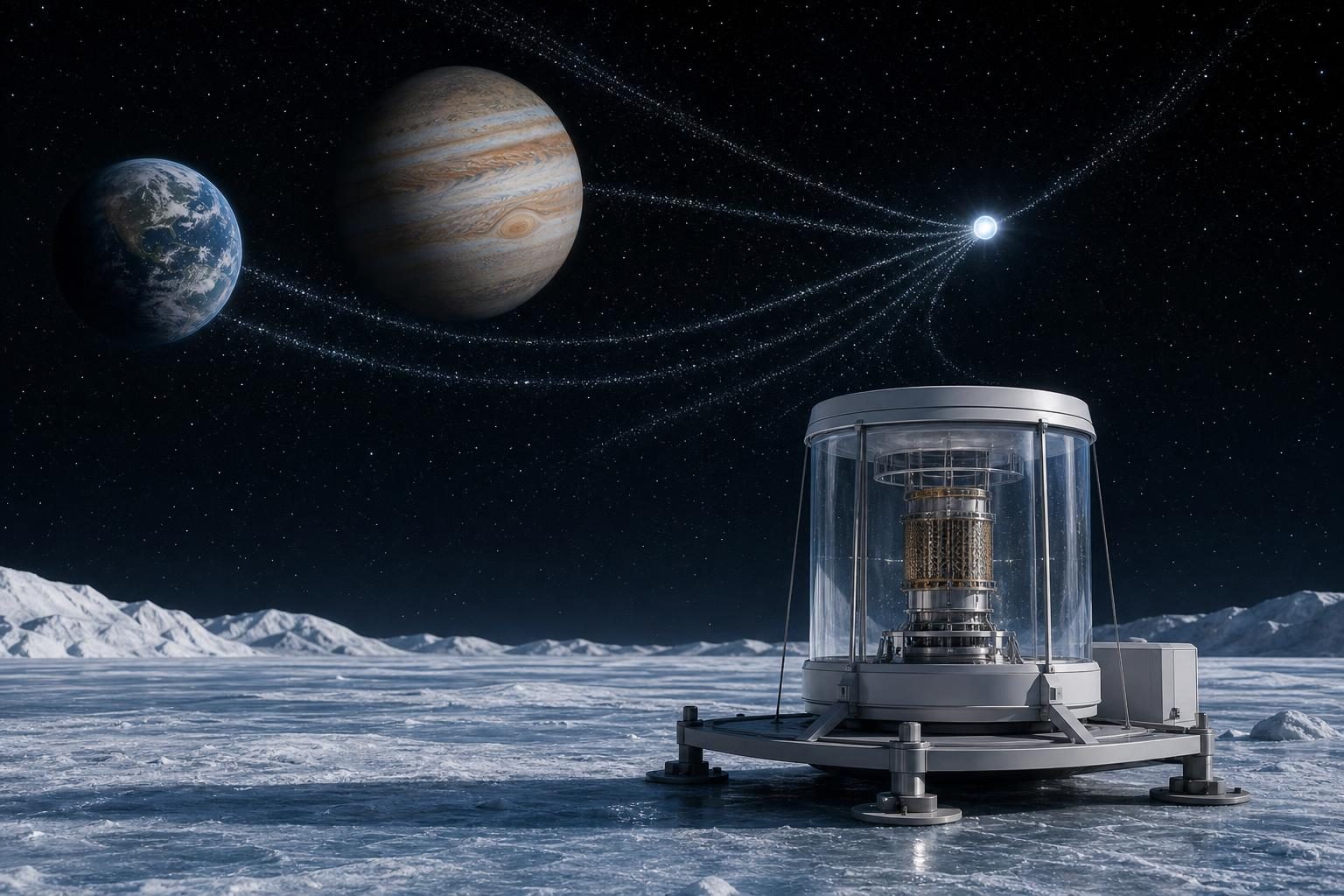
Researchers have used Earth, the sun, Jupiter and white dwarfs as giant test objects in the search for dark matter, according to reporting by Phys.org on a study published in the Journal of Cosmology and Astroparticle Physics. The team did not find dark matter, but it did rule out some possible versions of what dark matter could be. That may sound like a negative result, but in physics it matters: eliminating wrong designs helps the next experiment, detector or computer model get closer to something that can actually be tested.
Dark matter is matter that does not show up directly in telescopes because it does not give off, reflect or absorb light in the usual way. Scientists infer that it exists because its gravity affects galaxies and other large structures in space. The Phys.org article says dark matter accounts for about 85% of the matter in the universe, yet it has still not been directly detected. That creates an unusual technical problem: researchers are trying to design detection systems for something whose properties are still unknown.
The study focused on a possibility that dark matter particles may interact with ordinary matter through extremely weak electric or magnetic effects. An electric interaction would mean a particle responds in some way to electric charge, while a magnetic interaction would mean it behaves a little like a tiny magnet. If those interactions are too weak, ordinary detectors may miss them. A slow-moving particle could hit material inside a detector but transfer too little energy to create a readable signal.
The researchers turned that weakness into a strategy. A particle that is too slow to make a strong detector signal might still lose enough energy while passing through a planet or star to become trapped by gravity. Over billions of years, trapped particles could collect near the center of that object. If the particles can interact with each other, they might undergo annihilation, a process in which particles transform into other particles and release energy. That released energy could show up as particles leaving the object or as extra heat inside it.
For Earth and the sun, the study used results from searches for neutrinos. Neutrinos are tiny particles that can pass through large amounts of matter, which is why they are useful for looking inside places that light cannot escape from easily. The article mentions IceCube at the South Pole, a dedicated experiment that searches for neutrinos from Earth and the sun. In this kind of work, the detector is not a handheld meter; it is a large scientific system that has to be built, calibrated, maintained and interpreted by teams.
For Jupiter and white dwarfs, the researchers looked at heating. A white dwarf is the dense leftover core of a star after it has used up its main fuel. Jupiter and white dwarfs are useful in this study because they are not powered by nuclear fusion, the process that makes the sun shine by joining atomic nuclei and releasing energy. If dark matter trapped inside one of those objects would create more heat than the object actually emits, then that dark matter model can be rejected.
This is where the work looks familiar to people in technical programs, even though the subject is space physics. The job is not only “looking through a telescope.” It includes building a model, choosing assumptions, comparing predicted output with measured output, and deciding whether the numbers pass a reality check. A wrong assumption can send the whole job in the wrong direction. In this study, one key assumption is how much dark matter is near the stars being studied. For the M4 cluster, which contains the white dwarfs used in the study, that dark matter density has not been measured directly and has to be estimated from models.
Different workers touch different parts of a project like this. Theoretical physicists create the equations for how dark matter particles might behave. Observational scientists and detector teams work with instruments that collect data, such as neutrino detectors or telescopes measuring heat from distant objects. Data analysts compare what the model predicts with what the instruments record. Engineers and technicians matter because sensitive instruments only produce useful data when power, sensors, timing systems, cooling, communications and calibration are reliable.
The hiring pathway depends on the role. The research side usually demands advanced physics and math, because the work involves particle behavior, gravity and statistical limits. The technical side rewards people who can troubleshoot systems, document procedures, work safely around complex equipment and understand how sensors turn physical events into data. Coding is also central because large experiments generate data that must be filtered, checked and compared with simulations. In this field, a clean dataset is as important as a clean weld or a correctly wired panel: if the input is bad, the final conclusion is not trustworthy.
The study also shows how scientific progress can come from reusing existing tools in a new way. Instead of waiting only for a new dark matter detector, the researchers asked whether planets, the sun and dead stars could act like natural traps. They found no dark matter signal, but they narrowed the range of particle masses and electromagnetic properties that still make sense under their assumptions. Future searches may look at even colder white dwarfs in regions thought to contain more dark matter, or at exoplanets, which are planets outside our solar system. The work continues by making the search area smaller, more testable and more connected to real measurements.
Written from reporting by Phys.org, “The sun, Earth, Jupiter and white dwarfs: Potential traps for dark matter”.
Discussion questions
- When a study finds no direct signal but rules out some possibilities, should that be considered a successful result? Defend your answer using both scientific and workplace reasoning.
- This project depends on assumptions, such as estimated dark matter density near white dwarfs. How should a technical team decide whether an assumption is good enough to build on?
- If you were staffing a project like this, which would be harder to replace: the theoretical modelers, the instrument technicians or the data analysts? Make a case for one role while acknowledging the others.