
China Delays Moon Probe After Launch Readiness Check
The Chang’e-7 delay shows why space jobs depend on inspection, documentation, and the authority to stop a launch.
Print it — all four files
The student packet has no answers in it. The teacher copy is the same pages plus a note on each question and the answer keys. Both languages carry the same story, the same picture and the same vocabulary.
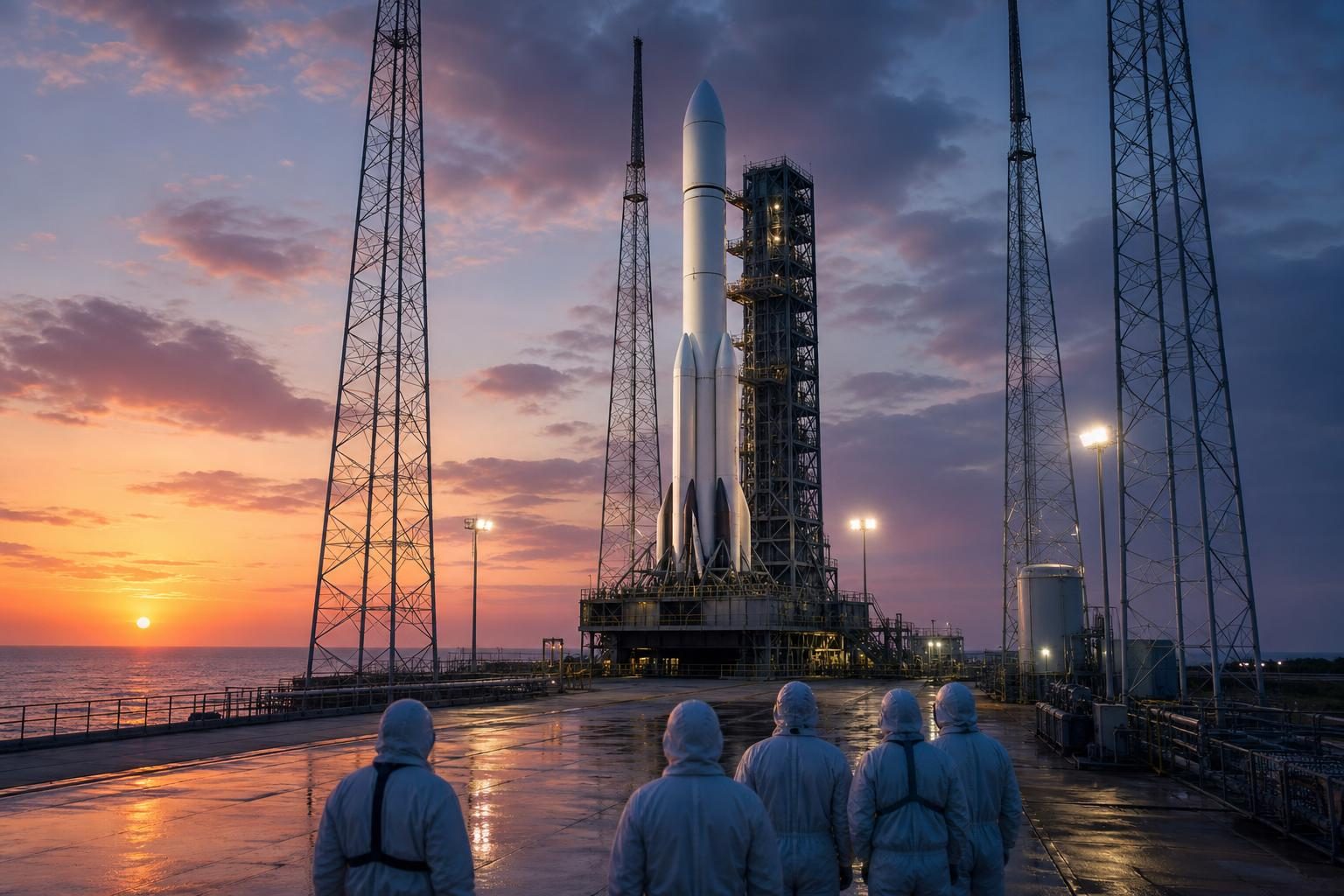
China has delayed an unmanned moon mission that was supposed to help search for water near the moon’s south pole, according to reporting by Phys.org. The mission, called Chang’e-7, was set to launch on a Long March 5 carrier rocket from the Wenchang Space Launch Center in Hainan province. China’s manned space agency said the mission “does not meet launch conditions” for its planned window this year and did not announce a new launch date.
That is a short announcement, but it points to a large amount of work. A launch window is the period when a spacecraft can leave Earth and still line up correctly with its target; missing it can mean waiting until orbital mechanics create another workable path. A carrier rocket is the launch vehicle that lifts the spacecraft out of Earth’s atmosphere and sends it toward its destination. In this case, the payload is a lunar probe, an uncrewed spacecraft built to travel to the moon and collect data.
The agency said the decision followed a comprehensive assessment and was based on prudence, reliability, and mission success. It did not say exactly what condition failed the readiness check. That missing detail matters. In technical fields, a delay can be caused by many different things: the vehicle, the payload, ground support equipment, weather, tracking systems, software, or an unresolved test result. The public statement does not identify which one, so the responsible answer is not to guess.
The timing adds pressure. Phys.org reported that the delay came less than two weeks after a rare launch failure involving a Long March 7A carrier rocket from the same Hainan launch site. In that case, state news agency Xinhua said an anomaly occurred during flight while the rocket was carrying a Zhongxing-4B communications satellite, and the cause was under investigation. An anomaly is an unexpected reading, behavior, or event that does not match the planned operating limits. In aerospace work, that word can cover anything from a sensor value outside tolerance to a serious system failure.
For CTE students thinking about aerospace, advanced manufacturing, electrical work, welding, machining, mechatronics, or quality assurance, the important part of this story is not only that a moon mission slipped. It is that a launch is a jobsite where the cost of being wrong is extremely high. The finished rocket on the pad is only the visible part. Before a launch, technicians and engineers have already spent months or years fabricating parts, routing cables, testing avionics, checking valves, reviewing software, moving hazardous materials, and documenting every step.
Launch readiness is not a vibe. It is a controlled process. Teams inspect hardware, verify test data, confirm that procedures were followed, and decide whether open issues are acceptable. Quality assurance means checking that work meets requirements before it is accepted. Configuration control means making sure the exact hardware and software installed on the vehicle match the approved design and paperwork. A nonconformance is a part, process, or result that does not meet the requirement. In a safety-critical operation, a nonconformance cannot simply be ignored because the schedule is inconvenient.
That changes what “good work” means. In many jobs, speed is rewarded. In launch operations, speed matters, but disciplined stopping matters too. A technician who notices a damaged connector, an unexpected pressure reading, or a test result that does not repeat correctly may be the person who prevents a failed mission. A supervisor who protects that technician’s authority to raise a concern is also doing the work. The decision to delay Chang’e-7 shows that the launch team, or the agency above it, judged the risk too high for the planned window.
This is also a reminder that space programs are not only about astronauts. China says it aims to land astronauts on the moon before 2030, and the United States is pursuing its own Artemis program. Those goals depend on uncrewed missions first. Chang’e-7 is meant to search for water at the lunar south pole. Water matters because it can help scientists understand the moon and because future missions may care about local resources. The source article does not say how Chang’e-7 will search or what instruments it carries, so the solid takeaway is broader: scouting work comes before crewed work.
The workforce behind that scouting includes people with different levels of education. Some roles require engineering degrees or advanced research training. Others are hands-on technical roles: precision machining, electronics assembly, nondestructive inspection, cleanroom work, fueling operations, crane and transport support, instrumentation, and maintenance of ground systems. Nondestructive inspection means checking a part for cracks or defects without cutting it open or ruining it. Cleanroom work means building or handling sensitive equipment in a controlled space designed to limit dust and contamination.
Getting hired into this kind of work usually requires more than being interested in space. Employers look for people who can read technical drawings and procedures, use measurement tools correctly, follow safety rules around energy and hazardous materials, and document what they did. Documentation is not busywork in this field; it is how the next shift, the quality team, and the failure investigation team know what actually happened. If a rocket fails, investigators need records detailed enough to trace parts, tests, and decisions.
The delay may be frustrating for China’s space program, especially after a recent launch anomaly. But from a technical-work point of view, a scrubbed or postponed launch can also be evidence that the system still has a brake pedal. The public may remember the dramatic liftoff, but the job often turns on quieter decisions made before ignition: sign the checklist, hold the count, retest the system, or say no until the evidence supports yes.
Written from reporting by Phys.org, “China says unmanned moon mission delayed over 'launch conditions'”.
Discussion questions
- When a high-profile launch is delayed without a full public explanation, how should the public balance trust in technical experts with the need for transparency?
- In safety-critical industries, should workers be rewarded more for keeping production on schedule or for stopping work when something seems wrong?
- How could the lessons from a delayed space launch apply to another CTE field, such as construction, automotive repair, aviation maintenance, or health care technology?