
Iron Bars in Austria Reveal an Ancient Supply Chain
A gravel-site discovery shows how metalworking, shipping, and recordkeeping connected Europe more than 2,000 years ago.
Print it — all four files
The student packet has no answers in it. The teacher copy is the same pages plus a note on each question and the answer keys. Both languages carry the same story, the same picture and the same vocabulary.
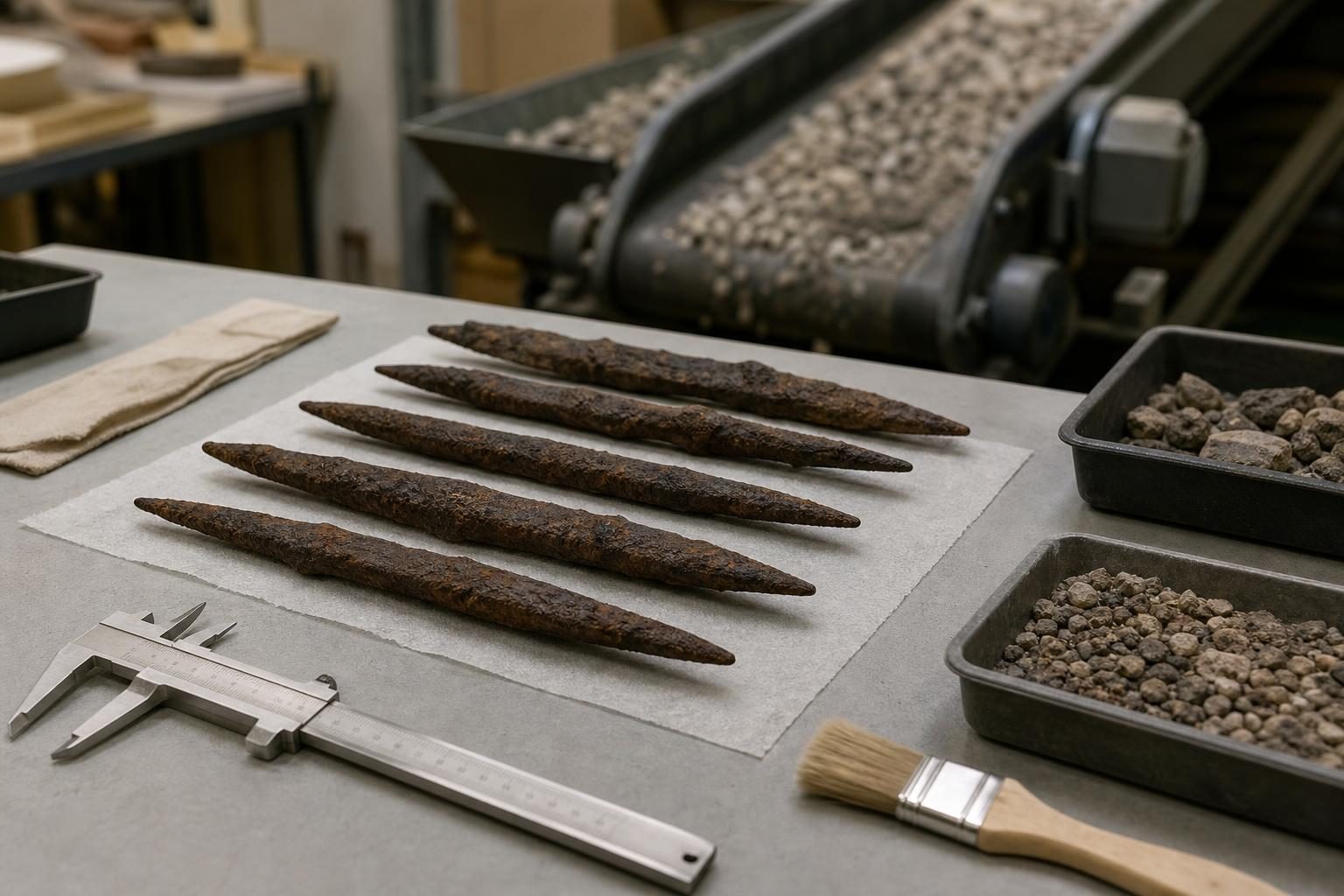
A find made during industrial gravel extraction at Deinham, Austria, has been identified as Europe’s largest known mass find of prehistoric iron bars, according to reporting by Phys.org on a new study in the journal Antiquity. The objects were not finished tools or weapons. They were iron semi-products, meaning pieces of metal made in a standard form so a smith could later forge them into blades, fittings, or other finished goods. At least 500 bars were recovered, together weighing more than 1 metric ton. Researchers dated them to the Late Iron Age La Tène period, from the mid-fifth to the first centuries B.C.
The find matters because it turns a pile of rusty metal into evidence of a large, organized production system. Archaeologists already knew that Iron Age Europe had dedicated iron-production centers, but the scale of trade is hard to measure. Semi-products can look like scrap, and iron is difficult to date precisely. In this case, the amount of metal, the repeated shape of the bars, and the location near the Danube River all point to more than local blacksmithing. The researchers argue that the bars were probably cargo lost from a vessel moving down the river for trade.
That makes the discovery useful for thinking about work, not just history. The first workplace in the story was not a museum or a university lab. It was an industrial gravel extraction site, where machines remove sand, gravel, and stone for construction materials. In that setting, unusual objects can be damaged, hauled away, or sold as scrap unless someone stops the process and reports them. The article says the finders reported the material to the Austrian monument authority, the public agency responsible for protecting important historical remains, and donated the trove to a state museum collection.
After that, the work shifted to specialists who could identify what the metal was and why it mattered. Peter Trebsche of the University of Innsbruck and Marion Berranger of the Université de Technologie de Belfort Montbéliard analyzed the bars and used radiocarbon dating, a lab method that estimates age by measuring carbon-14, a radioactive form of carbon that decays over time. The study describes the group as an assemblage, which in archaeology means a set of objects found together and studied as related evidence rather than as separate antiques.
The bars are described as double-pointed, or bipyramidal, meaning each piece tapers toward both ends like two low pyramids joined base to base. That shape matters because standard forms are easier to count, move, store, and trade. Modern manufacturing uses the same basic idea when material is shipped as billets, coils, sheet, pipe, or stock instead of as finished products. A fabricator does not always want a completed part; often the shop wants material in a predictable form that can be cut, heated, bent, machined, or welded into the final product.
The ancient supply chain appears to have included mining or ore processing, smelting, forging into trade bars, inland shipping, exchange, and final fabrication. Smelting is the high-temperature process that separates usable metal from ore, and forging is shaping metal by heating and hammering or pressing it. The article says the bars were likely forged in Bavaria, where iron-production sites have been found near oppida, large fortified towns of Iron Age Europe. Their final destination is still unknown, which is important: good evidence can answer one part of a workflow while leaving other parts open.
The scale is what surprised researchers. One metric ton of iron could have produced roughly 500 swords of the average weight given in the study, even allowing for material losses during manufacture. That does not prove the cargo was meant only for weapons, but it shows the economic value of moving so much metal at once. The article also compares this kind of value to large hoards of gold coins from the same broad period, suggesting that trade on this scale may have required more developed systems of payment and recordkeeping.
For CTE fields, the modern lesson is that technical work often depends on handoffs. Equipment operators, site supervisors, inspectors, archaeologists, lab technicians, conservators, and museum collection workers each protect a different part of the chain. One group recognizes that something is not ordinary waste. Another stabilizes and stores corroded metal so it does not keep breaking down. Another measures, dates, compares, and publishes the evidence so other professionals can check the claim. The discovery survived because the material was treated first as a job-site responsibility and then as a technical research problem.
Written from reporting by Phys.org, “'Rusty treasure' find revealed as Europe's largest assemblage of prehistoric iron bars”.
Discussion questions
- When a construction or extraction crew finds something unusual, how should a company balance project speed, material value, legal duties, and possible historical importance?
- The iron bars were valuable partly because they were standardized semi-products rather than finished items; where else in modern trades does standardizing material improve a supply chain, and what can it fail to capture?
- What kinds of evidence would make the shipwreck-and-trade explanation more convincing, and what alternative explanations should researchers still consider?