
New Homes May Need Room for Wildlife, Too
A new study says buildings already act like habitat, raising practical questions for builders, planners, and trade workers.
Print it — all four files
The student packet has no answers in it. The teacher copy is the same pages plus a note on each question and the answer keys. Both languages carry the same story, the same picture and the same vocabulary.
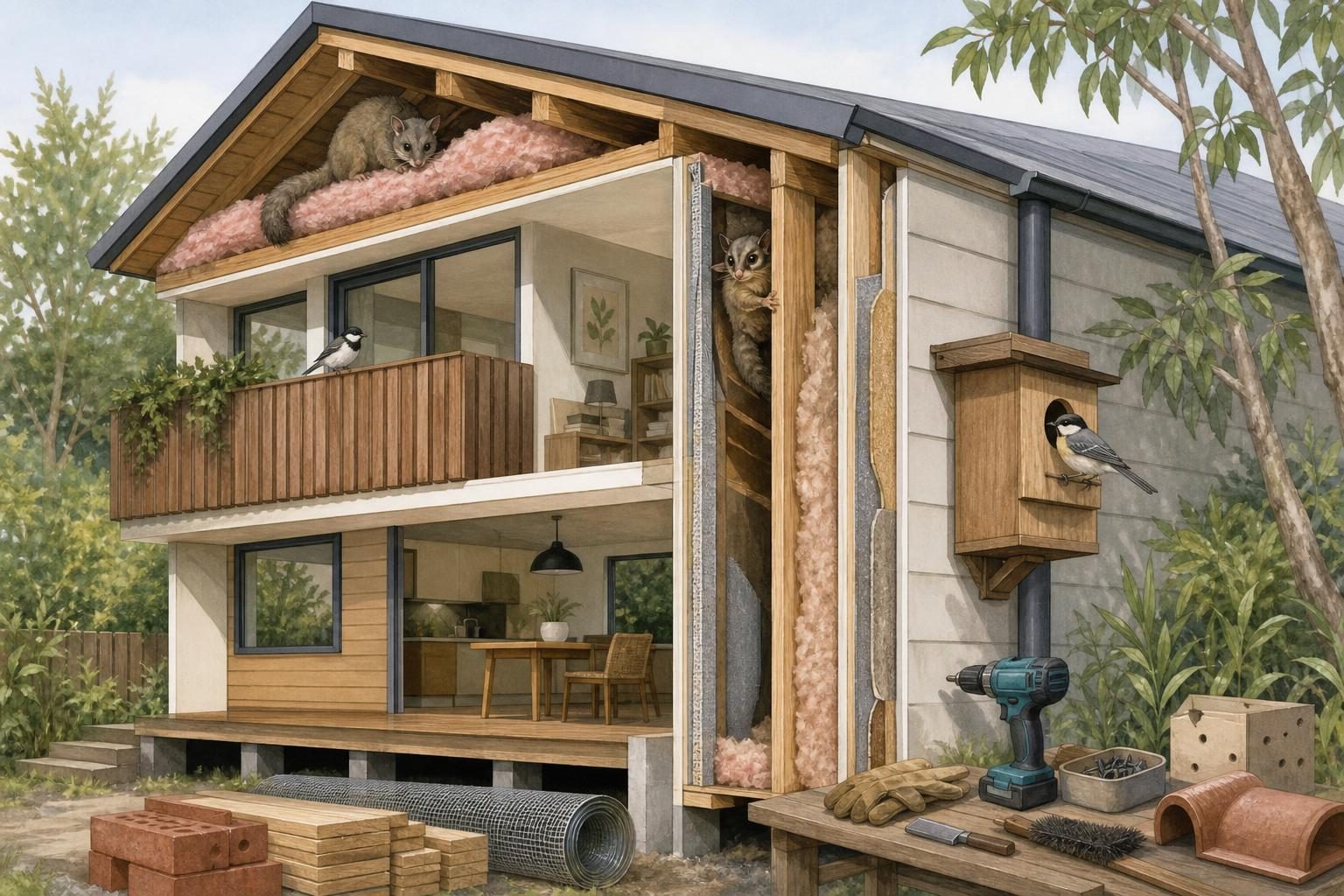
Buildings are becoming home to more than people, according to a Phys.org report on a new study of wildlife in Australian houses. Researchers analyzed reports to Wildlife Victoria from the past decade and found about 2,400 native animals reported in, on, or under buildings. The animals were not just passing through. The study found 36 native species using homes to nest, forage, or sleep, from microbats in curtains to Pacific black ducks on balconies.
The issue matters because Australia is trying to build many more houses while natural habitat is shrinking in cities. The country has a national target of 1.2 million new homes over the next five years. Every subdivision, renovation, roofline, wall cavity, and paved yard changes the local environment. For people headed into construction, architecture, site planning, HVAC, property maintenance, or building inspection, this is not just a nature story. It is a story about how the work may change when a building has to function as shelter for humans without accidentally harming wildlife that has nowhere else to go.
The study found that wildlife uses almost every part of a dwelling. Building cavities, meaning enclosed gaps such as spaces inside walls or roofs, were the most common location, used by 40% of the species studied. Another 19% were found in shelters and structures such as garages, while 16% were on outside surfaces such as eaves, balconies, and rooftops. Smaller shares were found inside rooms, under houses, or in utility services such as heaters and air conditioners. Those locations are familiar to trade workers because they are also the places where crews run ductwork, mount equipment, install insulation, repair leaks, and check for pests.
The reason animals choose those places is practical. A roof or wall cavity can work like a tree hollow, which is a protected opening in an old tree used by many animals for nesting or shelter. A crawlspace under a house can act like a burrow. A balcony can resemble a high ledge. A water heater or air-conditioning unit can create a microclimate, which is a small area with its own temperature and moisture conditions. In other words, wildlife is not using buildings randomly. Animals are responding to shelter, warmth, height, darkness, and protection from weather.
That creates a real trade-off for housing work. Australia is also strengthening energy-efficiency standards for new houses. The article notes that newly built homes must be properly sealed to limit air leaks, which account for 15% to 25% of heat lost from homes in winter. In building science, sealing the envelope means reducing uncontrolled air movement through walls, roofs, floors, and openings. A tighter building can save energy and improve comfort, but it can also close off spaces that animals have been using. The researchers argue that an energy-efficient home does not have to be a wildlife-free home if habitat features are planned instead of accidental.
Some places are already trying design solutions. In Scotland, new buildings must include swift bricks, which are nest boxes built into exterior walls for common swifts. A building in Germany’s Brantstrasse includes swift bricks, bat boxes, and hedgehog nest boxes. Australia does not currently have a policy like that, according to the article, though some grassroots efforts are emerging. One example is wildhouses, where builders fund a standalone bird, bat, or glider nest box for every building they construct.
For the trades, the key difference is between accidental habitat and designed habitat. Accidental habitat is a possum in an attic, a reptile near a warm mechanical unit, or bats in a wall cavity. Designed habitat is a planned feature that appears on drawings, is placed where it will not interfere with moisture control or fire safety, and can be maintained without tearing apart finished work. That kind of change would affect how a crew reads plans, coordinates rough-in work, seals penetrations, and schedules inspections. It also means a contractor may need to know when to stop and call a specialist rather than treating every animal as a nuisance.
The article is careful that keeping animals out is sometimes necessary. Exclusion means using barriers or devices to keep wildlife from entering a building. That may be needed when an animal creates a genuine health, safety, or welfare risk, and the article says it is best done by an expert wildlife caregiver. The problem is not exclusion by itself. The problem is removing an animal’s shelter without considering a safer alternative nearby. For a remodeling crew, that could mean a repair solves one owner’s problem but destroys the only nesting space available on that block.
There are also bad design choices to avoid. The article describes hostile architecture as building features meant to keep wildlife out, such as bird spikes, netting, and reflective glass, which can injure or kill animals. It also describes biodiversity-sensitive urban design, an approach that builds neighborhoods to reduce threats to plants and animals while still meeting their resource needs. That can include decisions beyond one house, such as using flowering meadows instead of lawns in parks or streetscapes.
This story points to a broader skill set for future work in the built environment. A strong worker still needs the basics: layout, measurement, code awareness, tool safety, material knowledge, and clean installation. But projects that include wildlife habitat also reward careful observation, documentation, communication with designers, and respect for what each trade controls. The question is not whether houses are for people or for animals. The study shows that, in many cities, buildings are already serving both roles. The job ahead is making that reality safer, more intentional, and less likely to be erased by the next repair.
Written from reporting by Phys.org, “Your house may be a haven for wildlife. It's time we design homes with nature in mind”.
Discussion questions
- If a new housing development has to be affordable, energy efficient, and wildlife-sensitive, which goal should be protected from cuts first, and why?
- Should wildlife habitat features be required by building policy, left to voluntary builders, or handled case by case during permits?
- In a renovation, who should be responsible for noticing and responding to wildlife using the structure: the owner, the contractor, the designer, or a specialist?