
A Man-Made Cloud Forest Becomes a Jobsite for Climate Science
Researchers are studying Ascension Island to learn whether damaged ecosystems can be rebuilt, not just protected.
Print it — all four files
The student packet has no answers in it. The teacher copy is the same pages plus a note on each question and the answer keys. Both languages carry the same story, the same picture and the same vocabulary.
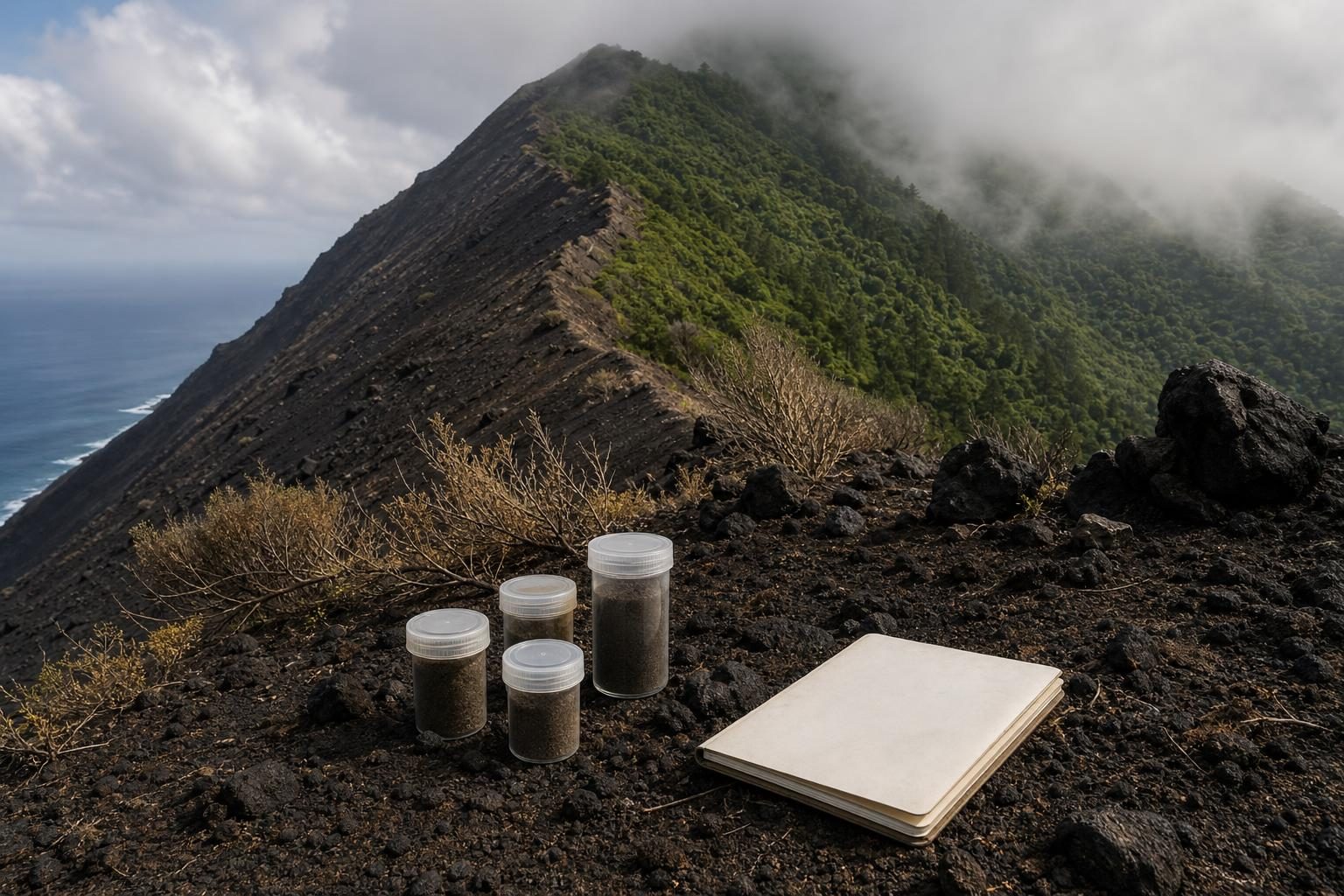
Researchers are studying Ascension Island, a small volcanic island in the Atlantic Ocean, because it may help answer a hard question in environmental work: can an ecosystem that is drying out or breaking down be pushed in the opposite direction? According to reporting by Phys.org, a team connected to Pompeu Fabra University and the Institute of Evolutionary Biology is investigating how a 19th-century planting project changed parts of the island from bare volcanic ground with only a few dwarf fern species into a humid forested landscape.
The basic story sounds almost impossible. Charles Darwin and Joseph Dalton Hooker, two British scientists who visited the island during their expeditions, helped design a plan to plant seeds brought from botanical gardens linked to the British Empire. The idea was to use the island’s clouds as a water source, or, in the wording used at the time, to start “harnessing the moisture of the clouds.” Over about five decades, planting changed the highlands of Ascension. Today, researchers can move quickly between very different conditions: wet forest in one area and harsh desert nearby.
That matters now because many ecosystems are moving the other way. Desertification means land is becoming more desert-like, often because vegetation, soil quality, and available water are being lost. Biodiversity means the variety of living things in a place, from plants and animals to fungi and microbes. When biodiversity drops, an ecosystem can become less stable and less useful to people who depend on it for water, food, shade, erosion control, or tourism. Ascension is unusual because its change was deliberate, documented, and fast enough for scientists to study as a system, not just as a legend.
For career and technical education, the important part is not only the science result. It is the work behind it. A project like this needs field researchers who can operate in difficult terrain, conservation staff who know the local land, lab workers who can handle soil samples without contaminating them, data modelers who turn observations into testable computer models, and archive researchers who can read old charts, logbooks, and handwritten letters. It is a mixed jobsite: outdoors, indoors, digital, historical, and biological all at once.
The fieldwork on Ascension included a month on the island by researchers from the Complex Systems Laboratory, working with the island’s Department of Conservation and government. Field ecology is the job of studying living things where they actually live, not only in a classroom or lab. On this project, that means comparing different parts of the island, observing vegetation and conditions, and connecting today’s landscape to the planting process that began in the 1800s. The work requires accuracy, stamina, and note-taking that another person could understand later. Bad field notes can make good samples much less useful.
The lab side focuses partly on the soil microbiome. A microbiome is the community of tiny living organisms, such as bacteria and fungi, in a specific place; in soil, those organisms help break down material and cycle nutrients. Nutrients are chemical materials that plants and microbes need to grow. The researchers see the soil microbiome as a foundation of the ecosystem because soil conditions help determine which plants can survive. Samples from different regions of the island are expected to help show how quickly the underground part of the ecosystem changed as the surface became greener.
There is also modeling work. In this context, a model is not a display object; it is a simplified mathematical or computer version of a real system. A minimal model uses only the most important parts of the system so researchers can test what may drive change without trying to copy every detail. The team usually studies ecosystems that are collapsing or degrading, meaning their living parts and basic functions are failing. Ascension gives them a rare chance to model recovery instead. If the model can explain what happened locally, researchers hope it can help them think about other damaged places.
But this story also raises practical cautions. The planting project used species brought from many places, and the article does not claim that copying Ascension would be safe or smart everywhere. In conservation work, introducing new species can create problems if they spread too aggressively or crowd out native organisms. Native species are the plants, animals, and other organisms that belong to a place because they developed there over time. A skilled worker in this field has to understand both the goal and the risk: greening land is not automatically the same as restoring the original ecosystem.
The hiring path for work like this depends on the role. A conservation technician might need strong field skills, safe equipment handling, mapping, sample collection, and the ability to follow a sampling protocol, which is a step-by-step method designed so results can be trusted. A lab technician needs careful labeling, sterile technique, and comfort with biological samples. A data or modeling role requires math, coding, and the ability to explain assumptions. A project manager has to coordinate scientists, government agencies, records, logistics, and safety. Ascension Island shows that environmental work is not one job. It is a chain of jobs, and the quality of each link affects what scientists can honestly claim about the planet’s future.
Written from reporting by Phys.org, “Ascension Island: How a planting project created a lush cloud forest”.
Discussion questions
- If a damaged landscape can be made greener by introducing plants from elsewhere, what should count as success: more vegetation, more native species, better soil function, or something else?
- Which part of this project seems most critical to trustworthy results: field sampling, lab microbiome analysis, historical records, or computer modeling?
- Should projects like Ascension be treated mainly as a model for future climate adaptation, or mainly as a warning about large-scale human control of ecosystems?