
Nobel Spotlight Falls on an Ice Telescope Crew
The IceCube observatory shows how extreme science depends on electronics, logistics, maintenance, and people who can work far from backup.
Print it — all four files
The student packet has no answers in it. The teacher copy is the same pages plus a note on each question and the answer keys. Both languages carry the same story, the same picture and the same vocabulary.
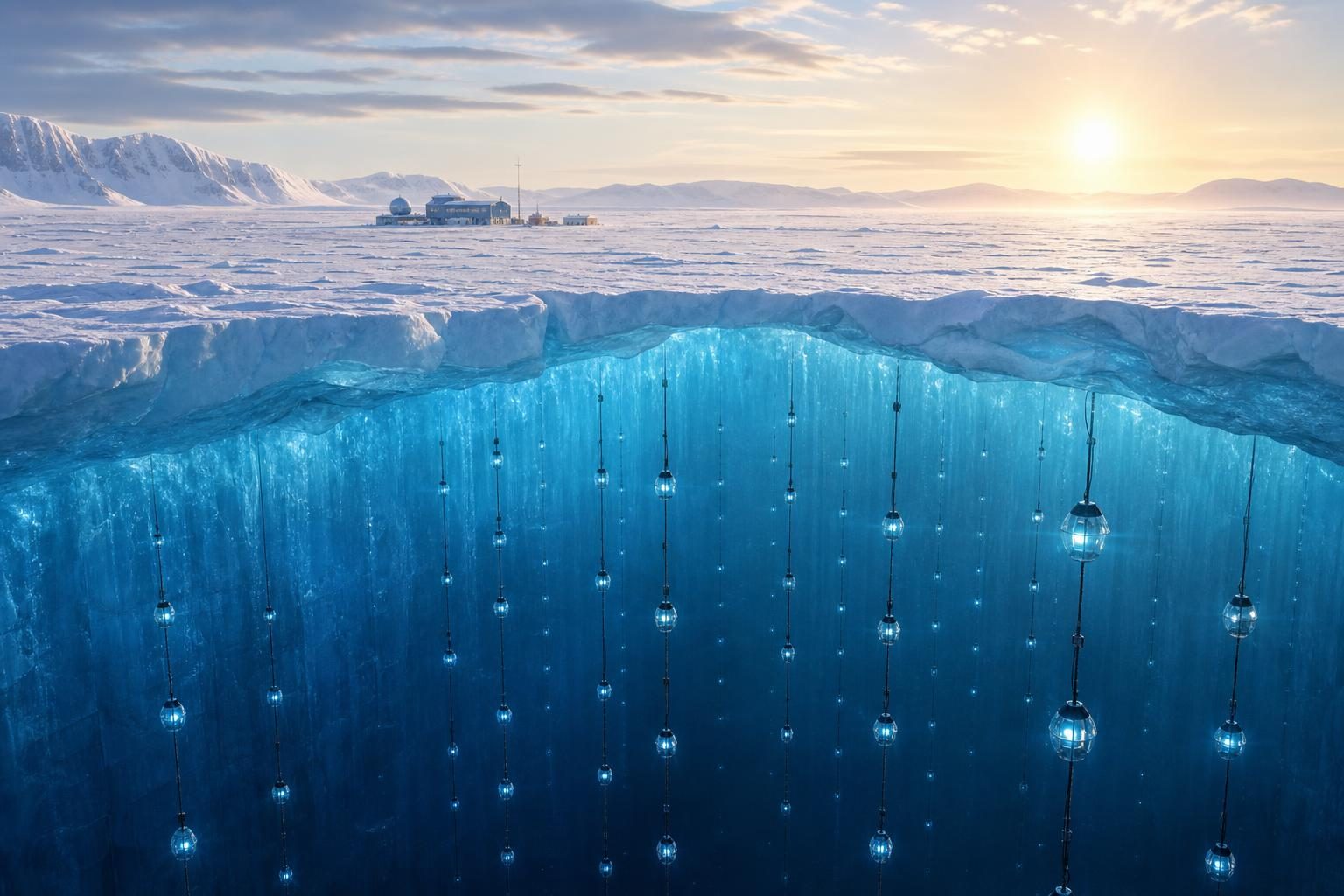
The 2026 Nobel Prize in physics has turned attention to one of the strangest worksites on Earth: the IceCube Neutrino Observatory at the South Pole. According to an essay in The Conversation by an astrophysicist on the IceCube team, physicist Francis Halzen received the Nobel for leading the project and for the discovery of high-energy neutrinos that come from astrophysical sources, meaning objects or events in space.
IceCube is called a telescope, but it does not look like the kind that sits on a tripod or inside a dome. It uses a cubic kilometer of Antarctic ice as part of the detector. A detector is an instrument system built to notice and measure something that people cannot sense directly. In this case, the thing being measured is a neutrino, a tiny subatomic particle that almost never interacts with ordinary matter. That is why neutrinos are sometimes nicknamed ghost particles.
The reason scientists care about these particles starts with cosmic rays. Cosmic rays are high-energy particles, including protons and atomic nuclei, that arrive at Earth from space. The article says more than 10,000 high-energy particles strike every square meter of Earth’s atmosphere each second. Some carry more than a million times the energy of protons in the Large Hadron Collider, the major particle accelerator at CERN in Europe. Earth’s atmosphere absorbs most of them, but cosmic rays are difficult to trace back to their original sources because magnetic fields in space bend their paths.
Neutrinos can help solve that problem because they travel differently. If a cosmic event accelerates particles, neutrinos may be produced along the way. Since neutrinos rarely interact with matter, they can move across the universe without being deflected much. That makes them useful messengers. The job of IceCube is to catch the rare moment when one of those neutrinos smashes into a proton or neutron inside the ice. That collision releases a shower of other particles, including high-energy electrons and photons. Photons are particles of light. Sensors can detect that shower and help scientists estimate the neutrino’s direction, energy, and type.
The work behind that measurement is not just theory. The IceCube team began building the observatory in 2005 and still operates it. The detector is designed to run mostly by remote control, but the article makes clear that some jobs still have to be done in person: maintaining and replacing electronics, installing new hardware, and upgrading instruments. Those are familiar categories of technical work. A system can be world-famous and still depend on connectors, circuit boards, power, data links, and hardware that must survive an extreme environment.
The South Pole is a hard place to staff and supply. Travel from the United States usually takes a week or more. The final flight is on a ski-equipped LC-130 cargo aircraft operated by the Air National Guard, landing on compressed snow. Those planes can reach the pole only during about four months of the year. By March, temperatures fall too low for the aircraft to operate there. That means the maintenance calendar is not flexible in the way it might be at a factory, hospital, dealership, or utility shop back home. If parts, tools, or people are not in place during the summer window, the next chance may be a long way off.
After the summer season, IceCube is handed to two winter-over scientists. They are part of a group of 45 people who remain at the station for the rest of the year, cut off from travel for eight months except for internet and radio communications. In summer, the station population grows to about 150. The place is a high-altitude desert with thin, dry air. Fuel is expensive because it must be brought in, so heated space is limited. Fuel is also needed to melt water, so showers are rationed. The sun stays up for six months and then disappears for six months, which can disrupt sleep and judgment.
For a career and technical education classroom, the important point is that advanced science creates advanced trade problems. The article does not list job postings or required certifications for IceCube, so it would be wrong to claim a single hiring path. But the work described points to several real competencies: electronics maintenance, hardware installation, instrument upgrades, remote operations, aircraft-supported logistics, and the ability to follow procedures when help is far away. The workforce includes scientists and students, but the success of the observatory also depends on practical systems thinking.
IceCube also shows how the meaning of “worksite” is changing. A telescope can be a billion tons of ice. A maintenance visit can require international travel, military cargo aircraft, and a narrow weather season. A technician-minded person looking at this project should not see science as separate from skilled work. The discovery may be about particles from space, but the job is also about keeping a complicated instrument alive in a place where ordinary shortcuts do not exist.
Written from reporting by The Conversation, “I’m a physicist who worked on the Nobel-winning neutrino search – here’s how a cubic kilometer of Antarctic ice became a telescope for ghost particles from space”.
Discussion questions
- If you were staffing a remote research facility like IceCube, would you prioritize deep specialists or workers with broader cross-training, and why?
- What trade-offs come with building scientific equipment in an extreme location instead of a more accessible place?
- The article does not give a clear hiring pathway for this kind of work; what information would someone need before deciding whether to pursue it?