
Old Weather Logs Become New Climate Data
Researchers turned fragile paper records from the Congo Basin into evidence of rising heat and changing rainfall.
Print it — all four files
The student packet has no answers in it. The teacher copy is the same pages plus a note on each question and the answer keys. Both languages carry the same story, the same picture and the same vocabulary.
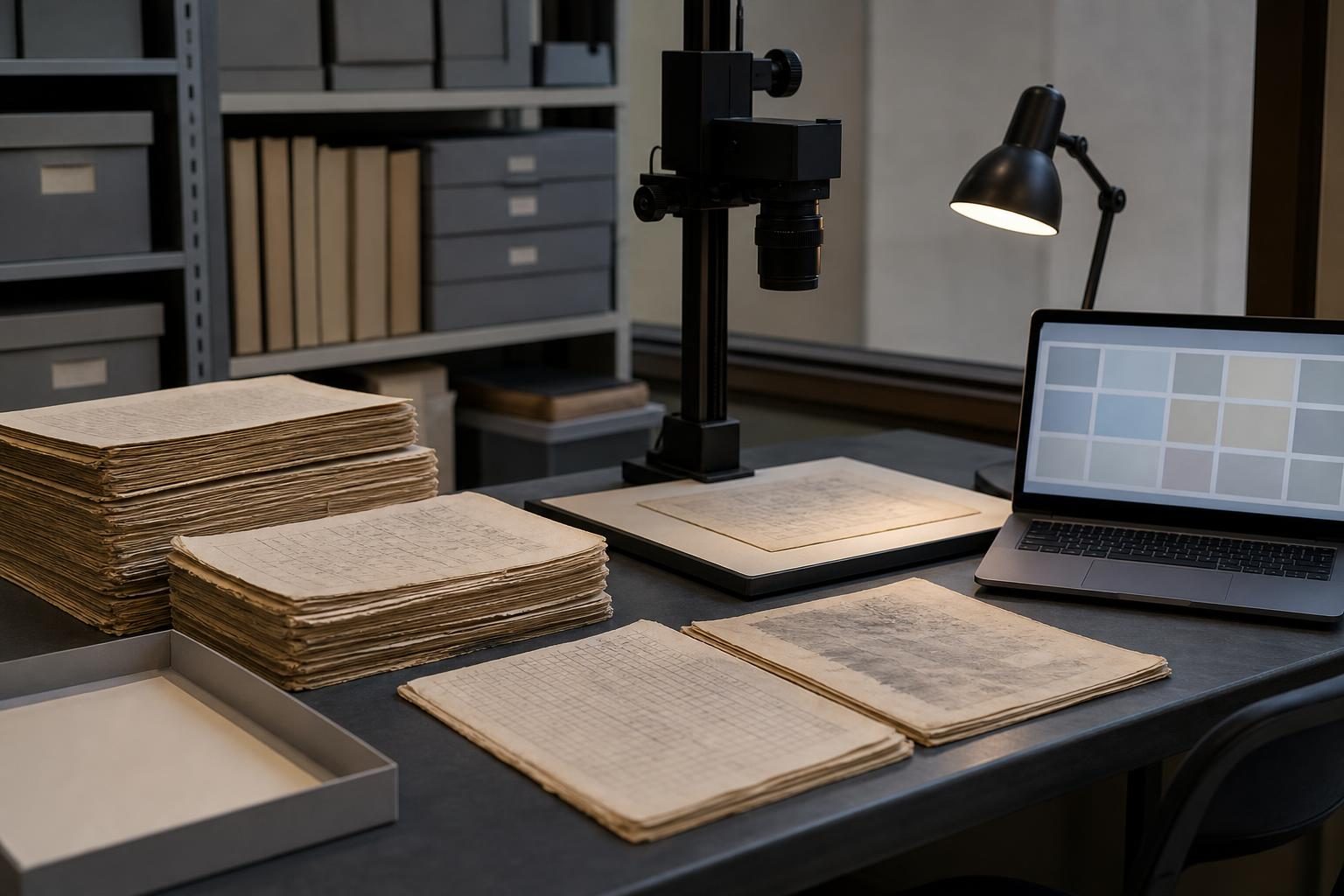
Researchers have turned thousands of handwritten weather records from the Democratic Republic of the Congo into a digital climate database, and the results show that hot days in the Congo Basin became nearly twice as common from the 1960s to the 1980s. According to Phys.org’s report on research led by Vrije Universiteit Brussel and published in the journal Earth System Dynamics, the project used records from the paper archives of INERA, the Institut National pour l’Etude et la Recherche Agronomiques, in Yangambi, DRC, and the State Archives of Belgium.
The basic job sounds simple: find old sheets of weather observations, photograph them, and move the information into spreadsheets. In practice, it is a technical workflow. During two field campaigns in 2023, lead author Derrick Muheki worked with INERA staff and Ghent University to photograph more than 9,000 handwritten monthly sheets from 37 weather stations across the DRC. Those sheets held daily and sometimes subdaily observations, meaning some measurements were taken more than once in a day.
The team then used MeteoSaver, open-source software developed by Muheki with the UGent Centre for Digital Humanities, to automatically transcribe the observations into digital spreadsheets. Open-source software is code that can be inspected, reused, and improved by others, which matters when researchers want public trust in how data are handled. The finished database contains more than 1 million weather observations. Together with earlier rescued data, it is now one of the largest climate datasets for the Congo Basin, a region the article says had been overlooked by many researchers.
This is called data rescue. In climate science, data rescue means saving older observations that exist on paper, film, magnetic tape, or other aging formats before they are damaged or lost. It is not just scanning for storage. The information has to become machine-readable, which means software can sort it, compare it, and use it in calculations. A paper page can show what one station recorded on one day. A clean spreadsheet can help reveal a pattern across decades.
The pattern matters because Central Africa has had fewer long-running, digitized climate records than many other regions. Without observations from the past, scientists have a harder time measuring how much local climate has changed or checking whether climate models match reality. A climate model is a computer simulation that estimates how the atmosphere, land, and water systems may behave. Models are useful, but they need real measurements to test them. The new database gives researchers more evidence from a place where the evidence had been thin.
The findings are specific. The research documented a clear warming signal across the Congo Basin since the 1960s. Annual hot days nearly doubled from the 1960s to the 1980s. Mean temperatures rose about 0.5°C during 1961–1990, and longer records showed continued warming into the 2000s. The team also studied past rainfall from three weather stations and found that heavy rainfall events doubled at two of them in the 1980s compared with the 1960s. The article connects these trends to global increases in extreme weather linked to rising temperatures from continued fossil fuel emissions.
For a CTE classroom, the work behind the headline is as important as the headline itself. This project needed people who could handle archives, protect fragile documents, operate cameras in a field setting, organize files, build software, manage spreadsheets, and understand weather observations. It also needed collaboration across institutions and countries. A person doing this work would not only need to be careful with equipment; they would need to understand chain of custody, which means knowing where a record came from and how it was handled so the final data can be trusted.
The hiring path for work like this can vary. Some workers enter through university research, but the skills overlap with jobs in records management, GIS, environmental technology, data processing, software development, and laboratory or field technician work. GIS, or geographic information systems, uses location-based data to analyze places and patterns. Even when the article does not describe a map, weather stations are location-based, so the accuracy of station records matters. Employers in these fields often care about attention to detail, file naming, version control, metadata, and basic coding or spreadsheet ability. Metadata means information about the data, such as where a measurement was taken, when it was recorded, and what instrument or station produced it.
The project also shows how technology changes a job without removing the need for human judgment. Automatic transcription can speed up work that would take people years to type by hand, but someone still has to decide which records are worth rescuing, photograph them clearly, verify that the software output makes sense, and explain what the numbers mean. In this case, a fragile archive became evidence that can improve climate history and future planning for a region already affected by climate change. The result is a reminder that some of tomorrow’s technical jobs will start with yesterday’s paperwork.
Written from reporting by Phys.org, “Rescued weather records reveal hot days became nearly twice as common in the Congo Basin over two decades”.
Discussion questions
- If a research team has limited money, should it prioritize rescuing old paper records or installing new weather stations? Defend your choice and explain the trade-off.
- Automatic transcription made this project faster, but what parts of the work should still require human review, and why?
- How could the skills used in this project transfer to a local workplace such as a hospital, utility company, city office, or construction firm?