
A Comet, a Meteor, and a Sky Trick
A new NASA sky photo shows two bright visitors that look close, but are really far apart.
Print it — all four files
The student packet has no answers in it. The teacher copy is the same pages plus a note on each question and the answer keys. Both languages carry the same story, the same picture and the same vocabulary.
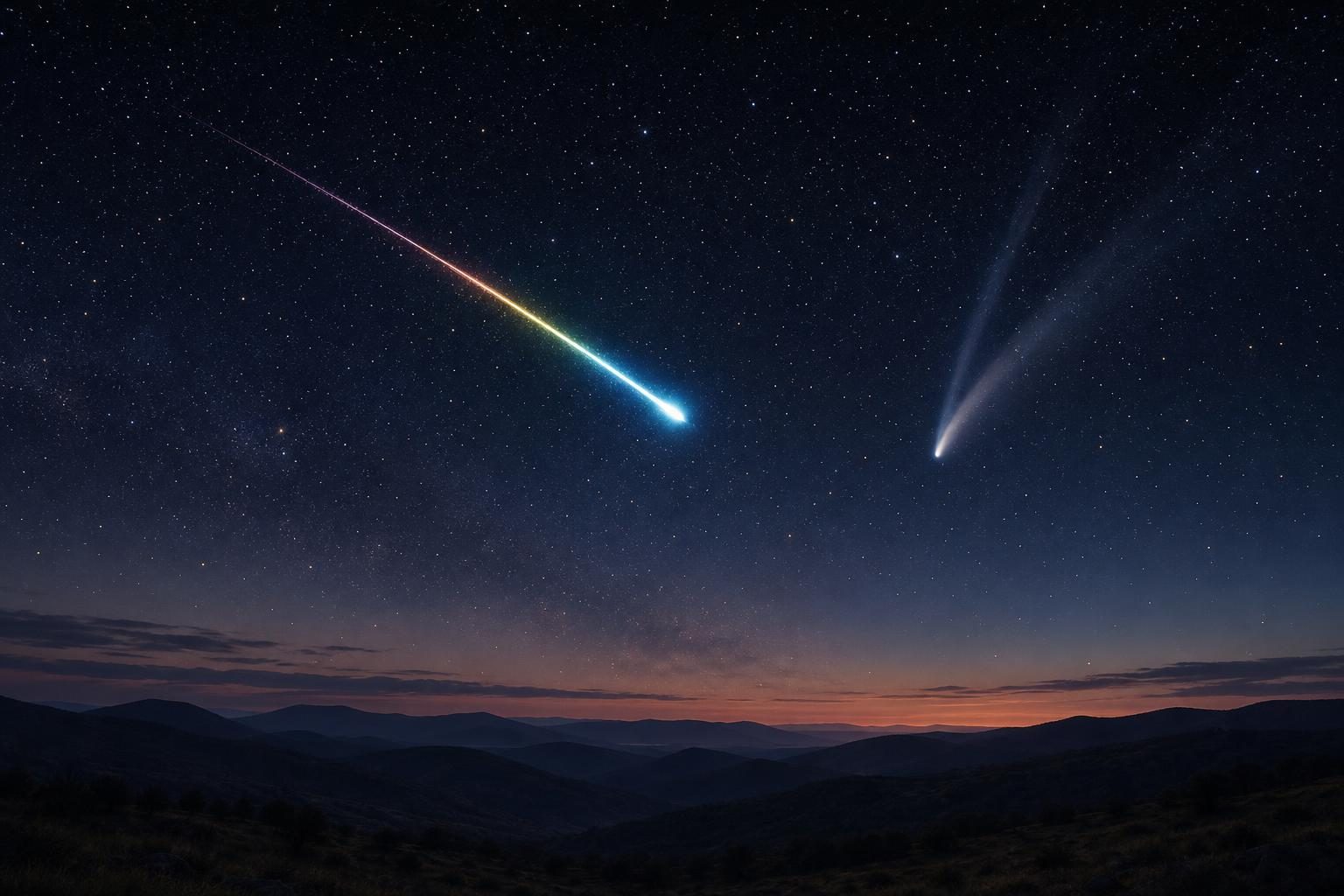
NASA shared a sky photo today with a comet and a colorful meteor in the same view, according to NASA’s Astronomy Picture of the Day. At first, the meteor looks like it might have come from the comet. NASA says it probably did not.
That is the interesting part. A comet is a giant icy body that travels around the Sun. It can leave dust and small rocks behind. A meteor is the bright streak we see when a small bit of space rock burns in Earth’s atmosphere. The atmosphere is the blanket of air around Earth.
In the photo, the comet is far behind the meteor. They only look close because the camera sees them in the same direction. It is like holding a finger near your face so it seems to touch the Moon. Your eye can line things up, even when they are not near each other.
The comet in the picture is called C/2025 R3, or PanSTARRS. It was photographed from Hautacam, France, in April. NASA says the comet had two tails. One was a blue ion tail. An ion is a tiny charged piece of an atom. The other was a dust tail, made from small bits left by the comet.
The meteor in the front was probably made by rocky debris about the size of sand. Its colors may give clues about what it was made of. Scientists call that its composition, which means the materials inside it.
The photo matters because November is a busy month for meteor watching. NASA says three notable meteor showers will peak this month. A meteor shower is a time when many meteors seem to come from one area of the sky.
The Southern Taurids are reaching their peak over the next few days. The Northern Taurids will peak about a week later. Both come from dust left by Comet 2P/Encke. The Leonids, November’s famous meteor shower, will peak in about two weeks. Those meteors come from Comet 55P/Tempel-Tuttle.
The picture is also a reminder that space can fool our eyes. One streak may be close. One fuzzy visitor may be very far away. Both can share the same patch of sky for one quick photograph.
Written from reporting by NASA, “APOD: 2026 November 3 – Comet PanSTARRs and Rainbow Meteor”.
Discussion questions
- Why might a photo make two objects in space seem connected when they are not?
- Should scientists be careful about saying where a meteor came from? Why or why not?
- How could watching a meteor shower change the way someone thinks about Earth’s place in space?