
A Faraway World May Join Pluto's Family
Astronomers found a distant object that could become a new official dwarf planet.
Print it — all four files
The student packet has no answers in it. The teacher copy is the same pages plus a note on each question and the answer keys. Both languages carry the same story, the same picture and the same vocabulary.
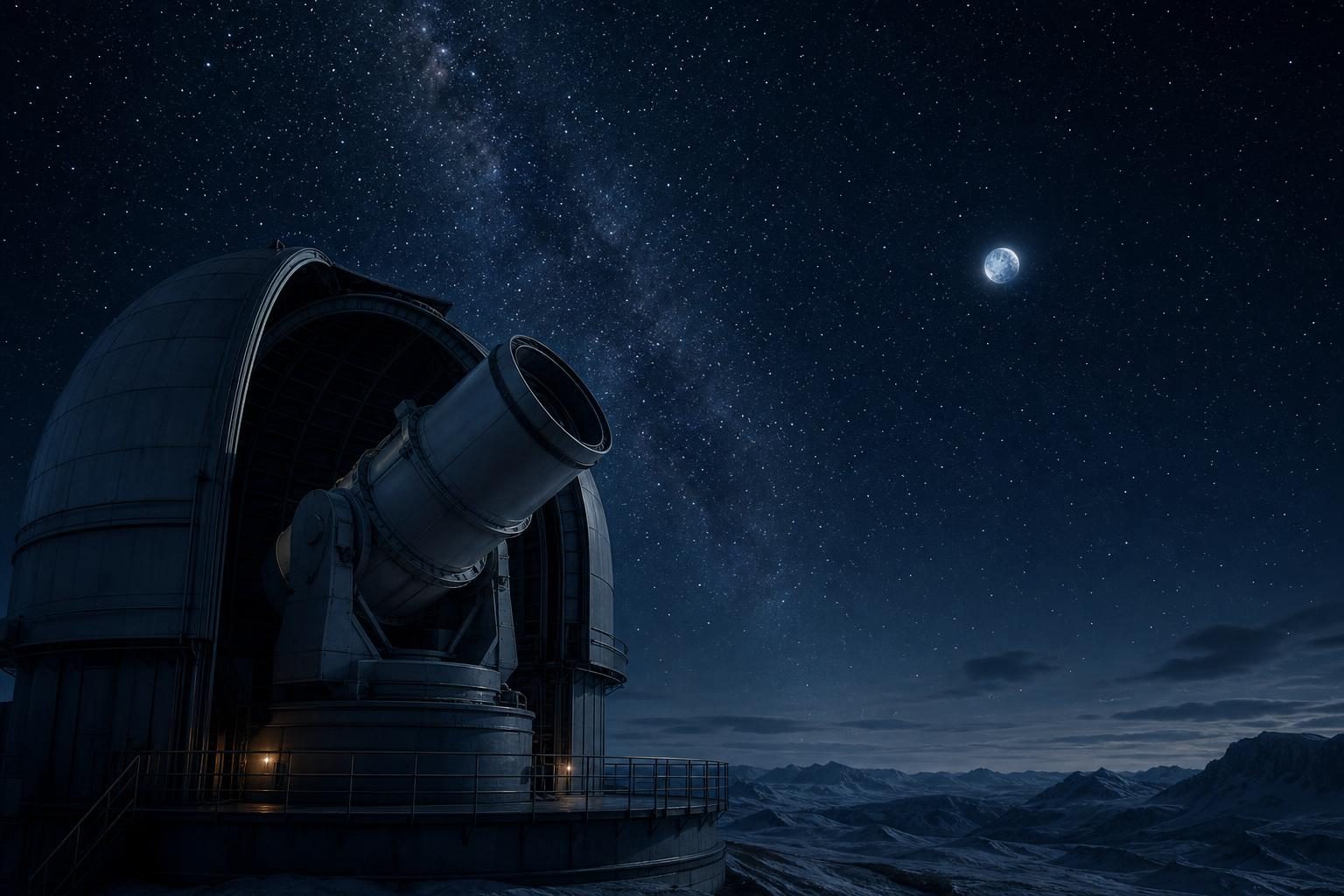
Astronomers may have found a small new world far beyond Neptune. According to reporting by Live Science, the object is called 2026 ED138. It was spotted by the Vera C. Rubin Observatory, a powerful telescope in Chile. If more observations confirm it, ED138 could become an officially recognized dwarf planet.
A dwarf planet is round like a planet, because its own gravity pulls it into shape. But it has not cleared its path around the sun. That means other objects still share its space. Pluto is the best-known dwarf planet. Scientists also count Ceres, Eris, Haumea and Makemake as official dwarf planets.
ED138 is hard to find because it is very far away. It orbits the sun about 46 times farther out than Earth does. From here, distant objects look dim. They also seem to move very slowly. This one was even harder to see because it sits near the bright band of the Milky Way. That is our galaxy, or giant group of stars.
The Rubin Observatory is built for this kind of hunt. Its camera images the whole southern sky every few nights. Then computer programs look for things that changed place or brightness. That can reveal a moving object in our solar system. It can also reveal a star explosion far away.
ED138 may be one of the largest bright objects found past Neptune. Scientists estimate its width from its brightness, its distance, and how shiny its surface may be. The estimate is still wide. ED138 could be smaller than Ceres, or more than half as wide as Pluto. Future observations should give a better size. They may also show whether ED138 is round enough for the dwarf planet list.
The place where ED138 travels is called the Kuiper Belt. It is a cold area beyond Neptune with many icy bodies. These objects are made from frozen materials and rock. Scientists study them because they can hold clues from the early solar system. They are like leftovers from when the planets formed.
This discovery also shows how new tools can change what people notice. ED138 was not nearby. It was not quick. It was hidden in a busy part of the sky. But Rubin will scan again and again for ten years. That means more quiet, faraway worlds may soon come into view.
Written from reporting by Live Science, “Bright object beyond Pluto may be the solar system's sixth dwarf planet”.
Discussion questions
- Should scientists talk about a possible dwarf planet before they are completely sure? Defend your answer.
- What are the benefits and risks of using computers to search the sky for hidden objects?
- Why might a cold, faraway object be worth studying, even if people may never visit it?