
Venus Shows Its Bright Horns in the Evening Sky
NASA’s daily space image shows why Venus can look like a tiny crescent, not a round dot.
Print it — all four files
The student packet has no answers in it. The teacher copy is the same pages plus a note on each question and the answer keys. Both languages carry the same story, the same picture and the same vocabulary.
NASA shared a new sky image today showing Venus as a thin, glowing crescent. According to NASA’s Astronomy Picture of the Day, the bright planet can look a little like a tiny Moon.
This happens because Venus has phases. A phase is the shape we see when sunlight hits part of an object in space. The Moon has phases, such as crescent, half, and full. Venus can show phases too.
In the image, Venus was almost in a straight line between Earth and the Sun. That kind of lineup happens for Venus about once every year and a half. It is a little like the lineup during a new Moon.
But a new Moon is hard to see. The lit side faces away from Earth. Venus is different because it has an atmosphere. An atmosphere is a layer of gases around a planet.
Sunlight passes through the edge of Venus’s atmosphere. The light bends and spreads there. Scientists call that bending refraction. They call the spreading scattering. Together, these effects make the crescent of Venus glow.
The glow can stretch farther than a half circle. The two bright tips are called the horns of Venus. They are not real horns, of course. They are the bright ends of the crescent shape.
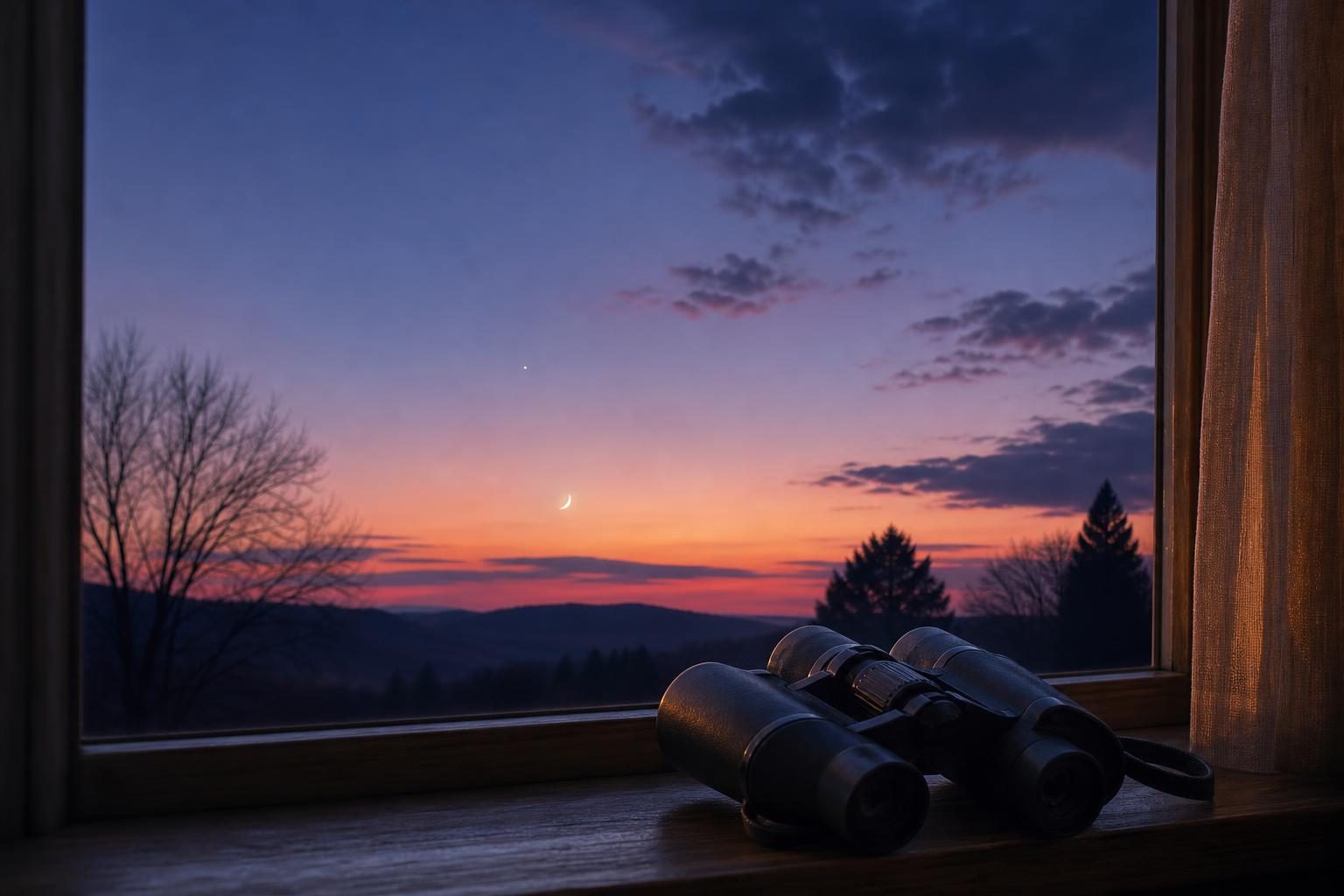
A person looking at twilight might see only a bright dot. Twilight is the time after sunset or before sunrise, when the sky is not fully dark. With binoculars or a small telescope, Venus can show its crescent shape. NASA says some people with very sharp eyesight may see it without tools.
Long ago, sky watchers noticed Venus changing brightness. NASA says ancient Babylonian astronomers may have studied these changes. Other cultures kept records too, including the Maya.
That makes the picture more than a pretty view. It shows how careful looking can turn a dot in the sky into a clue. The same planet can seem simple from far away and surprising through the right tool.
Written from reporting by NASA, “APOD: 29 October 2026 – The Horns of Venus”.
Discussion questions
- Is a telescope or binoculars more like a toy, a tool, or both in this story? Defend your answer.
- Why might ancient people have thought Venus was important enough to watch and record?
- If a class could observe only one object at twilight, should it choose the Moon or Venus? Explain the trade-off.