
A Space Delivery Is Getting Ready for Launch
NASA says Dragon will carry food, tools, power parts, and science experiments to the International Space Station.
Print it — all four files
The student packet has no answers in it. The teacher copy is the same pages plus a note on each question and the answer keys. Both languages carry the same story, the same picture and the same vocabulary.
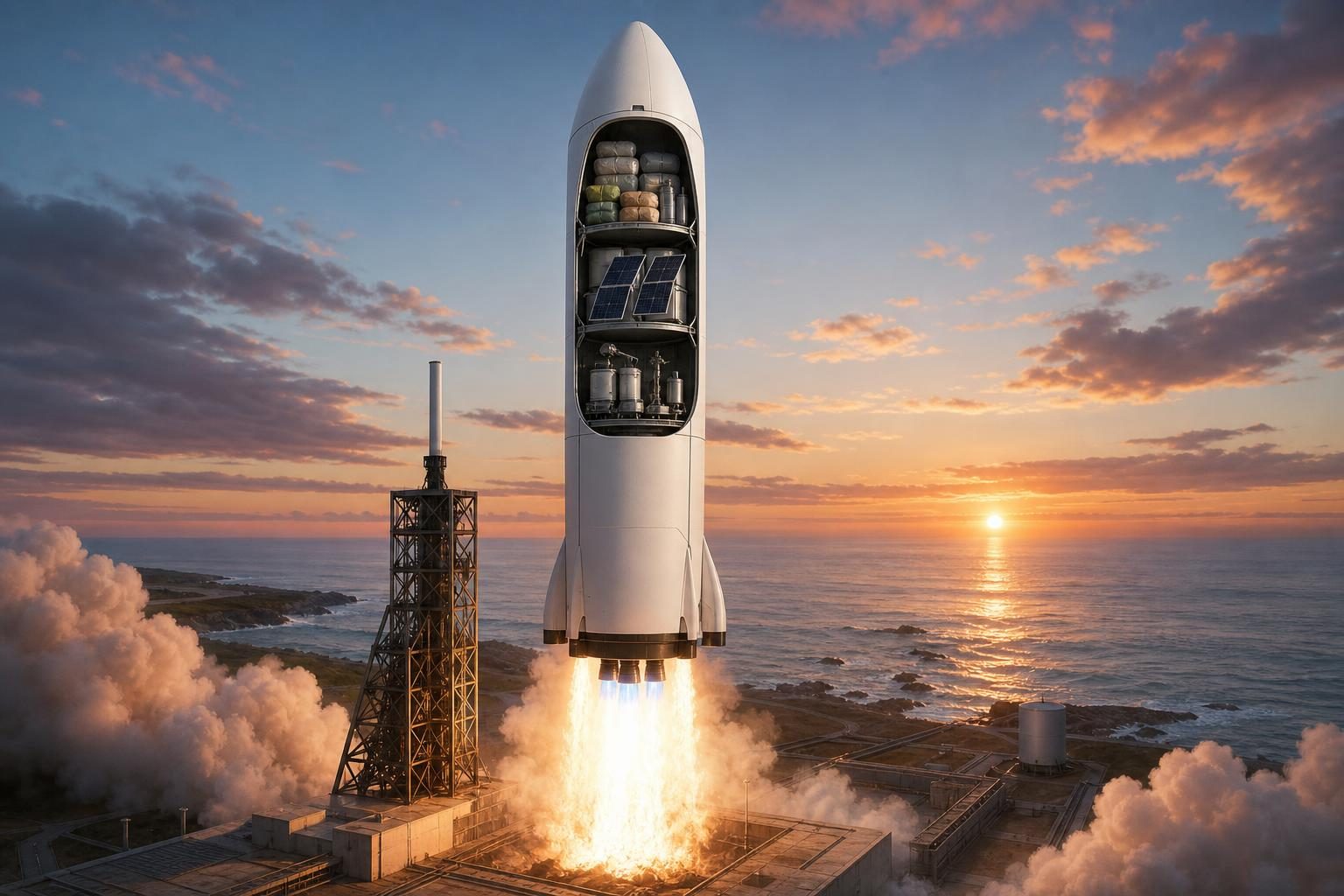
NASA announced a planned cargo trip to the International Space Station, according to a NASA news release. The station is a science lab that orbits Earth. SpaceX plans to launch a Dragon spacecraft no earlier than October. It will leave from Cape Canaveral Space Force Station in Florida on a Falcon 9 rocket.
This mission matters because a space station needs deliveries, just like a classroom or home. The Dragon will carry food, supplies, equipment, and science experiments. It is the 35th SpaceX cargo trip to the station for NASA.
People have lived and worked on the station for more than 25 years. They cannot run down the street for a missing part. Everything must arrive by spacecraft. A cargo launch is like sending a careful care package into orbit.
Some items will help keep the station working. Dragon will bring the final sets of new solar arrays. Solar arrays are panels that catch sunlight and turn it into electricity. Astronauts will install them during future spacewalks. More power helps run the station and its experiments.
Other items are for research. Research means careful work to answer a question. Dragon will bring tools to make artificial retinas in microgravity. A retina is the light-sensing part at the back of the eye. Microgravity means things seem almost weightless. NASA says this work could help restore vision for patients on Earth.
The spacecraft will also bring 3D heart cell models. These are tiny groups of heart cells grown for study. Scientists can use them to learn about testing medicines on future space missions. Dragon will carry materials for studying how a new kind of glass forms in microgravity. It will also bring brain organoids. These are small groups of brain-like cells grown in a lab. They may help scientists look for treatment targets for diseases such as Alzheimer’s and Parkinson’s.
Imagine watching the launch from a safe viewing area. The rocket is not just carrying boxes. It is carrying lunch, tools, electricity parts, and questions. Each item was chosen because space is hard to reach. On the station, one delivery can help people work, live, and learn far above Earth.
Written from reporting by NASA, “NASA Invites Media to SpaceX’s 35th Resupply Launch to Space Station”.
Discussion questions
- If the spacecraft had less room than planned, what kind of cargo should come first: crew supplies, station power parts, or science tools? Defend your choice.
- Do you think doing experiments in microgravity is worth the extra trouble of sending them to space? Why or why not?
- How is the space station like a school science lab, and how is it different in ways that matter?