
A health adviser exits as food-policy promises stall
Calley Means' resignation highlights a fight over how far government should go to change what Americans eat.
Print it — all four files
The student packet has no answers in it. The teacher copy is the same pages plus a note on each question and the answer keys. Both languages carry the same story, the same picture and the same vocabulary.
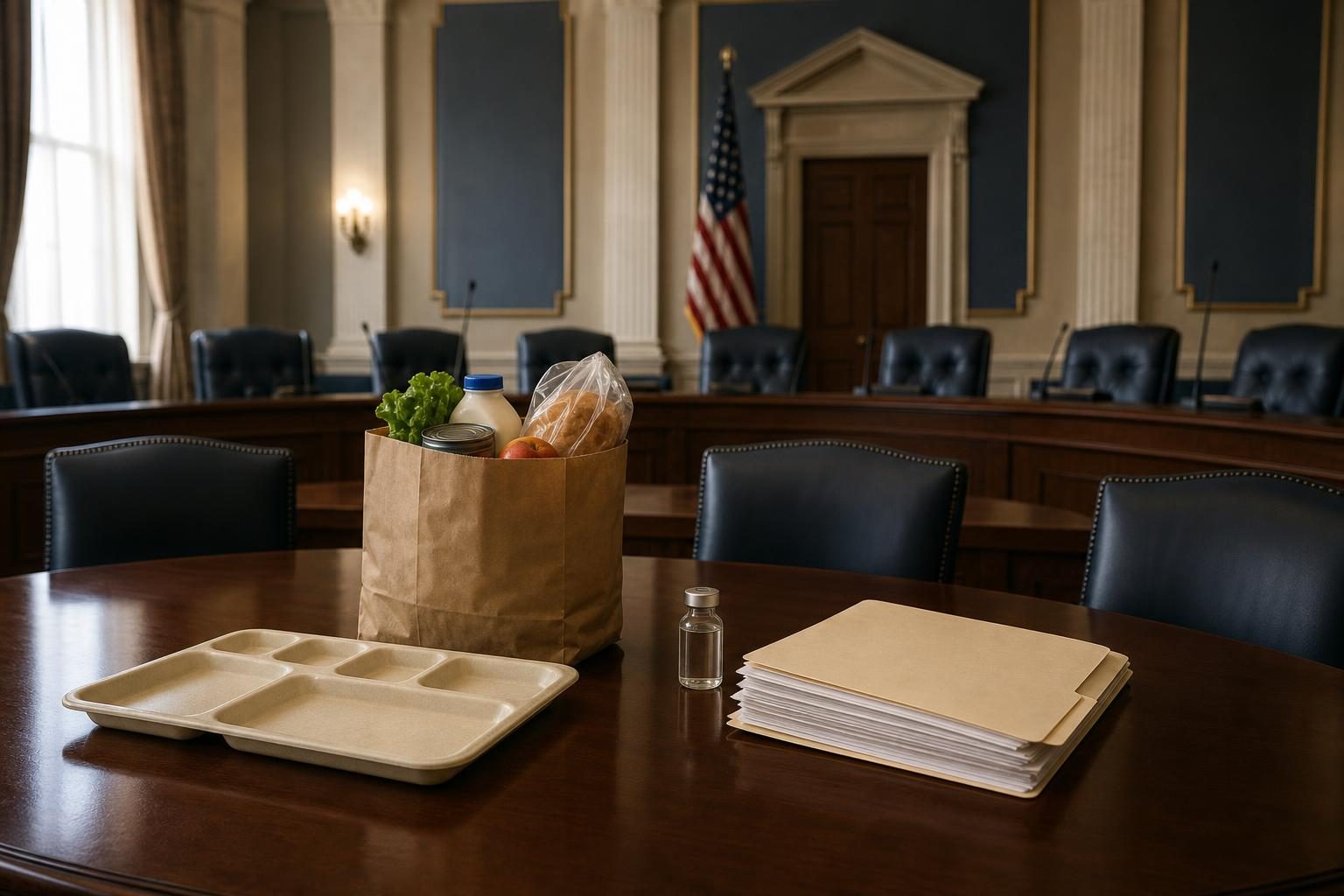
Calley Means, a top adviser to Health Secretary Robert F. Kennedy Jr. and a leading voice in the Make America Healthy Again movement, resigned from the Trump administration on Thursday, according to Associated Press reporting published by PBS NewsHour. Means did not give a reason for leaving. His departure comes as some supporters of the movement have grown frustrated with what they see as slow progress on promises to change food policy and confront chronic disease.
The story matters because it is not only about one aide leaving a government job. It shows a larger argument over what public health policy should do when many Americans are worried about diet-related illness, corporate influence and trust in government agencies. The Make America Healthy Again movement, often shortened to MAHA, has argued that the country should focus more aggressively on causes of long-term illness, including ultraprocessed foods, additives and pesticides. Ultraprocessed foods are packaged products made with industrial ingredients and manufacturing steps that go far beyond ordinary cooking, though exactly where to draw that line is part of the dispute.
Means and his sister, wellness author and entrepreneur Dr. Casey Means, became well known in the movement by arguing that the food system is a major driver of poor health. Inside government, Calley Means used his role to criticize major physician groups, federal agencies and government scientists, saying they often protected their own interests. Supporters saw that as needed pressure on institutions they distrust. Critics of that style of politics would likely ask whether attacking public-health institutions makes it harder to build credible rules that can survive scientific and legal scrutiny.
The most immediate tension is between bold promises and the slow machinery of government. Kennedy had promised a first-ever government definition of ultraprocessed food in April. That definition did not arrive. Instead, the Food and Drug Administration’s acting commissioner, Kyle Diamantas, told a conference that defining the category is difficult. In August, Kennedy staff again suggested a major announcement was near. The announcement that followed focused on a proposal for closer scrutiny of food additives and only briefly mentioned ultraprocessed foods.
That delay may sound like bureaucratic foot-dragging, but definitions matter. If the government says a certain category of food should be regulated, labeled or discouraged, companies, schools, stores and consumers all need to know what is included. A rule that is too vague can be hard to enforce. A rule that is too broad can sweep in foods that people rely on because they are cheap, shelf-stable or convenient. A rule that is too narrow may leave out products that public-health advocates believe are part of the problem.
There is also a political trade-off. AP reported that Means often clashed with senior White House officials who worried about alienating the powerful food industry. That is a familiar conflict in regulation: one side argues that government should protect the public even if major businesses object; the other worries that fast or sweeping rules could raise costs, disrupt supply chains, or provoke a fight that prevents any policy from passing. Food companies are not the only interested parties. Farmers, grocery stores, school meal programs and families with limited budgets can all be affected by changes in food rules.
The movement itself is not united on what should come first. Means’ focus was food: additives, pesticides such as glyphosate, a widely used weed killer, and ultraprocessed products. Other MAHA figures wanted Kennedy to focus more on medical freedom, a phrase they use for reducing government pressure or requirements around medical choices. For many in that camp, AP reported, the priority meant rolling back federal recommendations and approvals for vaccines. That creates a split between people who want the movement to spend its political capital on food regulation and people who want it to confront the medical establishment more directly.
Supporters of Means praised his work after the resignation. Kelly Ryerson, a health activist connected to the glyphosate issue, said he fought the food battle despite obstacles from corporate interests. Zen Honeycutt, founder of Moms Across America, said he pushed for healthier food in schools. Those reactions show why Means mattered to activists: he represented a link between outside pressure campaigns and the federal agencies that can actually write rules.
Still, a resignation does not prove that food-policy reform is over, or that it was succeeding. It does show how hard it is to turn a broad slogan about health into specific government action. To change food rules, officials have to decide what evidence counts, how to define categories, how to handle industry resistance and which faction of their own coalition to satisfy first. The disagreement is not simply whether Americans should be healthier. It is about who gets to define the problem, which risks deserve priority and how much power the federal government should use to change the food system.
Written from reporting by PBS NewsHour, “RFK Jr. adviser Calley Means resigns amid growing MAHA discontent over lack of progress”.
Discussion questions
- If the government wants to act on ultraprocessed foods but experts disagree on the definition, should officials move quickly with an imperfect rule or wait for a more precise one?
- How should policymakers balance public-health goals against the economic power and practical role of the food industry?
- When a political movement contains different priorities, such as food regulation and medical freedom, who should decide which goal comes first once the movement gains power?