
Airport ICE arrest raises questions about enforcement tactics
A Seattle airport detention shows the clash between immigration enforcement, public safety, and passengers' rights in shared spaces.
Print it — all four files
The student packet has no answers in it. The teacher copy is the same pages plus a note on each question and the answer keys. Both languages carry the same story, the same picture and the same vocabulary.
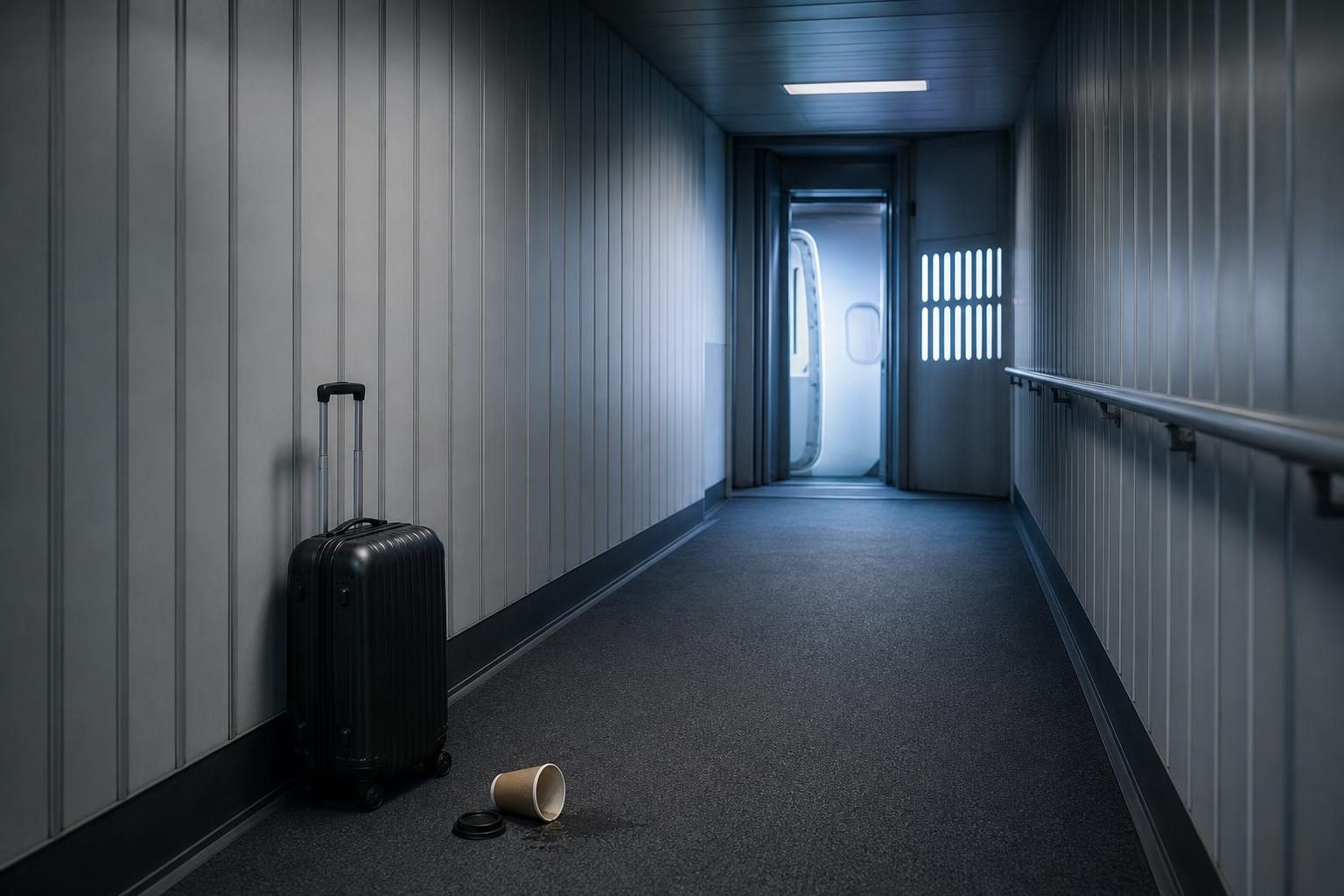
Masked immigration officers detained a father and daughter on a jet bridge at Seattle-Tacoma International Airport as they were boarding a flight to Los Angeles, according to reporting by the Associated Press published by PBS NewsHour. Their lawyer said they were traveling to California for a family baptism. Other passengers recorded the confrontation on cellphones, and the videos spread widely online. The flight was delayed, and the scene drew questions from the airline, airport officials, and local leaders about how immigration arrests should happen in crowded public travel spaces.
The case matters because it is not only about one family. It raises a larger question: how should the government enforce immigration law when the place of enforcement is also a shared transportation system full of travelers who do not know what is happening? Immigration and Customs Enforcement, or ICE, is the federal agency that enforces immigration law inside the United States. ICE said it detained Ricardo Larrondo Mendoza, an immigrant from Mexico, because he had overstayed his visa. A visa is government permission to enter or remain in a country for a specific purpose or period of time; overstaying means remaining after that permission expires.
The family’s lawyer, Olia Catala, gave a different emphasis. She told the AP that the father and daughter have lived in the United States since 2015, are seeking asylum, and have no criminal record. Asylum is protection a country may grant to someone who says they cannot safely return to another country because of persecution. Catala also said the daughter, Sofia Hernandez Mejia, had married a U.S. citizen and filed paperwork to adjust her immigration status. Adjustment of status is a legal process that can allow some people already in the United States to apply for lawful permanent residence without leaving the country.
ICE said another passenger threw hot coffee on officers during the confrontation and identified that person as Mejia. The agency said she could face a charge of assaulting a federal officer. Catala said Mejia was carrying coffee when the confrontation happened and argued that, in a moment when people in unmarked clothing were moving toward her, a spilled cup should not be treated the same way as an attack. That disagreement shows one of the hard parts of evaluating a fast-moving public incident: the same physical event can look different depending on who is describing it, what happened just before it, and what the available video does or does not show.
The tactics are also contested. The officers were described as masked and wearing unmarked jackets and khaki pants, not standard uniforms that ordinary travelers would instantly recognize. For law enforcement, surprise and officer safety can be reasons not to announce an operation widely in advance. But in an airport boarding area, a sudden detention by people whose identity is not immediately clear can create fear, confusion, and the possibility that bystanders will react in ways that make the situation more dangerous. The lawyer said passengers did not know who the officers were; ICE said its officers were enforcing the law.
Alaska Airlines said ICE gave the airline no advance notice of the enforcement action, which took place during a busy travel weekend before Thanksgiving. The airline said it was working with the Port of Seattle, which manages the airport, to determine whether protocols were followed, and that it had raised concerns with the proper authorities. A protocol is an agreed-upon procedure for handling a situation. Airports depend on protocols because security, passenger flow, crew schedules, and emergency response all overlap in the same space. An arrest that might be legally authorized can still create practical safety questions for an airline and airport.
The Port of Seattle said the arrest was distressing for the family and for other passengers, and said local officials would speak with federal officials to understand what occurred. Washington Gov. Bob Ferguson also sharply criticized ICE’s tactics. ICE, for its part, said airport arrests have increased since the summer, especially against people the agency says overstayed visas. That means this incident may be part of a broader enforcement pattern, not a one-time misunderstanding. If airports become more common sites for immigration arrests, then the rules for how those arrests are carried out become more important.
There is no single simple issue here. The federal government has authority to enforce immigration law, and a visa system has little meaning if overstays are never addressed. At the same time, people in immigration proceedings may have pending legal claims, family ties, work histories, or other circumstances that do not fit neatly into a single label. Public arrests in crowded spaces can make enforcement visible, but visibility does not automatically create clarity. In this case, the unresolved question is not only what the law allowed ICE to do, but what a democratic society should expect from government power when it is used in front of everyone.
Written from reporting by PBS NewsHour, “Lawyer: Father and daughter detained by ICE at Seattle airport were traveling to family baptism”.
Discussion questions
- Should federal agents be required to coordinate with airlines or airport authorities before making an arrest in a passenger area, even if advance notice could make enforcement harder?
- When an official agency, a lawyer, and cellphone videos offer different views of the same incident, what evidence should the public treat as most reliable, and why?
- How should immigration policy balance enforcing visa rules with the circumstances of people who have pending legal claims, family ties, or long residence in the United States?