
Amazon Leaders Push UN to Treat Forest Crime as Global Crime
The fight over illegal mining and logging is also a fight over who gets power to protect Indigenous lands.
Print it — all four files
The student packet has no answers in it. The teacher copy is the same pages plus a note on each question and the answer keys. Both languages carry the same story, the same picture and the same vocabulary.
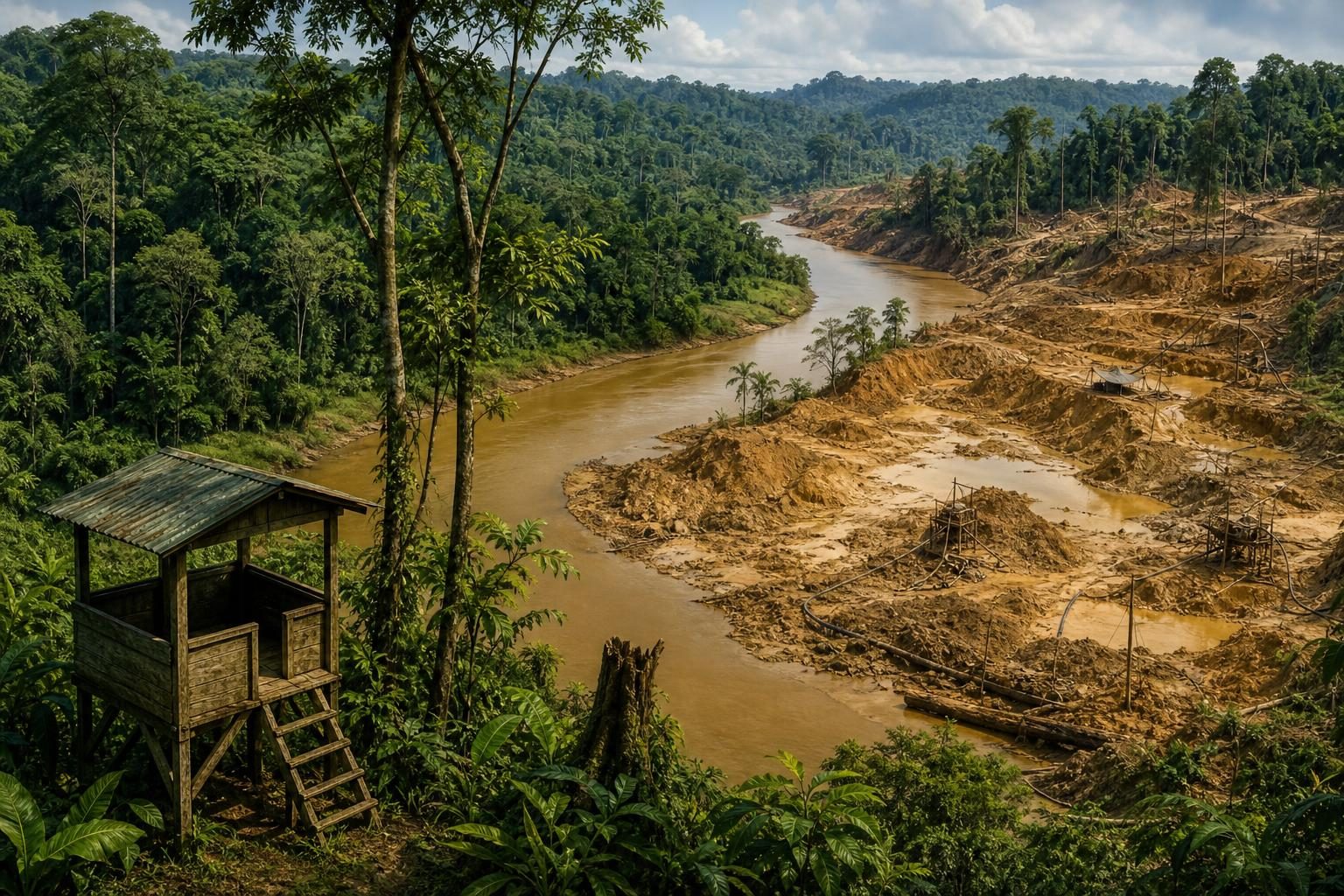
Indigenous leaders from several Amazon countries are taking concerns about illegal mining, logging, drug trafficking and deforestation to a United Nations conference in Vienna that begins Monday, according to Associated Press reporting published by PBS NewsHour. More than a dozen representatives from Peru, Brazil, Colombia and Ecuador plan to attend the Oct. 19-23 meeting on transnational organized crime, meaning criminal activity that crosses national borders or depends on networks in more than one country.
The leaders want governments to treat environmental crimes in the Amazon less like isolated local problems and more like organized international businesses. They argue that illegal gold mining, timber operations, drug production and wildlife trafficking are tied to money, weapons, intimidation and markets that extend far beyond the forest. Their proposal is not only about punishing people at a mine site or logging road. It is about following the money behind those operations and giving Indigenous peoples a stronger role in protecting ancestral territories, which are lands communities have lived on and governed through their own traditions over generations.
The issue matters because the Amazon is not just a distant rainforest. It stores carbon, produces rainfall patterns that affect large regions, and holds enormous biological diversity. It is also home to Indigenous nations whose food, water, culture and safety are tied to rivers and forests. When illegal gold mining releases mercury, a toxic metal used to separate gold from other material, that pollution can move through rivers used for drinking water and fishing. When illegal roads are cut through forests, they can open the way for more logging, mining or drug routes.
The Vienna conference brings together countries working under a U.N. treaty against organized crime. Governments are expected to consider whether to begin negotiations on a new protocol, which is an added agreement connected to an existing treaty, focused on crimes that damage the environment. Such a protocol could include illegal mining, illegal logging and wildlife trafficking. For Indigenous leaders, the key question is whether they will merely be discussed or actually included in shaping the rules.
That is where the main tension sits. Governments often respond to illegal mining or trafficking with raids, soldiers, police and seizures of equipment. Indigenous representatives and their allies are not saying enforcement is unnecessary. But they argue that temporary operations do not solve the larger problem if criminal groups return after authorities leave. They also say communities can be left in danger when enforcement focuses on short-term action instead of long-term protection, land rights and support for local monitoring.
Some Amazon communities are already building their own systems. In Peru, the Wampis have set up monitoring posts staffed by Indigenous guards to confront illegal mining. The article says each post has 14 guards. Leaders from the Kakataibo people, also in Peru, say drug traffickers have created illegal coca plantations and processing laboratories in ancestral forests; coca is the plant used in illegal drug production. In Brazil, Ashaninka leaders report pressure from illegal logging, drug trafficking and roads used to move illicit goods. In Colombia’s southern Putumayo region, Indigenous leaders say armed groups that once depended mainly on drug trafficking are increasingly turning to illegal mining, and that pollution can still reach Indigenous communities even when the mining happens upstream or outside their official territories.
The danger to environmental defenders is part of the case Indigenous leaders are making. The article cites Global Witness, an environmental and human rights group, which documented 124 killings of land and environmental defenders worldwide in 2025. It reported that 105 of those killings, or 85%, were in Latin America, with Colombia and Brazil recording the highest numbers named in the story. These numbers are not just statistics in the debate; they show why some communities argue that asking them to defend the forest without stronger legal protection is asking too much.
The U.N. Office on Drugs and Crime says it already works with Indigenous communities in Latin America, including a project in Brazil that helps communities monitor illegal gold mining and cooperate more closely with authorities. The agency also says the project has helped prepare a national system for detecting and responding to environmental crimes. But the article says the agency did not say whether Indigenous representatives would have a formal role in negotiating the possible new protocol.
That unanswered question is important. A treaty process run only by national governments might produce tougher language against environmental crime, but still leave Indigenous communities outside the room where decisions are made. On the other hand, governments may worry about how to balance local authority, national law enforcement and international agreements. The policy challenge is not simply whether the Amazon should be protected. Almost everyone in the story says it should be. The harder question is who should have power, resources and legal standing to protect it, especially when the threats are criminal networks that do not stop at borders.
Written from reporting by PBS NewsHour, “Criminal networks threaten the Amazon. Indigenous leaders want the UN to act”.
Discussion questions
- If environmental crimes in the Amazon are treated like transnational organized crime, what might improve, and what problems might that approach create?
- Should Indigenous representatives have a formal role in negotiating international rules about environmental crimes on their territories? Why or why not?
- When criminal groups damage land and rivers, is the most important response law enforcement, economic change, community control, or something else?