
Britain’s Food Story Was Never Just Roast Beef
New research on 18th-century royal meals shows cuisine shaped by migration, empire, fashion and wartime nationalism.
Print it — all four files
The student packet has no answers in it. The teacher copy is the same pages plus a note on each question and the answer keys. Both languages carry the same story, the same picture and the same vocabulary.
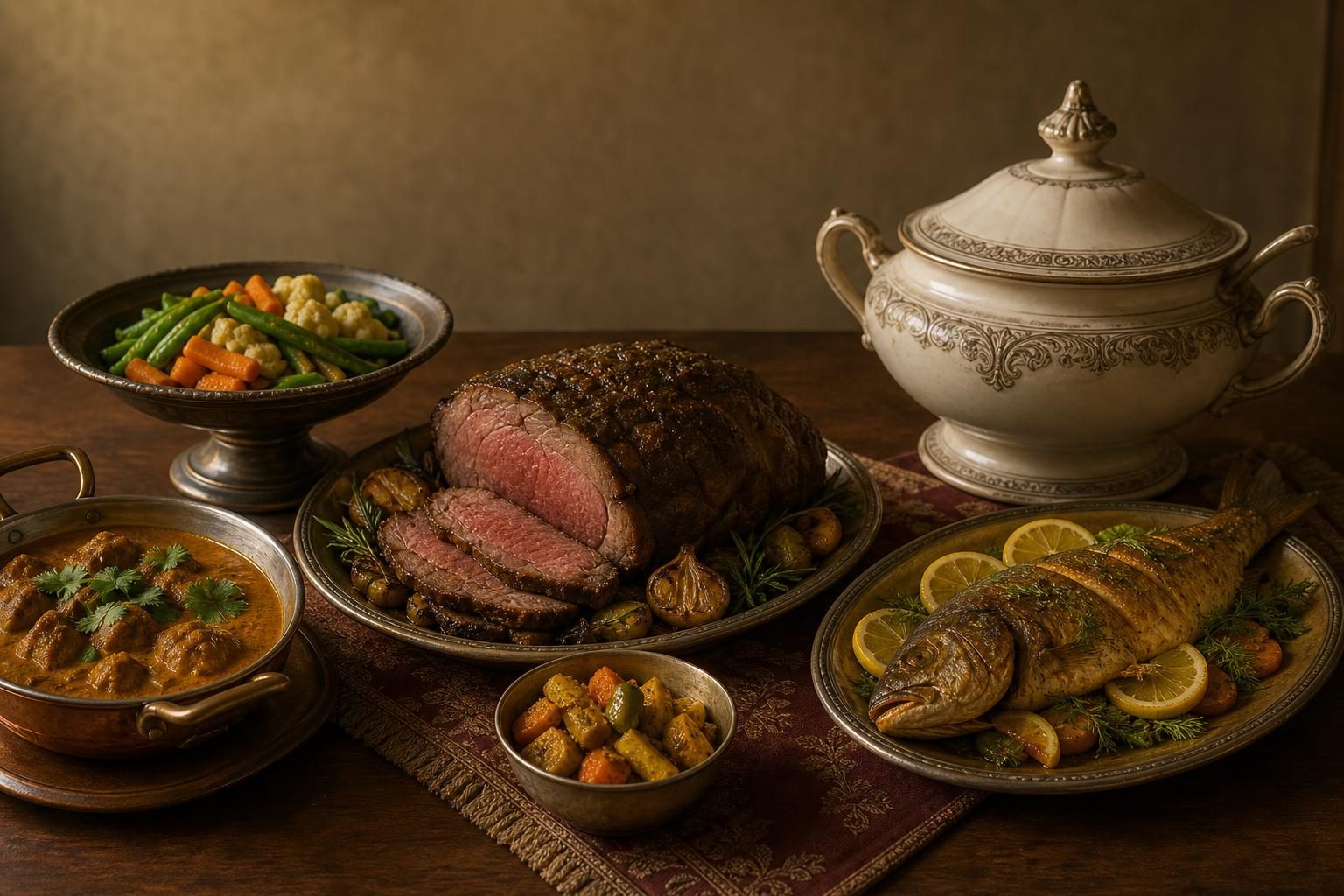
British food has a reputation problem: people often joke that it is bland, boiled or stuck on roast beef and pudding. But according to a Phys.org article about the book The King’s Dinner, researchers looking at Britain during the reign of George III found a much more complicated food culture. In the late 1700s and early 1800s, British tables, including royal ones, included vegetables from several continents, European imports, Indian-style pickles and curries, and luxury dishes tied to Britain’s expanding empire.
That matters because food is never just food. What a country calls its “national cuisine” can become a story it tells about itself. The research described by Phys.org suggests that the familiar image of old-fashioned British eating was built from several competing forces at once: local farming, migration, war, fashion, trade and colonial power. The tension is that this history can show Britain as more multicultural than its stereotype, while also showing how tastes from around the world were folded into British identity during an age of empire.
The researchers focused on the age of King George III, who ruled from 1760 to 1820. Account books for the royal household at Kew between 1794 and 1799 show that the king and his family regularly bought 32 kinds of vegetables and fruits. Some were long established in Britain, such as cabbage and artichokes. Others had traveled through global exchange: potatoes from the Americas, cucumbers from Asia and broccoli, originally from Italy. George III had been born in England, unlike earlier Hanoverian monarchs, who were born in Germany. His wife, Queen Charlotte, came from Mecklenburg-Strelitz, in what is now Germany. Their meals at Kew were heavier on fish and vegetables than the stereotype of British food might suggest, and resembled German eating habits in some ways.
Eighteenth-century Britain was also shaped by migration. Some people moved there after religious persecution or the French Revolution, and London shops sold foods from around Europe, including Parmesan cheese, olives, smoked sausages and even reindeer. During the Napoleonic Wars, when Britain and France were enemies, some people treated French food as politically suspicious. Yet fashionable Britons still liked French cuisine. That contradiction is one of the most interesting parts of the story: people could reject France as an enemy while still admiring French taste.
Indian-style food entered British cooking in another way. Recipes for curries appeared in the 18th century, helped by the return of employees from the East India Company, the powerful trading company that played a major role in British expansion in India. In 1810, Deen Mahomet, an Indian immigrant, opened the Hindostanee Coffee House, which served Indian-style food. It closed two years later, partly because another nearby business had already been serving curries for decades. The royal family does not seem to have eaten many curries, according to the article, but they may have eaten Indian-style pickles. One recipe involved hollowing out cucumbers or similar foods, stuffing them with spices associated with India, and preserving them in vinegar.
This is where the word “multicultural” gets complicated. On one hand, these foods show that British cuisine was not sealed off from the rest of the world. It was mixed, adaptive and influenced by people and ingredients moving across borders. On the other hand, many of those movements were connected to unequal power. Britain’s empire gave elites access to ingredients, recipes and symbols that came from colonized or economically dependent places. Calling the result simply “British” can hide the people and power relationships behind it.
Roast beef, meanwhile, became more than dinner. The article explains that during repeated wars with France in the 18th century, roast beef became a symbol of British abundance and strength. Political cartoons contrasted well-fed English figures eating beef with thin French figures eating poor or strange food. In other words, a dish became propaganda: it helped turn eating habits into a patriotic image. Even when food shortages grew by the 1800s, nostalgia for roast beef remained strong. In the royal household, roast meat was also common enough that servants ate it daily.
Another luxury dish, turtle soup, carried a different message. Turtles had to be kept alive on long sea voyages from the Caribbean, making the soup expensive and difficult to prepare. That cost helped make it fashionable. The Prince Regent enjoyed turtle soup in summer, and it appeared at major banquets and elite dining clubs. A cheaper imitation, mock turtle soup, was made from a calf’s head. Here again, food signaled status and imperial reach: eating turtle soup advertised that Britain’s wealthy could command goods from far away.
The trade-off in how to read this history is real. One interpretation celebrates the evidence that British food was more varied and international than many people assume. Another asks who got credit for that variety, who profited from it and who had the power to turn other people’s foods into symbols of British life. Both can be true. The same dinner table can show openness to outside influences and the inequalities that made those influences available.
Written from reporting by Phys.org, “British food was complex, multicultural and flavorful in the 18th century—despite what you might think”.
Discussion questions
- When a country absorbs foods from migrants, trade partners or colonized places, when should that be seen as cultural exchange, and when should it be seen as appropriation?
- Does learning that 18th-century British food was multicultural weaken national food traditions, or make them more accurate and interesting?
- Roast beef became a patriotic symbol during war with France; what are the benefits and risks of turning everyday things like food into national symbols?