
Court Keeps Mail Voting Rules in Place for Midterms
The Supreme Court blocked last-minute Postal Service limits, but the larger fight over who controls mail voting is not over.
Print it — all four files
The student packet has no answers in it. The teacher copy is the same pages plus a note on each question and the answer keys. Both languages carry the same story, the same picture and the same vocabulary.
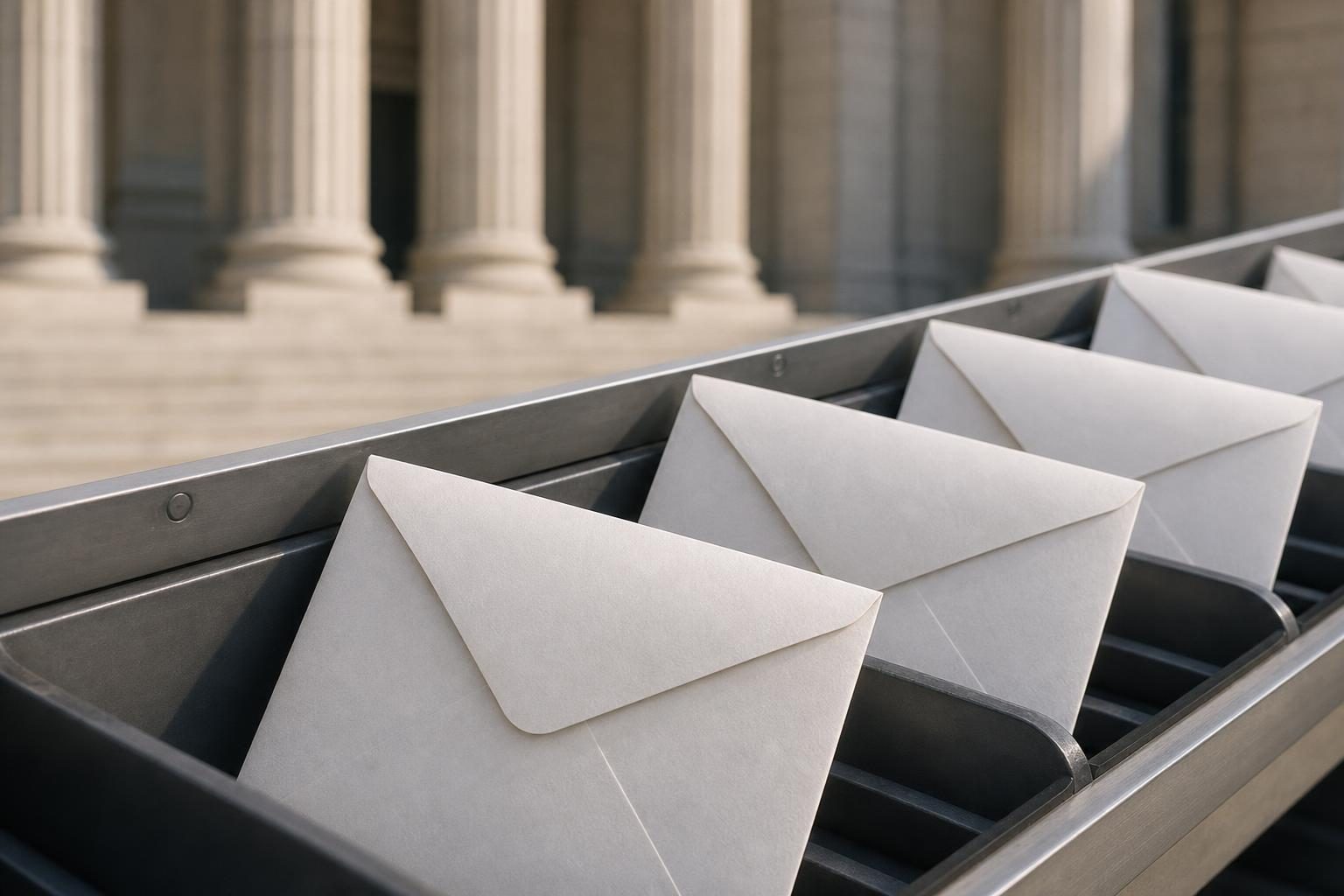
The Supreme Court on Monday rejected President Donald Trump’s request to let new Postal Service restrictions on mail ballots take effect before the November midterm elections, according to reporting by PBS NewsHour and the Associated Press. The order means states can keep using the mail-ballot systems they have used for years, even as voting is already beginning in some places. Midterm elections are the congressional elections held halfway through a president’s four-year term, and this year’s contests will decide control of Congress.
The administration’s plan would have required states to use a uniform envelope style for mail ballots and to submit lists of voters eligible to vote by mail into an online portal. If a state did not meet the requirements, the Postal Service could refuse to deliver those ballots. The practical effect would have been large: PBS reported that mail ballots have accounted for nearly a third of votes cast, and some states depend on them far more than others. Washington and Oregon, for example, conduct elections almost entirely by mail.
The timing was central to the case. Alabama, North Carolina and Wisconsin had already begun sending mail ballots to voters over the past week while the new system was not yet active. Election officials said there was no realistic way to redesign their procedures in the final weeks before the election. In Colorado and Washington, state officials said the ruling allowed election workers to continue using systems they had already prepared.
The administration argued that the federal government has authority over the Postal Service and therefore can set rules for how election mail is handled. Trump has repeatedly described mail voting as a threat to election integrity, even though PBS reported that there is virtually no evidence of fraud with mail ballots. Supporters of tighter rules can still point to a real concern: elections need procedures that voters trust, and ballots sent through the mail do require careful tracking, deadlines and verification.
Opponents saw the plan differently. Democratic state officials and voting rights groups argued in court that the president does not have constitutional authority to impose election rules that could sharply reduce mail voting right before a national election. They warned that a late change could leave voters confused, states unprepared and ballots undelivered for technical reasons unrelated to whether a voter was eligible.
Lower courts blocked the plan before it reached the Supreme Court. One of those rulings was a preliminary injunction, which is a temporary court order that pauses a policy while a lawsuit continues. The Supreme Court’s order kept that block in place. The majority did not explain its reasoning, which PBS noted is typical on the court’s emergency docket, the fast-moving part of its work where justices decide urgent requests without the full process of a regular case.
Two justices, Samuel Alito and Clarence Thomas, publicly dissented. Alito wrote that the Postal Service likely does have broad power to regulate the mail. Justice Brett Kavanaugh agreed that the restrictions should not apply to the midterms, but he also suggested the administration might have a stronger argument if the case returns later. That detail matters because the ruling is not the same as a final decision that the policy is unconstitutional. It is a decision about what should happen now, with an election already underway.
The case also turned on the difference between a rule that is orderly in theory and workable in practice. A whistleblower report cited by PBS said the online portal was not properly built and that a single bar-code error could cause an entire batch of ballots to be rejected. If accurate, that would make the system less like a security check and more like a bottleneck, where many valid ballots might never move through the mail. The administration, however, argued that compliance was possible and that the requirements were within federal control of postal operations.
The trade-off is not as simple as rules versus no rules. All elections rely on rules, including rules for who may vote, when ballots must arrive and how officials confirm that ballots are legitimate. The harder question is who gets to make those rules, how much warning states and voters must have, and what risk is worse: a system with uneven state procedures, or a last-minute federal overhaul that could stop lawful ballots from being delivered.
For now, the result is stability. States may continue sending and receiving mail ballots under existing procedures for the midterms. But the larger dispute remains open: whether the Postal Service’s control over mail handling can justify national requirements for ballots, or whether election administration must remain mainly with states and Congress. The answer could shape future fights over voting long after this election is over.
Written from reporting by PBS NewsHour, “Supreme Court rejects Trump mail ballot restrictions ahead of midterms”.
Discussion questions
- When election rules are changed close to Election Day, should courts give more weight to the government’s stated security goals or to the risk of disrupting voters and election workers?
- Should mail voting rules be nationally standardized, or should states be allowed to run different systems if those systems fit local needs?
- What evidence would be most important for judging whether restrictions like these protect elections or mainly create barriers to voting?