
Hormuz Clash Tests U.S. Strategy on Iran
A brief exchange of fire raised oil prices and sharpened the risk of protecting shipping while trying to avoid a wider war.
Print it — all four files
The student packet has no answers in it. The teacher copy is the same pages plus a note on each question and the answer keys. Both languages carry the same story, the same picture and the same vocabulary.
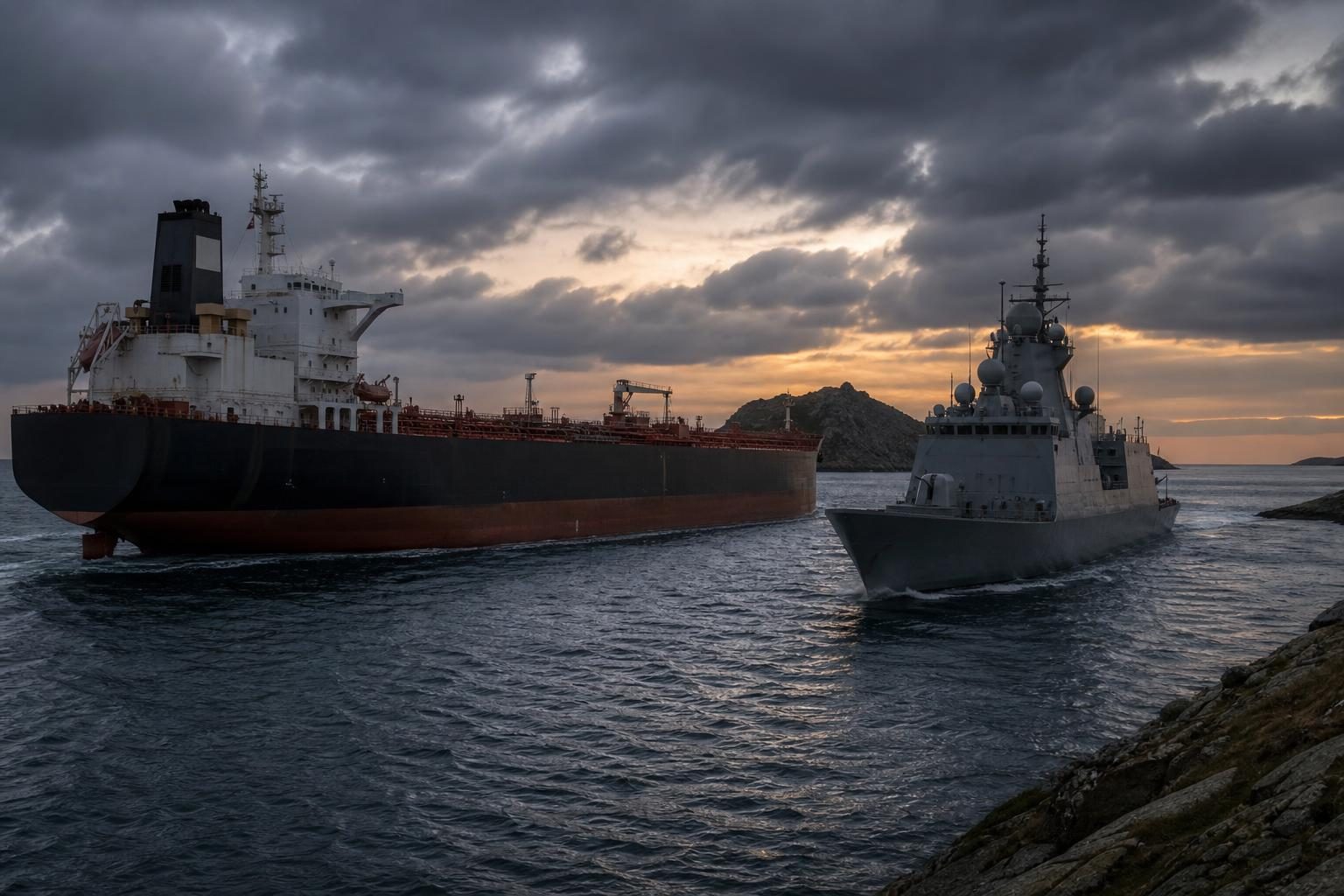
U.S. and Iranian forces exchanged fire near the Strait of Hormuz for the first time in more than a month, according to reporting by PBS NewsHour, raising tensions in a narrow waterway that matters to global oil shipping. U.S. officials said American forces struck two Iranian rocket launchers on Larak Island after observing Iranian forces preparing to launch rockets carrying sea mines into the strait. Sea mines are explosives placed in the water to damage or sink ships. Iran responded by launching missiles at U.S. sites in Jordan, and Jordanian officials said the missiles were intercepted by Patriot missiles, which are air-defense weapons designed to shoot down incoming missiles.
The clash did not become a full-scale battle, but it quickly affected countries far from the Persian Gulf. The United Arab Emirates said it intercepted an Iranian drone over its territorial waters, meaning waters near its coast that it claims under international rules. Global oil markets also reacted. PBS reported that Brent crude, a major international price marker for oil, rose past $90 a barrel. That matters because oil prices can affect gasoline, shipping costs, and the price of goods moved by trucks, ships, and planes.
The Strait of Hormuz is important because ships use it to move oil out of the Persian Gulf. When a waterway like that looks unsafe, companies and governments worry that tankers could be delayed, damaged, or forced to take costlier routes. President Trump said ships were still passing through with U.S. Navy assistance and said many ships had gotten through at night. The administration’s argument is that military action can keep the strait open and prevent Iran from threatening shipping.
Iran offered a different version of events. Iranian leaders said they did not seek war but would respond to aggression. That disagreement is central to the crisis: one side describes a strike as prevention, while the other describes it as escalation. A preemptive strike is an attack meant to stop an enemy from acting first. Supporters of that approach argue it can prevent a worse attack. Critics argue it can make war more likely by convincing the other side that it must strike back to avoid looking weak.
The United States also used economic pressure as part of its strategy. Treasury Secretary Scott Bessent, speaking on CNBC as PBS reported, said Iran was reacting militarily because it was losing economically. He said the goal was to create conditions that would bring Iran to negotiations. The Treasury Department handles many financial tools of U.S. policy, including sanctions, which are penalties meant to cut off money, trade, or resources. The trade-off is that pressure can push a government toward talks, but it can also push that government to lash out if its leaders believe they have little left to lose.
Another contested issue is messaging. Over the weekend, President Trump posted an AI-generated video suggesting that Kharg Island, Iran’s main energy hub, was under attack. AI-generated means created or altered by artificial intelligence software rather than recorded as real footage. PBS reported that there was no evidence Kharg Island was under attack. In a tense moment, a fake or misleading image can do more than confuse the public. It can affect how other governments interpret U.S. intentions, how markets react, and how citizens judge whether leaders are being honest about military action.
The story is not only about whether the United States or Iran is right about one exchange of fire. It is about how countries manage danger when each move can be read in more than one way. A strike can be framed as defense or aggression. An intercepted missile can be seen as a success or a warning sign. An oil-price jump can be temporary or the start of broader economic pain. Leaders often want to look strong enough to deter an opponent, meaning to discourage that opponent from attacking, while also leaving room to step back. The harder part is that both countries may believe the other side is the one escalating.
For people outside the region, the immediate question may be whether oil prices rise or whether U.S. forces are drawn into more fighting. For governments in the region, the question is whether the waterway remains safe and whether their territory becomes part of a larger confrontation. For the public, the question is how to judge claims made during a crisis, especially when officials, military spokespeople, markets, and social media posts are all moving faster than confirmed facts.
Written from reporting by PBS NewsHour, “U.S. and Iran trade strikes for first time in weeks over Strait of Hormuz control”.
Discussion questions
- When, if ever, is a preemptive military strike justified to protect shipping or prevent an attack?
- How should the public evaluate government claims during an international crisis when each side gives a different account?
- Should leaders avoid posting AI-generated images or videos during a military crisis, even if they see them as political messaging?