
Free activities › Middle school
Leonid Meteors Light Up November Skies
The annual shower peaked overnight, showing how Earth passes through old comet dust.
Print it — all four files
The student packet has no answers in it. The teacher copy is the same pages plus a note on each question and the answer keys. Both languages carry the same story, the same picture and the same vocabulary.
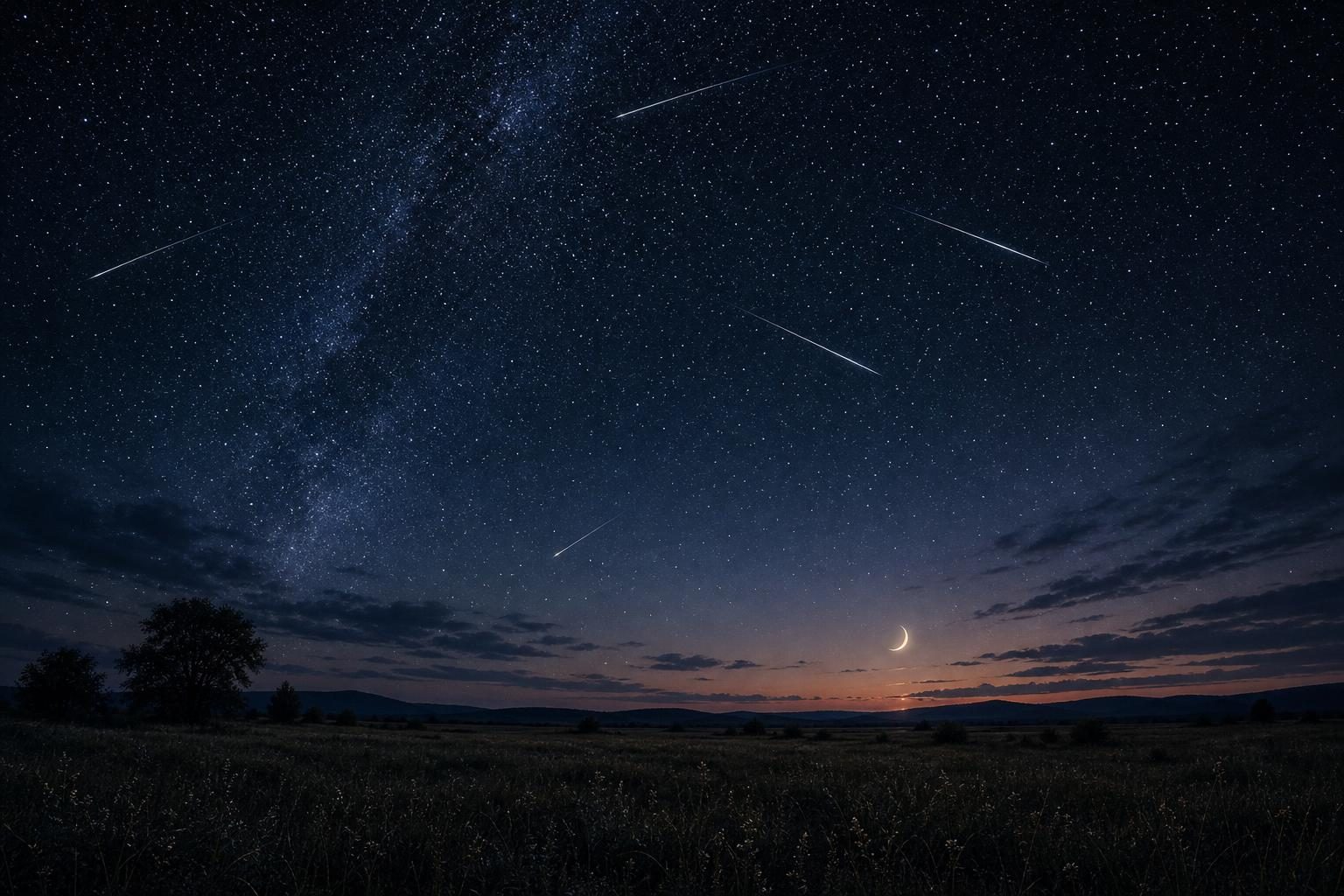
According to Live Science, the Leonid meteor shower peaked overnight from Monday into Tuesday, Nov. 16 to 17. A meteor shower is a time when Earth passes through many tiny bits of space dust, making more streaks of light than usual in the sky. The Leonids can bring about 15 shooting stars per hour under ideal conditions. They are called shooting stars, but they are not stars at all. They are small pieces of dust and rock burning up high in Earth’s atmosphere, the blanket of gases around our planet.
This year’s peak had a useful helper: a moon that did not brighten the sky for most of the best viewing time. Live Science reported that a 45-percent-lit waxing crescent moon, which means a partly lit moon that is growing toward full, set just before midnight. That left darker skies between midnight and dawn Tuesday. Dark skies matter because faint meteors can be washed out by moonlight, streetlights, porch lights and bright signs.
The Leonids appear every November because Earth crosses debris left behind by Comet 55P/Tempel-Tuttle. A comet is a small icy object that travels around the sun and can leave dust behind as it warms. Tempel-Tuttle takes about 33 years to orbit, or travel once around, the sun. It last came into the inner solar system in 1998 and is due back in 2031. The comet itself is not hitting Earth. Instead, Earth moves through the dusty trail it left behind.
The Leonids are known for speed. Live Science says they can move about 43 miles per second. That is why some can look bright and leave glowing trails. The shower gets its name from Leo, a constellation, or star pattern, because the meteors seem to spread out from that part of the sky. They can still appear anywhere overhead, so a wide view is better than staring through binoculars or a telescope. Those tools make faraway objects look bigger, but they also narrow the patch of sky you can see.
For someone in middle school, this is a real-life example of several science ideas at once. Earth is not sitting still. It is moving through space. Gravity keeps comets and planets in paths around the sun. Tiny objects can tell a big story about the solar system, the family of the sun, planets, moons, asteroids and comets. The shower is also a reminder that observation is part of science. A person can collect evidence just by looking carefully, choosing a dark place and giving their eyes about 20 minutes to adjust.
There is also a history lesson in the sky. The Leonids sometimes produce meteor storms, when far more meteors appear than usual. Live Science lists storms in 1833, 1866, 1966, 1999, 2001 and 2002. No storm was expected this year, and the next one is expected in 2099. That long wait shows how space events can happen on time scales much longer than a school year, a sports season or even a childhood.
The Leonids are active from Nov. 6 to Nov. 30, so the peak is not the whole story. The best show may be brief, but the science behind it is always there: moving planets, old comet dust, dark skies and human eyes trying to make sense of a universe that is both far away and close enough to streak across our atmosphere.
Written from reporting by Live Science, “The Leonid meteor shower peaks tonight: How to see more than a dozen 'shooting stars' per hour”.
Discussion questions
- Should science news about events like meteor showers focus more on how to watch them or on the science behind them? Defend your choice.
- If city lights make meteor showers harder to see, what trade-offs should communities consider before changing outdoor lighting rules?
- How does knowing that meteors come from comet dust change the way you think about a sky event: as entertainment, evidence, or both?