
A 42-Light-Year Trail Points Back to a Pulsar
New X-ray observations help explain where some extreme gamma rays in space may come from.
Print it — all four files
The student packet has no answers in it. The teacher copy is the same pages plus a note on each question and the answer keys. Both languages carry the same story, the same picture and the same vocabulary.
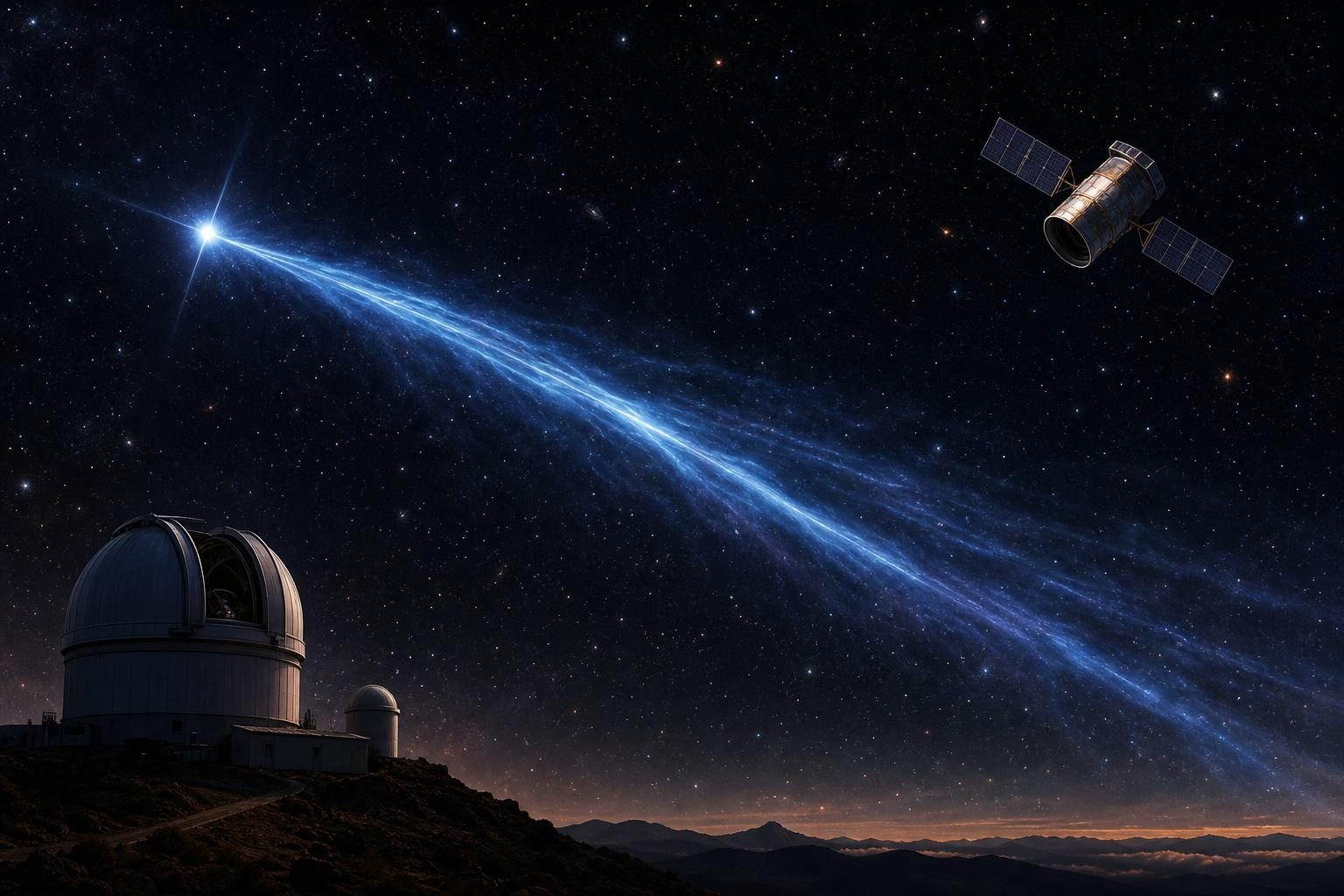
Astronomers have connected a huge X-ray tail in space to a pulsar and to previously unexplained ultrahigh-energy gamma rays. According to reporting by Phys.org, observations from China’s Einstein Probe satellite and the Large High Altitude Air Shower Observatory, known as LHAASO, show a close match between a long X-ray structure near the pulsar PSR J1740+1000 and gamma-ray emission seen in the same direction. The pulsar is about 4,600 light-years from Earth, and the tail stretches about 42 light-years. A light-year is the distance light travels in one year, so this is not a short plume; it is a structure spanning about 250 trillion miles.
A pulsar is the dense, spinning leftover core of a dead star that sends out beams of radiation as it rotates. Around some pulsars is a pulsar wind nebula, a cloud of high-energy particles pushed outward by the pulsar. The new work suggests that particles from this nebula did not spread evenly in all directions after leaving their source. Instead, they appear to have traveled in a preferred direction for tens of light-years. That matters because scientists have been trying to explain where some of the universe’s most energetic particles come from and how they move through interstellar space, the space between stars.
The finding also helps with a practical problem in astronomy: sometimes an observatory detects gamma rays but cannot identify the object that made them. Gamma rays are the highest-energy form of light, far more energetic than visible light or X-rays. LHAASO has found ultrahigh-energy gamma-ray sources, including some without an obvious nearby source object. This new observation supports one possible explanation: the particles may have been accelerated near a pulsar, traveled away from it, and produced gamma rays somewhere else. In other words, the source and the signal do not always have to sit on top of each other in the sky.
The work was published Sept. 21 in Science China: Physics, Mechanics & Astronomy, with corresponding authors from the Institute of High Energy Physics of the Chinese Academy of Sciences and Nanjing University. The job behind a result like this is not one person looking through an eyepiece. It involves astrophysicists, instrument teams, software specialists, and data analysts comparing measurements from different machines. LHAASO detects air showers, which are cascades of particles created when high-energy radiation from space hits Earth’s atmosphere. The Einstein Probe’s Follow-up X-ray Telescope observes X-rays from orbit, above the atmosphere that would block many of them from ground instruments.
The hardware matters. The Phys.org report says the Einstein Probe telescope has a wide field of view, meaning it can examine a large patch of sky at once, and low background, meaning it can pick out faint signals without as much interference from unwanted noise. With about 70,000 seconds of observations, it showed that the X-ray tail was much longer than earlier XMM-Newton observations had revealed. For technicians and engineers, that points to familiar workplace issues: sensor sensitivity, noise reduction, calibration, and making sure the instrument can collect reliable data for long stretches without turning faint signals into false ones.
The data work is just as important as the equipment. Researchers had to compare where the X-rays appear in the sky with where LHAASO detected gamma rays. They also had to compare the radiation properties, including how the signal changes with energy, to see whether both kinds of radiation could come from the same population of high-energy electrons. An electron is a tiny negatively charged particle found in atoms, but here the electrons have been boosted to extremely high energies. As they move through magnetic fields, they give off synchrotron radiation, which is radiation made when charged particles curve through a magnetic field. Some of that radiation shows up as X-rays.
The same electrons may also explain the gamma rays. As the electrons travel, they can collide with low-energy photons, which are packets of light already present in space, and boost them to much higher energies. That produces the ultrahigh-energy gamma rays detected by LHAASO. The result is like two different kinds of evidence from the same job site: X-rays show one part of the particle trail, and gamma rays show another. The source report says this is the longest X-ray tail of a pulsar wind nebula yet discovered.
The next question is why the particles stayed so organized for so long. Usually, high-energy particles entering interstellar space are scattered by magnetic-field fluctuations and gradually diffuse, or spread out, in many directions. The researchers propose two possible explanations. One is that the interstellar magnetic field is ordered enough to guide particles along a narrow path, like a magnetic track. The other is that a fast, collimated outflow, meaning a narrow stream moving in one direction, keeps carrying the particles outward, like water from a fire hose.
For someone aiming at this kind of career, the lesson is that space science is both research and technical production. A team has to design instruments, operate observatories, process large datasets, understand physics, and defend its conclusions in peer-reviewed publication. Hiring into work like this usually depends on being able to connect theory with tools: math for modeling particle motion, programming for data pipelines, electronics or mechanical knowledge for instruments, and enough communication skill to explain why one interpretation fits the evidence better than another.
Written from reporting by Phys.org, “A 42-light-year X-ray tail links a pulsar to previously 'orphan' gamma rays”.
Discussion questions
- When scientists match data from two different observatories, what makes the conclusion stronger, and what risks still remain?
- If you were hiring for a team studying high-energy space signals, would you prioritize physics knowledge, instrument engineering, or data science most heavily? Defend your choice.
- How could the idea of following an indirect trail apply to another technical field, such as automotive diagnostics, cybersecurity, or medical imaging?