
Beef, Bulldozers, and the Jobs Behind Land Clearing
An Australian investigation links recent forest loss to cattle grazing, bank loans, and the growing work of proving where products come from.
Print it — all four files
The student packet has no answers in it. The teacher copy is the same pages plus a note on each question and the answer keys. Both languages carry the same story, the same picture and the same vocabulary.
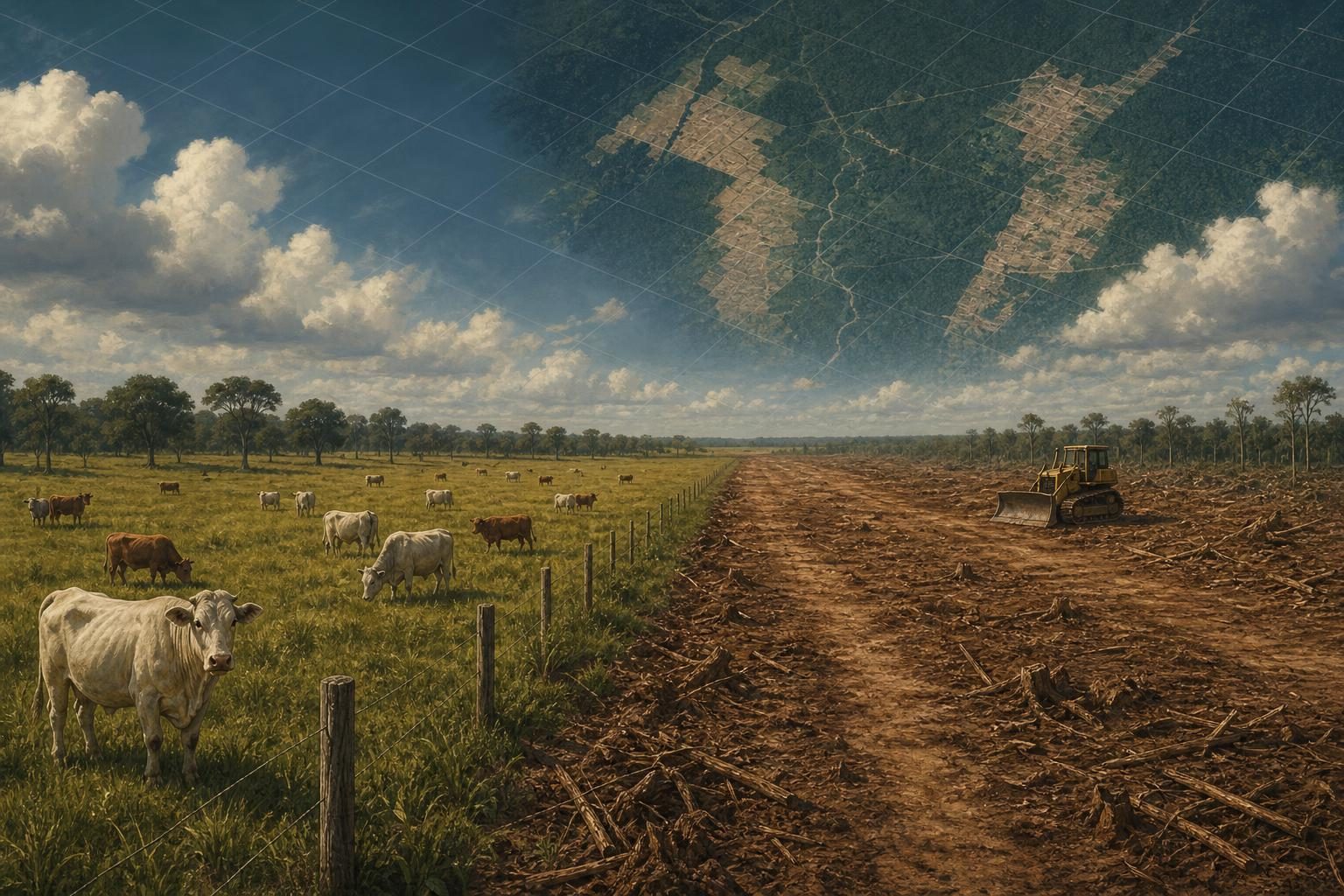
An environmental investigation in Australia has linked recent bulldozing of native forest and woodland to beef grazing properties, major bank mortgages, and companies that sell beef to the public. According to Phys.org’s report on the Australian Conservation Foundation’s 2026 investigation, researchers identified 150 recent clearing cases that together removed more than 32,000 hectares of native vegetation. A hectare is a land measurement equal to about 2.47 acres, so the total area described is larger than many cities.
The investigation said 99% of the detected clearing was linked to agriculture, and 127 of the 150 cases were on grazing properties, mainly for beef. A grazing property is land used to raise animals on pasture rather than in a feedlot. The report also connected 82 clearing cases, covering 16,540 hectares, to mortgages from major Australian banks. A mortgage is a loan secured by property, meaning the land itself helps back the loan.
The story matters because it shows that land clearing is not just an environmental issue or a farming issue. It is also a work issue. A single package of beef can connect cattle producers, dozer operators, truck drivers, meat processors, supermarket buyers, fast-food procurement teams, loan officers, satellite-image analysts, environmental regulators, and compliance staff. When a company promises “deforestation-free” beef, meaning beef not connected to the clearing of forest or woodland, someone has to verify that claim with records, maps, audits, and field evidence.
Phys.org reported that Australia clears an average of about 400,000 hectares of forest and woodland each year, with much of the clearing unregulated and driven by a small number of beef farmers. The article says clearing destroys wildlife habitat, releases carbon into the atmosphere, damages soil, and can create runoff problems. In the Great Barrier Reef catchment area, clearing can allow sediment to wash toward the reef. A catchment is the land area where rainwater drains into a river, bay, or other body of water; sediment is loose soil or rock particles carried by water.
One example in the article involved a beef property in the Herbert River catchment in Queensland’s Wet Tropics, where more than 1,700 hectares were bulldozed. After ACF reported the clearing, Australia’s National Environmental Protection Agency issued a stop-work order. A stop-work order is a legal instruction to halt an activity, often used when regulators believe continuing could violate rules or cause harm. The agency said any further clearing there could have contributed 1,000 metric tons of sediment flowing into the Great Barrier Reef.
Another case was on the Cobar Peneplain in western New South Wales, an area described as a deforestation hot spot. The article says cattle ranchers destroyed 796 hectares of native vegetation that had been mapped as habitat for endangered koalas and pink cockatoos. In several cases, the cleared land included remnant vegetation, which means vegetation that had never been cleared before. For workers, that word matters because older, intact habitat may trigger different rules, permits, inspections, or restrictions than previously cleared land.
The investigation also points to a growing technical job area: remote sensing. Remote sensing means gathering information from a distance, often using satellite images rather than standing on the ground. The article says Australia does not have an early detection and mapping system for deforestation, so ACF investigators, helped by thousands of citizen scientists, scanned more than 10 million hectares of satellite imagery in 2026. Citizen scientists are members of the public who help collect or review data for research or investigations.
That kind of work requires more than caring about the environment. It requires careful image comparison, attention to property boundaries, documentation, and the ability to tell the difference between normal land management and major clearing. In the same way that a welding inspector checks whether a weld meets code, or an automotive technician documents a repair, environmental monitoring depends on evidence that can hold up when a company, bank, regulator, or landholder challenges it.
The banking connection adds another layer. The article says no Australian bank has a policy requiring its customers to avoid deforestation, even though major bank mortgages were linked to dozens of cases. If banks change their rules, agricultural lending could involve more land-use questions before a loan is approved and more monitoring afterward. That would affect not only bankers, but also farmers and contractors who may need to provide maps, permits, grazing plans, or proof that clearing did not happen.
The companies that buy beef are under pressure, too. Phys.org reported that supermarket chains Coles and Woolworths had promised to sell only deforestation-free beef by the end of 2025, but the article says neither has kept that promise. It also named McDonald’s and Hungry Jack’s as major buyers of Australian beef. For procurement workers, the people who buy products for a company, a promise like that is not a slogan. It becomes a supply-chain problem: tracing which cattle came from which properties and deciding what evidence is good enough.
For trades and technical careers, the takeaway is that the job is changing at the edges. Beef production still needs practical skills with animals, pasture, fencing, water systems, machinery, and transport. But the market around beef increasingly also asks for traceability, environmental compliance, and data. Traceability means being able to follow a product back through the steps that produced it. The person who can run equipment safely, understand land conditions, and keep accurate records may be more valuable than someone who can do only one of those things.
This case does not prove that every cattle producer is clearing land or that every beef product is connected to deforestation. It does show how hard it can be to prove what happened on land that may be far from the store, restaurant, or bank office connected to it. The work now includes not only producing the beef, but also proving how it was produced.
Written from reporting by Phys.org, “Investigation links Australian deforestation to beef farming and major bank loans”.
Discussion questions
- If a supermarket promises deforestation-free beef, how much responsibility should fall on the supermarket, the rancher, the bank, and the government regulator? Defend how you would divide that responsibility.
- Should satellite monitoring become a normal part of agricultural lending and food purchasing, or would that create too much cost and surveillance for producers? Explain the trade-off.
- What skills would make a worker more hireable in a beef, construction, banking, or environmental-compliance job if deforestation rules become stricter?