
A new koala rescue dog trains for Australia’s fire season
Oaka, a high-energy Australian koolie, was chosen to replace a retired scent-detection dog that helped rescuers find koalas after fires.
Print it — all four files
The student packet has no answers in it. The teacher copy is the same pages plus a note on each question and the answer keys. Both languages carry the same story, the same picture and the same vocabulary.
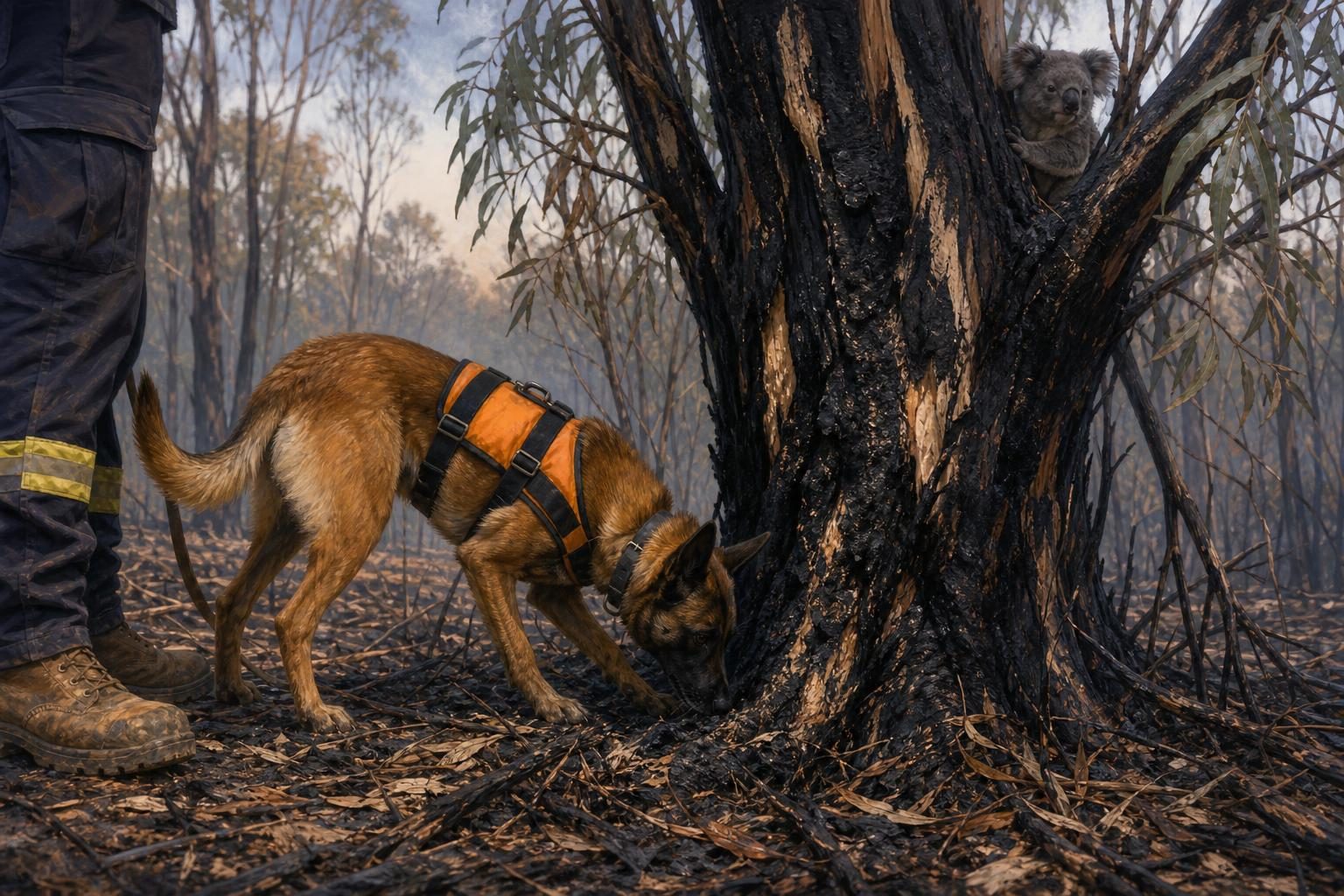
Oaka, an Australian koolie, has been chosen as the next koala detection dog for an animal welfare team in Australia. A koolie is a herding dog breed known for energy and work drive, traits that can be difficult in a family pet but useful in a trained working dog. According to Phys.org, the International Fund for Animal Welfare selected Oaka after reviewing applications from Australia and even the United States. The group was looking for a successor to Bear, a retired detection dog credited with helping save more than 100 koalas during Australia’s 2019–2020 Black Summer wildfires.
The story matters because it shows a real technical job that is easy to misunderstand. This is not simply a cute animal story. It is about scent detection, field rescue, and how teams prepare before an emergency. A detection dog is trained to locate a target odor, in this case the scent of koala fur. That skill can help rescuers find surviving animals in burned or damaged habitat, where seeing them from the ground may be difficult. Koalas are marsupials, meaning their young develop in a pouch, and they often live in eucalyptus trees, so a rescuer may be searching upward through smoke-damaged forests, fallen branches, and unstable ground.
Bear’s retirement created an operations problem: a skilled worker left the field, and the organization needed a replacement before the next major demand for that skill. In any trade, that is succession planning, which means preparing for who can do specialized work when an experienced worker steps away. Bear had worked for about a decade and was described as one of the first dogs in Australia trained for this specific koala-detection role. That kind of experience is not replaced overnight. Oaka passed an initial test strongly enough that the organization plans to fast-track her training, meaning the normal training timeline will be compressed because the need is urgent.
For people thinking about technical careers, the hiring lesson is interesting: the “best” candidate may not look easy at first. Oaka, like Bear before her, had been considered “too much to handle” by a family. In a home, that may mean too much energy, drive, or intensity. In a working-dog program, those same traits can become assets if they are matched with structure, training, and a clear task. A local rescue group recognized Oaka’s potential and submitted the application that put her into the selection process. In other words, the pathway into the job was not a simple résumé. It involved observation, referral, testing, and then training.
The human side of this work is just as important, even though the dog gets the headline. A canine unit is a working team built around trained dogs, handlers, and supervisors who understand both animal behavior and field conditions. The source names Frederic Chappee as the animal welfare group’s director of canine units and Josey Sharrad as its Oceania head of programs. Their roles point to the planning behind the field work: selecting the animal, judging the test results, deciding whether training can be accelerated, and connecting the dog’s ability to an actual rescue mission. The article does not list job qualifications for those human roles, so it would be wrong to invent them. But the work clearly sits where animal training, emergency response, conservation, and safety procedures meet.
The timing also changes how the job is done. The Black Summer wildfires burned across Australia’s eastern seaboard from late 2019 into early 2020, destroying homes, burning millions of hectares, and filling cities with harmful smoke. A hectare is a metric unit used to measure land area, often used in agriculture, forestry, and firefighting. The article says Australian fire services are warning that the coming Southern Hemisphere summer could bring more intense blazes. That changes the pressure on the team. Training is not happening for a someday assignment; it is preparation for a season when fast deployment may matter.
This kind of work also shows why technology does not always mean electronics. A trained dog’s nose is a biological tool, and the handler’s job is to turn that tool into reliable information. In a rescue setting, a false signal could waste time, while a missed signal could leave an animal unfound. That is why selection and testing matter before a dog is sent into the field. Oaka’s early success is promising, but the article makes clear that she is entering training, not that she has already replaced Bear’s full experience.
A useful way to read this story is as a workforce story. Australia has a wildlife problem made worse by severe fires, and one part of the response depends on a rare skill set. The organization found a candidate with the right drive, tested that candidate, and is now trying to prepare her quickly without pretending the work is simple. Whether the workplace is a fireground, a repair shop, a hospital, or a construction site, specialized work depends on spotting potential early, training it carefully, and having a plan before the emergency arrives.
Written from reporting by Phys.org, “Paw-fect candidate: Australia finds new koala rescue dog”.
Discussion questions
- Should a high-energy animal that is difficult in a home be steered toward working roles more often, or does that risk pushing animals into jobs they may not be suited for?
- When an organization depends on one highly specialized worker or team, what responsibilities does it have before that person, animal, or unit retires?
- If wildfire seasons become more intense, should rescue groups prioritize faster training, stricter standards, or larger teams—and what trade-off comes with that choice?