
Arctic Ice Loss May Help Forecast Summer Drought
A new study links low winter sea ice to later drought risk across parts of eastern Europe and Central Asia.
Print it — all four files
The student packet has no answers in it. The teacher copy is the same pages plus a note on each question and the answer keys. Both languages carry the same story, the same picture and the same vocabulary.
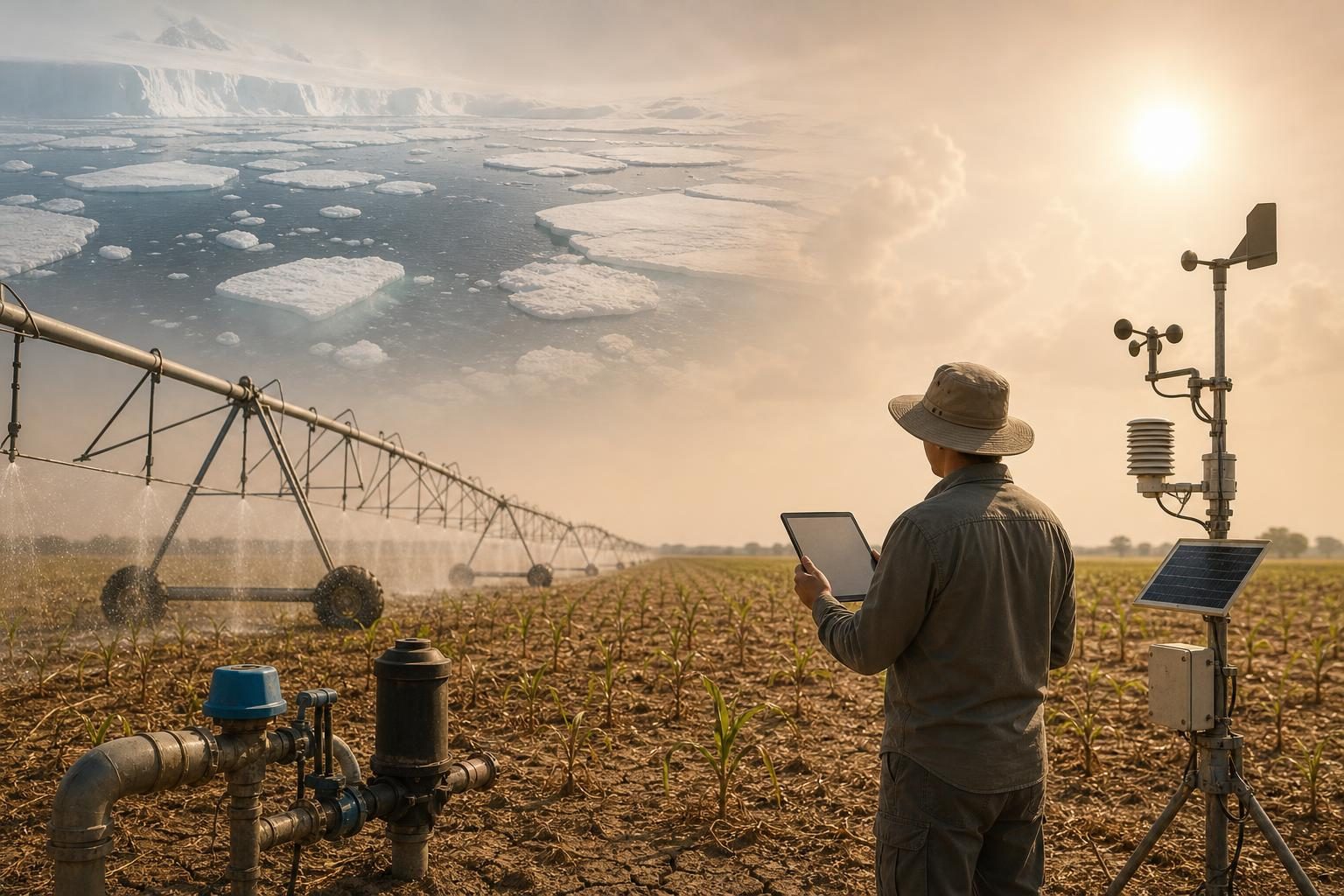
A new climate study says that less winter sea ice in two Arctic seas may be an early warning sign for summer drought thousands of miles away, across a wide stretch from eastern Romania and Ukraine toward western Kazakhstan. According to reporting by Phys.org on research published in Frontiers in Water, the study focused on the Barents and Kara seas, two Arctic areas that have lost winter sea ice rapidly since the 1980s.
The finding matters because drought is not just a weather story. It changes work schedules, supply chains, irrigation plans, fire risk, crop yields, river transport, energy demand, and construction conditions. If a winter ice measurement can help crews and agencies see a higher drought risk months ahead of time, then water managers, farmers, utilities, emergency planners, and insurers have more time to prepare instead of reacting after the ground is already dry.
The researchers looked at sea ice records from October through March and compared them with dry conditions from May through September. They used ERA5, a large European weather and climate database that blends real observations with a weather model to estimate atmospheric conditions across Eurasia going back to 1940. A weather model is a computer system that uses physics equations and data to estimate how air, water vapor, temperature, and pressure behave.
To measure drought, the team did not look only at rainfall. They also used potential evapotranspiration, which means the amount of water that could leave soil and plants if the atmosphere is dry and warm enough to pull moisture away. That matters on the job because two places can receive the same rainfall but have different drought stress if one has hotter air, stronger sunlight, fewer clouds, or more wind.
The study found evidence of more than a simple pattern where two things happen at the same time. The researchers tried to account for the long-term rise in carbon dioxide, the main heat-trapping gas from burning fossil fuels, because both shrinking sea ice and worsening drought can be pushed by overall global warming. Without that step, the result could be a spurious correlation, meaning a connection that looks real in the data but is actually caused by another factor.
The possible mechanism is in the atmosphere. The study points to Rossby waves, which are huge bends in high-altitude winds shaped partly by Earth’s rotation. In the Northern Hemisphere, some northward bends, called ridges, can help create warm, dry, stagnant weather. The researchers found that winters with less Barents-Kara sea ice were followed by a bendier wind pattern over the North Atlantic and Eurasia. That pattern can help move warm, dry air into the drought-prone zone and reduce cloud cover, allowing more sunlight to heat the land.
For a career and technical education classroom, the important part is the work behind the headline. This kind of result is built by people who can handle data, instruments, models, and quality control. Climate scientists design the research question. Hydrologists study water in rivers, soils, snow, and aquifers. Meteorologists understand the atmosphere. Data analysts and scientific programmers clean records, run calculations, check for errors, and make sure a pattern is not just a coincidence. GIS technicians, who work with geographic information systems, can turn location-based data into usable maps for planners and field crews.
The study also shows why technical workers need both tool skills and judgment. A technician can download a dataset, but a professional has to ask whether the dataset fits the job. A programmer can run a statistical test, but the team has to decide whether the test answers the real question. A map can show a dry region, but an irrigation district still needs local knowledge about wells, reservoirs, soil type, crop stage, equipment, and legal water rights before changing operations.
If drought forecasts improve, the workflow in several trades could change. Agricultural operations might schedule irrigation maintenance earlier, choose different planting or harvesting plans, or order parts before a dry season creates a rush. Municipal water departments might inspect pumps, valves, and storage systems sooner. Wildland fire crews and utility vegetation crews might adjust staffing and equipment staging if hot, dry conditions look more likely. Construction managers might plan dust control, worker heat safety, and concrete curing procedures with more lead time.
The study does not mean one low-ice winter guarantees a drought. Forecasting risk is different from predicting one exact outcome. A useful early warning system gives a probability, not a promise. That difference matters in the workplace because decisions cost money. Preparing too little can leave a community short of water or firefighting capacity. Preparing too much can waste labor, fuel, materials, and public funds.
The hiring lesson is that climate-related jobs are not only for people who picture themselves in a lab. The field needs people who can operate sensors, maintain field equipment, manage databases, write code, interpret maps, communicate uncertainty, and connect science to decisions made by farms, utilities, governments, and contractors. As climate signals become part of everyday planning, the workers who can translate data into safe, practical action will be valuable far beyond traditional science offices.
Written from reporting by Phys.org, “From Romania to Kazakhstan, summer droughts linked to less winter ice in two rapidly warming seas”.
Discussion questions
- If a drought forecast is only a probability, when is it still worth spending money on preparation? Defend a standard a city, farm, or utility could use.
- Which technical workers would be most important in turning this research into a useful local warning system, and why?
- What information is missing from this study before a local employer should change its operations because of it?