
Florida’s Dengue Outbreak Puts Mosquito Control to Work
A record outbreak is testing the crews, labs, clinicians, and public health teams that turn disease prevention into hands-on work.
Print it — all four files
The student packet has no answers in it. The teacher copy is the same pages plus a note on each question and the answer keys. Both languages carry the same story, the same picture and the same vocabulary.
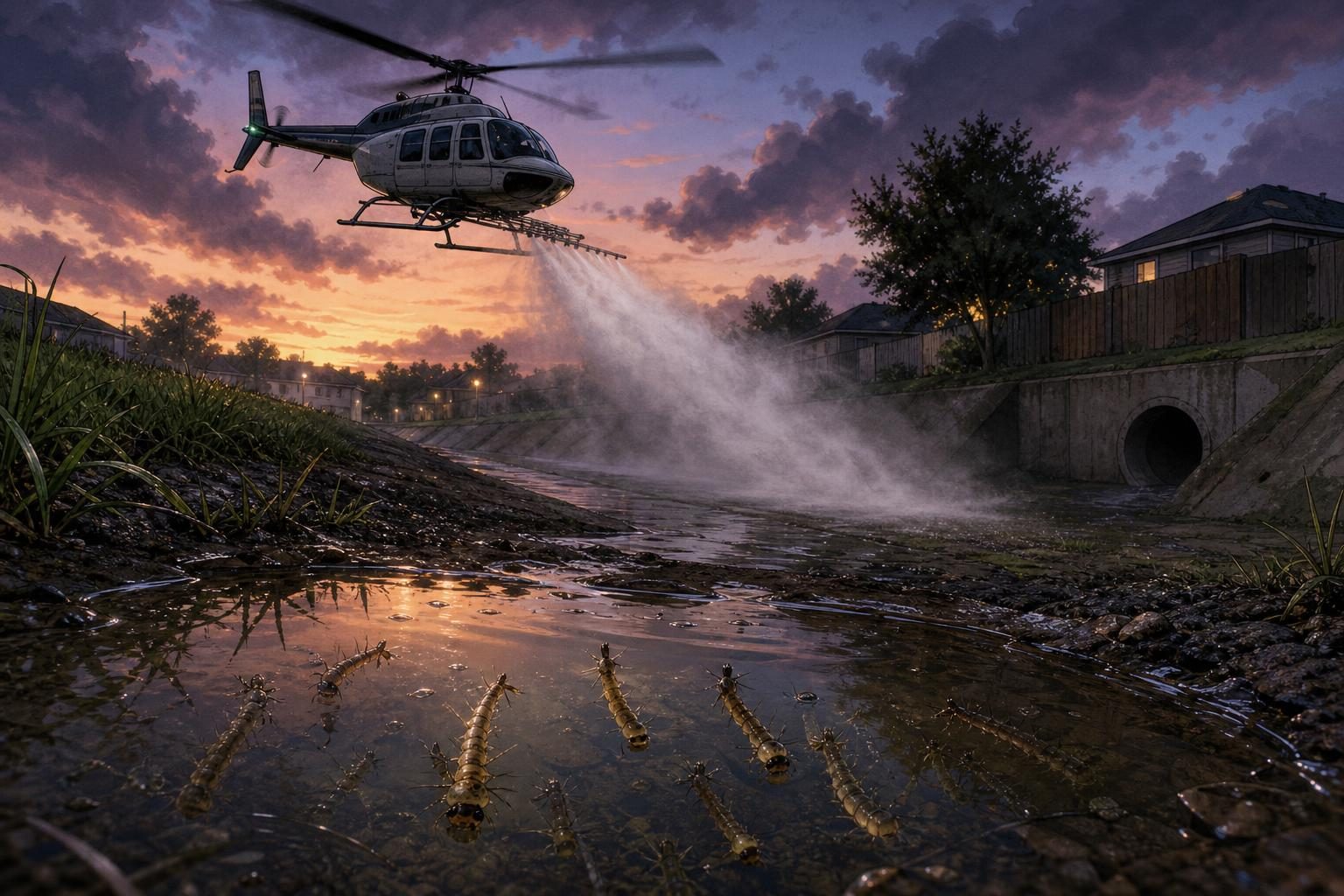
Florida health officials are trying to slow the state’s largest dengue fever outbreak in more than 15 years, including by sending low-flying helicopters over parts of Pinellas and Hillsborough counties on Nov. 5 to spray a fine mist that targets mosquito larvae. According to reporting by PBS NewsHour, Florida had recorded 524 locally acquired dengue cases this year, meaning people were infected in Florida rather than while traveling somewhere else.
Dengue fever is a viral illness spread by mosquito bites, not by ordinary person-to-person contact. Florida also reported 382 international travel-associated cases as of Oct. 31, meaning those infections were linked to travel in areas where dengue risk is higher. The difference matters for public health work: travel cases can enter a state one person at a time, but locally acquired cases show that mosquitoes in that area are part of the transmission chain.
The helicopter spraying is one example of vector control, the field that manages insects or animals that carry disease. In this case, the vector is the Aedes mosquito, a type of mosquito that can spread dengue. The spray used in the Florida operation was water mixed with Bti, a naturally occurring soil bacterium that kills mosquito and black fly larvae. Larvae are the immature, water-living stage of insects before they become flying adults. That detail is important: crews are not just chasing adult mosquitoes; they are trying to interrupt the life cycle before mosquitoes can bite.
For people working in health departments, mosquito control districts, environmental services, and emergency management, an outbreak like this changes the job from routine prevention to active response. The work includes deciding where spraying is needed, communicating risk to the public, watching case counts, and reminding residents to remove standing water where mosquitoes breed. Standing water can be as small as water left in a container after rain. The practical instruction is simple, but the work behind it depends on surveillance, timing, weather conditions, and public cooperation.
The medical side matters too. About three in four people infected with dengue do not get sick, according to the PBS NewsHour report. When symptoms do appear, they usually begin four to 10 days after a bite from an infected mosquito. Mild dengue can include high fever, headache, nausea, vomiting, rash, pain behind the eyes, and muscle, joint, or bone pain. For most people, the Centers for Disease Control and Prevention says recovery takes about a week.
A smaller share of cases can become dangerous. About one in 20 people infected with a dengue virus develops severe dengue, a life-threatening condition that can involve shock, internal bleeding, and death. Warning signs include serious stomach pain or tenderness, repeated vomiting, bleeding from the gums or nose, rapid breathing, blood in stool or vomit, extreme tiredness, restlessness, and purplish spots or patches under the skin. The article notes that these signs often appear 24 to 48 hours after the fever and can come on quickly, so immediate medical care is needed.
There is no specific cure for dengue. For mild illness, the CDC recommends rest, fluids, and acetaminophen for fever and pain. It recommends avoiding aspirin and ibuprofen because they can increase bleeding risk. For severe dengue, medical professionals may monitor blood pressure and platelet count. Platelets are blood cells that help clotting, so a low platelet count can raise concern about bleeding. Patients may also receive blood transfusions or intravenous fluids, which are fluids delivered through a vein, along with electrolyte replacement to help keep body chemistry stable.
This outbreak also shows why disease control is not one job. An epidemiologist, a public health worker who studies patterns of disease in populations, looks for how an illness is spreading and who is at risk. Clinicians assess symptoms and decide when care must escalate. Laboratory and surveillance systems help confirm cases. Field crews focus on mosquitoes and breeding sites. Communications staff turn technical information into advice people can act on. None of those roles works well alone.
The biology of dengue makes the work harder. There are four dengue viruses. Infection with one type can help protect a person from that same type, but not necessarily from the other three. The article reports that a second infection with a different type can be more dangerous. Florida has documented all four types since 2009, and the type circulating most now has been noted by a University of Florida public health professor as causing more severe symptoms than the other three.
Florida’s climate and environment help Aedes mosquitoes thrive, and rainfall can leave more places for breeding. The PBS NewsHour report explains that if a mosquito bites an infected person, even someone with no symptoms, the virus can enter the local mosquito population. An infected female mosquito can stay infected for life and can pass the virus to her eggs, creating a bigger control problem.
For CTE pathways, the takeaway is not only that dengue is a health threat. It is that public health depends on skilled, practical work: operating equipment safely, understanding materials like Bti, documenting conditions, following protocols, reading risk information, and communicating clearly with the public. The outbreak turns a tiny insect into a jobsite problem, a medical problem, and a systems problem at the same time.
Written from reporting by PBS NewsHour, “What to know about dengue fever as Florida reports more than 500 cases this year”.
Discussion questions
- When an outbreak grows, should officials put more effort into public education, mosquito-control operations, or clinical preparedness first? Defend a priority and explain what trade-off it creates.
- The article describes advice that depends on residents removing standing water. How much responsibility should be placed on individual households versus public agencies in controlling mosquito-borne disease?
- If you were hiring for a mosquito-control or public health field team during this outbreak, what skills and habits would matter most beyond simply being willing to work outdoors?