
A Virtual Cell Could Speed Up New Cancer Drug Design
Researchers built a computer model to help drug teams decide which proteins to destroy, not just block, inside diseased cells.
Print it — all four files
The student packet has no answers in it. The teacher copy is the same pages plus a note on each question and the answer keys. Both languages carry the same story, the same picture and the same vocabulary.
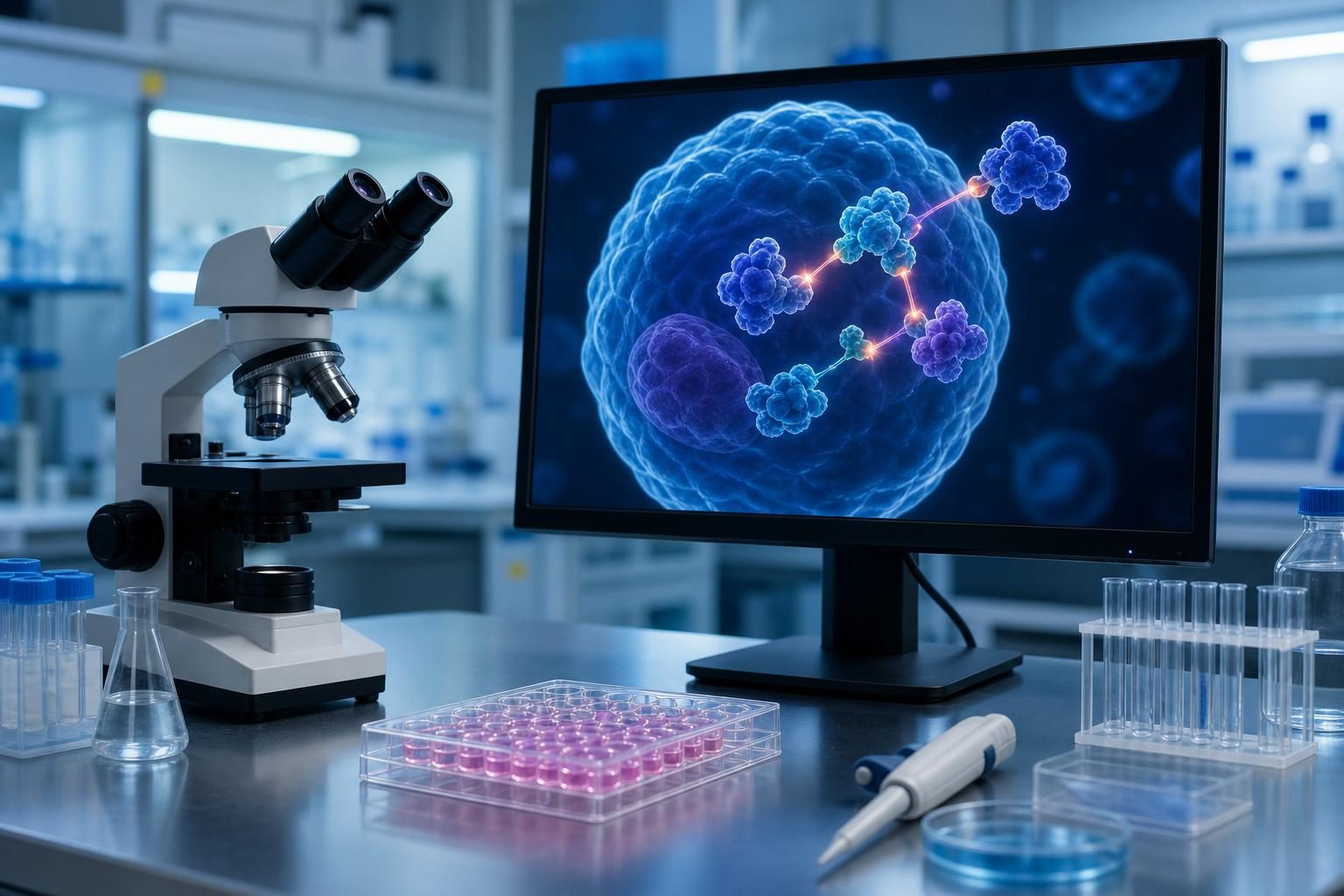
A Weill Cornell Medicine team has developed a computer model meant to help scientists design protein-degrader therapies more efficiently, according to reporting by Phys.org. The study, published in Nature Communications, focuses on a newer kind of drug strategy: instead of only blocking a harmful protein, a protein degrader is designed to make the cell destroy that protein altogether.
That difference matters because proteins are the working parts of cells. A protein is a molecule that carries out a job, such as sending a growth signal, building structure, or controlling a chemical reaction. In cancer, some proteins may be changed by mutations, which are errors in genetic instructions, or may be made in much larger amounts than normal. Phys.org gives the example of a protein that might have 200 copies in a normal cell but 2,000 copies after a cancer-linked mutation. In that situation, simply turning down the protein’s activity may not be enough; the treatment goal may be to remove the excess protein or bring it closer to a normal level.
Protein-degrader therapies try to use the cell’s own disposal system. Cells already have machinery for breaking down proteins that are damaged or no longer needed. A degrader molecule is built to connect two things: the disease-related target protein and the cell’s protein-destruction machinery. The linking part matters because it holds the target close enough for the cell to tag it for removal. In trade terms, the degrader is not just an active ingredient; it is a designed tool with geometry, timing, and fit.
The problem is that designing these molecules has involved a lot of trial and error. Drug development already takes major time and resources, and repeated testing of one design after another can slow the work before a treatment ever reaches patients. The new model is intended to help teams choose better targets and plan a more cost-effective route for improving a degrader. Cost-effective does not mean cheap or low-quality; it means using time, supplies, staff hours, and testing capacity in a way that gets the most useful result.
The model uses laboratory measurements that the researchers describe as easily obtained, then lets scientists study how a degrader might behave in a computer version of a cell. That is why the work is important for career and technical education: it sits at the connection point between wet lab work and computational work. A wet lab is a laboratory where people handle physical samples, chemicals, and biological materials. Computational biomedicine is the use of math, data, and computer models to solve medical biology problems. This project needs both.
One key idea in the report is binding affinity, which means how strongly one molecule attaches to another. Drug designers often want strong binding, because a drug that attaches well to its target may work at a lower dose or stay effective longer. But the Weill Cornell model suggests that for proteins with slow turnover, even weaker binding may still produce strong degradation. Turnover means how quickly a protein is naturally made and broken down inside a cell. If a harmful protein normally sticks around for a long time, a degrader may have more opportunity to remove it even if the initial attachment is not extremely strong.
That kind of finding can change the work plan. Instead of spending months trying to make every degrader bind as tightly as possible, a team might first ask whether the target protein’s turnover rate makes it a good candidate. The model also produced a list of potential targets that the researchers consider high value for degrader development. The source does not say that any finished treatment has come from this model yet, so the practical importance is in design and prioritization, not an approved drug.
The jobs behind this kind of project are varied. A laboratory technician might prepare samples and run assays, which are tests that measure a biological activity or chemical interaction. A computational scientist or data analyst might translate those assay results into equations and simulations. A medicinal chemist might adjust the structure of a degrader molecule so it binds the right proteins. A clinician, meaning a medical professional who works with patients, may later help judge whether a treatment approach matches a patient’s disease. A regulatory or clinical-trial team would be involved before testing in people, because clinical trials are controlled studies used to evaluate safety and effectiveness.
For someone aiming toward this field, the hiring signal is not just “likes science.” The work rewards people who can measure carefully, document results, understand cell biology, use math without fear, and communicate across job roles. A technician who understands why a measurement matters to the model is more valuable than one who only follows a recipe. A coder who understands what a lab result can and cannot prove is more useful than one who treats all data as clean numbers.
The long-term goal described by the researchers is precision medicine, which means choosing or designing treatment based on the specific biology of a patient’s disease rather than treating every case the same way. Phys.org reports that the team has also worked on modeling drug safety before clinical trials. If tools like this keep improving, drug development may become less like guessing which prototype to build next and more like using a digital test bench before committing materials, money, and time in the lab.
Written from reporting by Phys.org, “Virtual cell model could accelerate protein-degrader therapy design”.
Discussion questions
- If a drug-development team has limited time and lab capacity, how much should it trust a computer model before spending resources on physical experiments?
- Should future biotech hiring put more emphasis on cross-trained workers who understand both lab procedures and data modeling, or on specialists who go deeper in one area?
- Protein degraders aim to remove harmful proteins rather than only block them; what kinds of diseases or situations might justify that more aggressive approach?