
Honda Plans $3B Ohio Plant for Hybrid Vehicles
The factory is expected to add 2,000 jobs and shows how auto work is shifting toward hybrids, automation and flexible production.
Print it — all four files
The student packet has no answers in it. The teacher copy is the same pages plus a note on each question and the answer keys. Both languages carry the same story, the same picture and the same vocabulary.
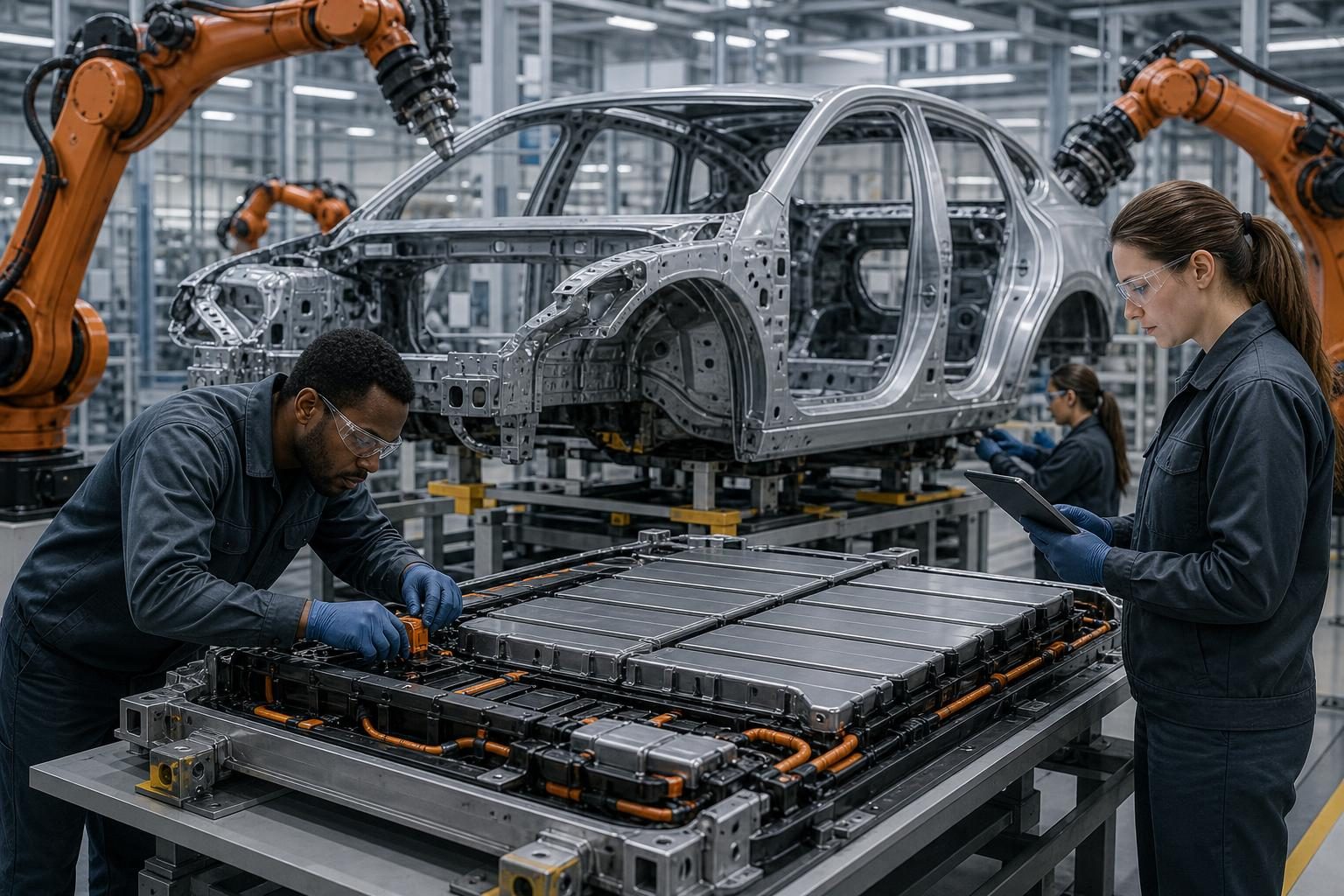
Honda announced a $3 billion plan for a new hybrid-vehicle factory in Central Ohio, according to reporting by Automotive Dive. The plant is expected to create more than 2,000 jobs and begin production in 2029, if it receives final government approvals. Honda says the factory will be built near its existing Marysville and East Liberty operations, close to the company’s long-running Ohio manufacturing base.
The biggest point is not just that one automaker is building one plant. It is that Honda is putting major money into hybrids at a time when the vehicle market is still sorting out the pace of the shift from gasoline engines to electric vehicles. A hybrid vehicle uses both an internal-combustion engine, which burns fuel, and an electric motor system, which can help power the vehicle and improve efficiency. That means hybrid production touches both traditional automotive skills and newer electrical, battery and control-system work.
The new Ohio plant is planned for an annual capacity of 240,000 vehicles. Capacity means how many units a factory is designed to produce in a year when it is running as planned. Honda says the project is part of a larger manufacturing network across Ohio, Alabama and Georgia. After the expansion, the company says its annual U.S. production capacity will be about 1.3 million vehicles, and its total North American capacity will be about 1.9 million vehicles.
For career and technical education, the work behind this announcement matters. A modern auto plant is not just a building full of people tightening the same bolts all day. Honda said the new factory will use advanced automation, data-driven technologies and flexible production systems. Automation means machines, robots or computer-controlled equipment handle repeated or precise tasks. Data-driven production means workers and engineers use information from machines, quality checks and production flow to make decisions. Flexible production means a plant can adjust what it builds or how it builds it without starting from scratch.
Those words point to the kinds of skills that are becoming more valuable on a factory floor. Mechanical skill still matters because vehicles have frames, engines, transmissions, fasteners, fixtures and moving parts. Electrical knowledge matters because hybrids include motors, batteries, wiring, sensors and control modules. Digital troubleshooting matters because many production problems now show up as data, alarms or software-controlled equipment behavior before they show up as a visibly broken part.
The article does not list specific job titles, wages or hiring requirements for the 2,000 jobs. That is important: a plant announcement is not the same thing as a job posting. Still, the production plan gives clues about the work. A factory making vehicles, engines and hybrid systems will need people who can follow standardized work, use measuring tools, understand safety procedures, spot defects, maintain equipment and communicate across shifts. A plant described as automated and data-driven will also need workers who are comfortable around sensors, programmable machinery and production software, even if not every worker is a programmer.
Honda is also retooling its transmission plant in Ohio to make two hybrid systems for compact and midsize vehicles in North America. Retooling means changing equipment, tooling, layouts or processes so a facility can build different parts or use a different method. In this case, the shift is from traditional transmission work toward hybrid system production. That is a major signal for people entering the trades: the same building or workforce can be asked to produce different technology as the market changes.
The company says Ohio was chosen for several reasons, including proximity to suppliers, development operations, existing plants and L-H Battery Company, which began as a joint venture with LG and is expected to supply batteries for hybrids and electric vehicles. A supplier base is the network of companies that provide parts, materials, tooling and services to a manufacturer. Being near suppliers can reduce transportation time, make problem-solving faster and help a factory respond when demand changes.
Honda is not only investing in Ohio. The company also described related investments in Alabama, Georgia and Canada. In Alabama, Honda plans to increase capacity and expand production of a new V-6 hybrid engine at an adjacent plant. In Canada, Honda announced a 166 million Canadian dollar investment, equal to about $118 million, as part of a larger 867 million Canadian dollar commitment tied to its Canadian manufacturing workforce and North American production network.
This announcement also shows how automakers are hedging their bets. Honda previously reduced electric vehicle investments and shifted toward expanding its hybrid lineup. The company has said it plans 15 next-generation hybrids by 2030, mainly for North America. A next-generation model is a redesigned version that uses newer engineering, manufacturing or performance features, not just a minor styling update.
For people preparing for manufacturing careers, the lesson is practical. Auto work is still auto work: production, quality, maintenance, machining, logistics and assembly all remain central. But the product is changing. A worker who understands engines only, or electrical systems only, may be less flexible than someone who can connect the two. The hiring details will come later, but the direction of the work is already visible: hybrid vehicles, automated lines, data-informed troubleshooting and plants built to change faster than older factories could.
Written from reporting by Automotive Dive, “Honda to invest $3B in new Ohio hybrid vehicle plant”.
Discussion questions
- If a CTE program had to update one course because of this Honda announcement, should it prioritize electrical systems, automation, quality control or engine technology? Defend your choice.
- Honda is investing in hybrids while also reducing some electric vehicle investment. Is that a cautious business move, a delay in the shift to EVs, or both?
- The article gives job numbers but not wages, credentials or job titles. What information would a future applicant need before deciding whether this plant is a good career opportunity?