
Farm Tech Study Finds Water Savings in Tomatoes and Grapes
Researchers say sensor-guided irrigation and drones helped crops use less water while improving yield and fruit quality.
Print it — all four files
The student packet has no answers in it. The teacher copy is the same pages plus a note on each question and the answer keys. Both languages carry the same story, the same picture and the same vocabulary.
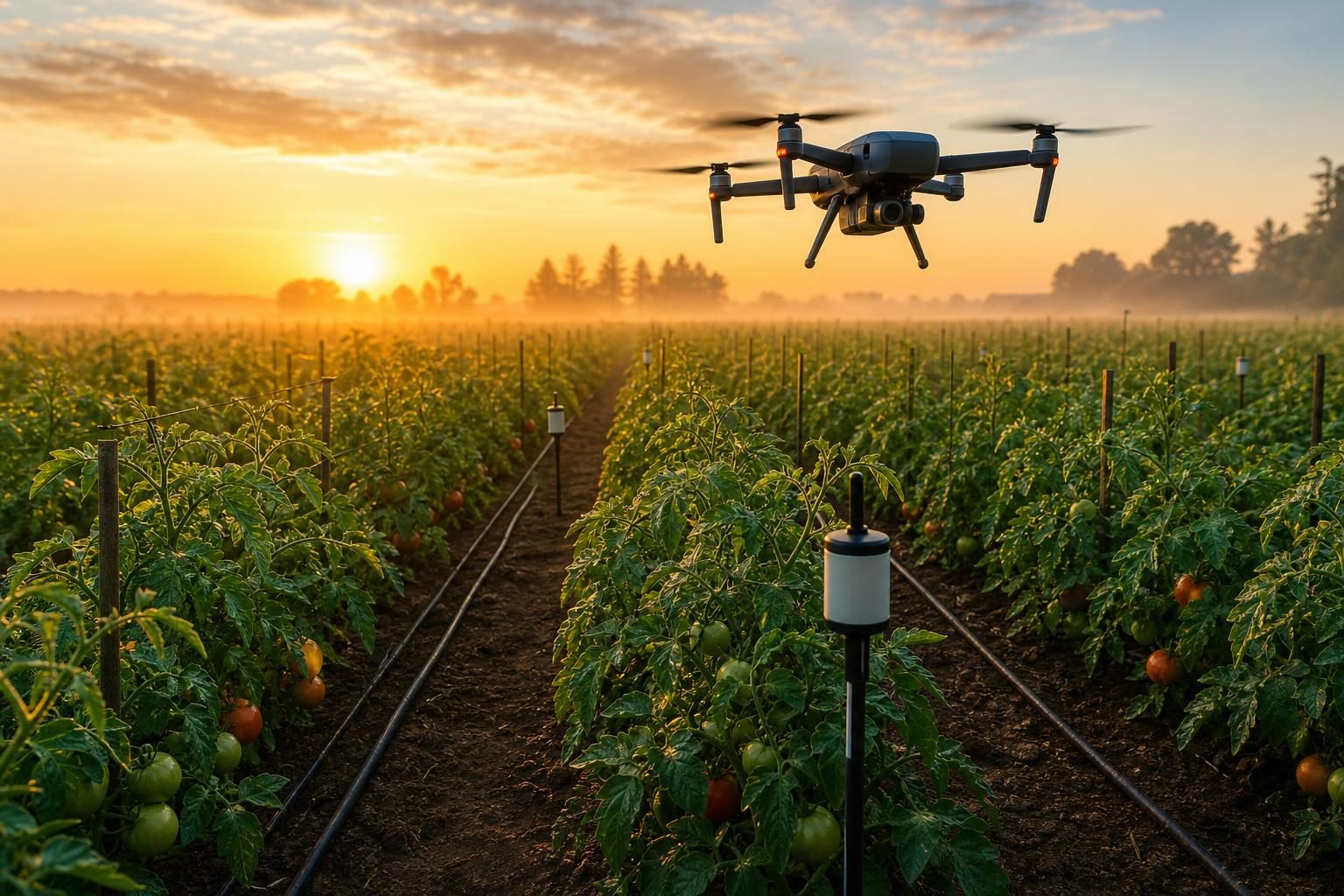
Farmers may be able to grow better tomatoes and table grapes while using less water by combining drones with sensor-controlled irrigation, according to reporting by Phys.org on new research published in Plants, People, Planet. The study compared crops managed with traditional methods to crops managed with a more advanced irrigation system that used sensors. In the sensor-managed plots, researchers reported water savings of up to 15% and also found improvements in yield and fruit quality.
That matters because water is becoming a tighter operating limit for farms in many places. Drought and extreme heat do not just make farming harder in a general way; they change daily decisions about when to irrigate, how long to run pumps, how to protect plants from stress, and how to keep produce good enough for a buyer. A field can look fine from the road and still be under stress in ways that affect size, sugar, firmness, or shelf life. The study points to a version of farming where more of those decisions are supported by field data instead of only by habit, calendar schedules, or a quick visual check.
The approach is called precision agriculture, which means using technology to manage crops more exactly instead of treating a whole field as if every row needs the same thing at the same time. In this case, the precision tools included drones and sensor-based irrigation. Sensor-based irrigation means the watering system responds to information collected in or near the crop, rather than simply running on a fixed schedule. Irrigation is the controlled delivery of water to crops, usually through drip lines, sprinklers, canals, or other farm systems. A sensor is a device that measures a condition, such as moisture, temperature, or another signal useful for deciding what the crop needs.
For a career and technical education classroom, the important part is not just that the technology exists. It is that the work changes. A farm still needs people who understand plants, soil, weather, machinery, timing, and markets. But a farm using these tools also needs workers who can install equipment, check whether sensors are giving believable readings, operate drones safely, manage irrigation hardware, and communicate what the data means to the person making production decisions. The job is not only “fly the drone” or “turn on the water.” It is making sure a technical system actually helps the crop.
Drones can be useful because they let a grower inspect a field from above without walking every row. In agriculture, a drone is an unmanned aircraft used to gather images or other field information. It does not replace crop scouting, which is the job of checking plants for stress, disease, pests, or growth problems. Instead, it can guide the scouting by showing where conditions may be different. A worker may still need to go into the field to verify what the drone suggests. That matters because a bad assumption can lead to wasted water, wasted labor, or fruit that misses quality targets.
The study also mentioned nondestructive technologies for checking fruit quality. Nondestructive means the crop can be tested without cutting it open, crushing it, or sending samples away in a way that destroys them. For farms growing produce for sale, that is a big difference from testing that sacrifices fruit or waits on slow lab work. If quality can be checked in the field, a grower may make faster decisions about harvest timing, irrigation, or handling. Yield means how much usable crop is produced, while fruit quality can include traits that make produce more valuable or acceptable to buyers.
This kind of system creates a bridge between trades. It touches agriculture, electrical work, equipment maintenance, computer skills, data handling, and environmental management. A person hired into this kind of operation would need to be comfortable around pumps, valves, batteries, controllers, software screens, and living plants. They would also need the discipline to calibrate equipment, document what was done, notice when a reading seems wrong, and avoid treating the computer as always correct. Technical work often fails at the small points: a dirty sensor, a dead battery, a loose connector, a clogged line, or a drone flight that collects data no one knows how to use.
The research was done in Italy on tomatoes and table grapes, so it should not be read as a guarantee that every crop in every region will save the same amount of water. Soil, climate, crop variety, equipment cost, and worker training can all affect whether a system pays off. But the result is still significant because it shows that saving water and improving crop quality do not have to be opposite goals. In a water-stressed farm business, that combination is the target: keep production strong while using fewer inputs.
For future workers, the takeaway is that agriculture is becoming more technical, not less hands-on. Someone still has to understand the field well enough to know what a healthy crop looks like and what a stressed crop feels like in real conditions. But the person who can pair that field sense with drone operation, sensor troubleshooting, irrigation control, and clear reporting will be more useful on a modern farm than someone who can only do one side of the job.
Written from reporting by Phys.org, “Sensors and drones can help farmers improve crop quality while saving water”.
Discussion questions
- If a farm can afford only one upgrade, should it invest first in drone scouting, sensor-based irrigation, or worker training? Defend your choice.
- How might precision agriculture change entry-level farm jobs: by reducing opportunities, raising skill requirements, or creating better jobs?
- What information is missing before a grower should decide whether this system is worth buying for a different crop or region?