
Manta Ray Tracking Shows How Field Science Is Changing
Researchers combined tags, satellites, and photo ID to learn how young rays use coastal waters before moving into the open ocean.
Print it — all four files
The student packet has no answers in it. The teacher copy is the same pages plus a note on each question and the answer keys. Both languages carry the same story, the same picture and the same vocabulary.
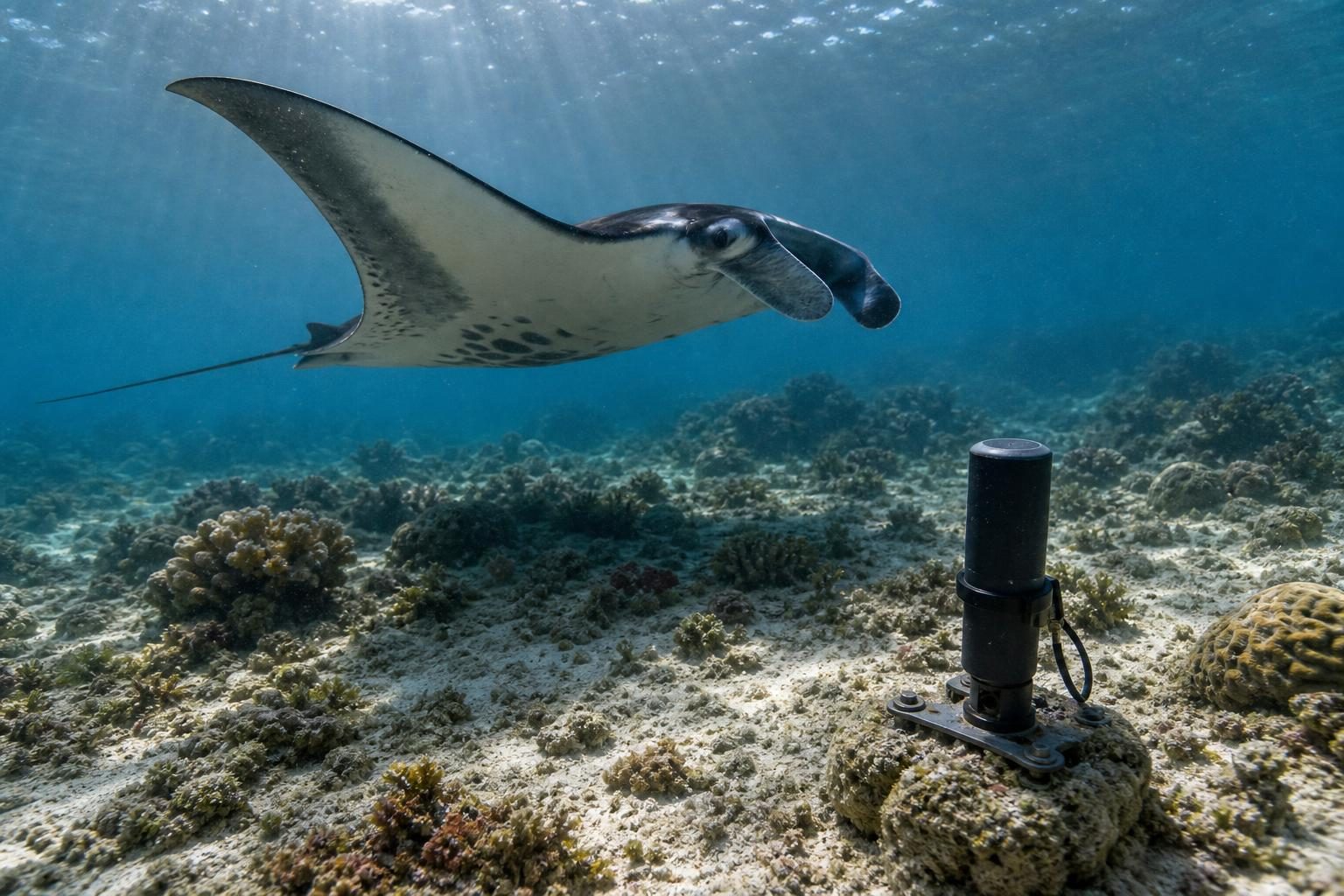
Researchers studying giant manta rays in Central America found that young rays stay close to shore in safer coastal waters before they are large enough to handle the risks of the open ocean, according to reporting by Phys.org on a new study in Frontiers in Fish Science. The work matters because it shows both a wildlife pattern and a job pattern: modern field science is not just one person watching animals. It is a technical operation that combines animal behavior, electronics, boats, data systems, and conservation planning.
Giant manta rays are among the largest rays in the ocean. Adults can grow to about 30 feet long, with a disk, or flat body width from wingtip to wingtip, of about 23 feet, and can weigh up to 4,400 pounds. Once they reach adulthood at around eight to 10 years old, their size gives them few natural enemies. Pups, which are baby manta rays, do not have that protection. In the open ocean, they can be vulnerable to predators such as several shark species and orcas.
The study found that young mantas with disk widths of about 10 feet or less stayed in shallow nearshore waters. Nearshore means close to the coast, where reefs and shallow areas can offer food, hiding places, and cleaning stations. A cleaning station is a reef area where small fish remove parasites and dead skin from larger animals. For a young manta, that coastal zone is not just a place to pass through. It functions more like a nursery and service area.
Adults behaved differently. The researchers found that mature mantas traveled long distances along the continental shelf break. The continental shelf is the underwater edge of a continent, and the shelf break is the zone where the seafloor drops more sharply into deeper water. For adult rays, that route can connect feeding, social, and breeding areas across national waters. For people managing the species, it creates a problem: an animal can be protected in one coastal reserve and then lose that protection when it crosses into unprotected or international waters.
The work was built from three kinds of tracking and identification. Acoustic telemetry uses underwater sound signals to detect tagged animals when they pass near receivers. Satellite telemetry uses transmitters that can track movement and behavior over larger distances. Photo ID uses natural markings, such as spot patterns, to recognize individual animals without relying only on a tag number. The team used these tools at five locations between 2018 and 2025, with acoustic tracking for 59 individuals, satellite tracking for 12 individuals, and photo identification to help confirm who was who. The combined data included more than 12,000 detections.
That mix of tools is the career lesson inside the science. A field technician on a project like this may need to help deploy and recover equipment, keep gear working in saltwater, record exact observations, follow animal-handling procedures, and keep clean data logs. A researcher or project lead has to design the study, choose the right tracking method, train the team, coordinate permits and partners, and turn thousands of detections into a pattern that can be defended in a scientific paper. A data technician has to make sure one animal is not counted as two, that time and location records match, and that photos, tag records, and receiver detections can be compared.
This is not a job where technology replaces field skill. It changes what field skill means. A person still has to work around weather, boats, seawater, wildlife, and equipment that can fail. But the best observation may come months later, when detections from underwater receivers are matched with satellite tracks and photo records. The study’s lead author, Jeffry Madrigal-Mesén of Mantas Costa Rica, described the value of combining methods: “Combining these tools turned fragmented data into a unified, undeniable story.”
For hiring, the study points toward hybrid skills. Marine science employers and conservation groups need people who can work safely outdoors and also handle technical systems. That can include comfort with basic electronics, batteries, sensors, waterproof housings, data entry, image organization, and troubleshooting. It also requires careful habits: labeling files, checking measurements, recording where equipment was placed, and not guessing when a record is incomplete. In a project that may run for years, sloppy data can ruin work that took thousands of hours to collect.
The study also shows why science jobs connect to policy and industry. The researchers argue that marine protected areas by themselves are not enough for a species that moves across borders. A marine protected area is a zone where human activity, such as fishing or vessel traffic, may be limited to protect wildlife or habitat. Adult rays leaving those areas can face unselective industrial fisheries, which are large-scale fishing operations that may catch animals other than the target species, and vessel strikes, which happen when boats or ships hit marine animals.
The authors suggest multinational conservation swimways, meaning protected movement corridors across more than one country’s waters, that connect coastal nurseries with adult migration routes. Creating those corridors would not be only a biology job. It would involve field crews, fisheries managers, boat operators, conservation organizations, government agencies, and people who can explain data clearly enough for decision-makers to use it.
The manta ray story is easy to picture as a nature story: young animals staying close to shore until they are ready for deeper water. But the work behind that picture is a technical workplace. The discovery depended on people who could combine marine fieldwork with tracking hardware, long-term records, and careful analysis.
Written from reporting by Phys.org, “Baby manta rays hunker down close to coasts before facing the open ocean's dangers”.
Discussion questions
- If funding were limited, should a manta ray project prioritize more field tagging, better data analysis, or more work with governments on protected corridors? Defend your choice.
- How does this study change the idea of what “fieldwork” means in a technical career?
- What risks could come from relying on only one tracking method, such as satellite tags or photo ID, when making conservation decisions?