
One Tea Gene Points to Better Flavor and Hardier Plants
A new study links tea taste and cold tolerance, showing how plant science can change the work of growers, breeders, and lab technicians.
Print it — all four files
The student packet has no answers in it. The teacher copy is the same pages plus a note on each question and the answer keys. Both languages carry the same story, the same picture and the same vocabulary.
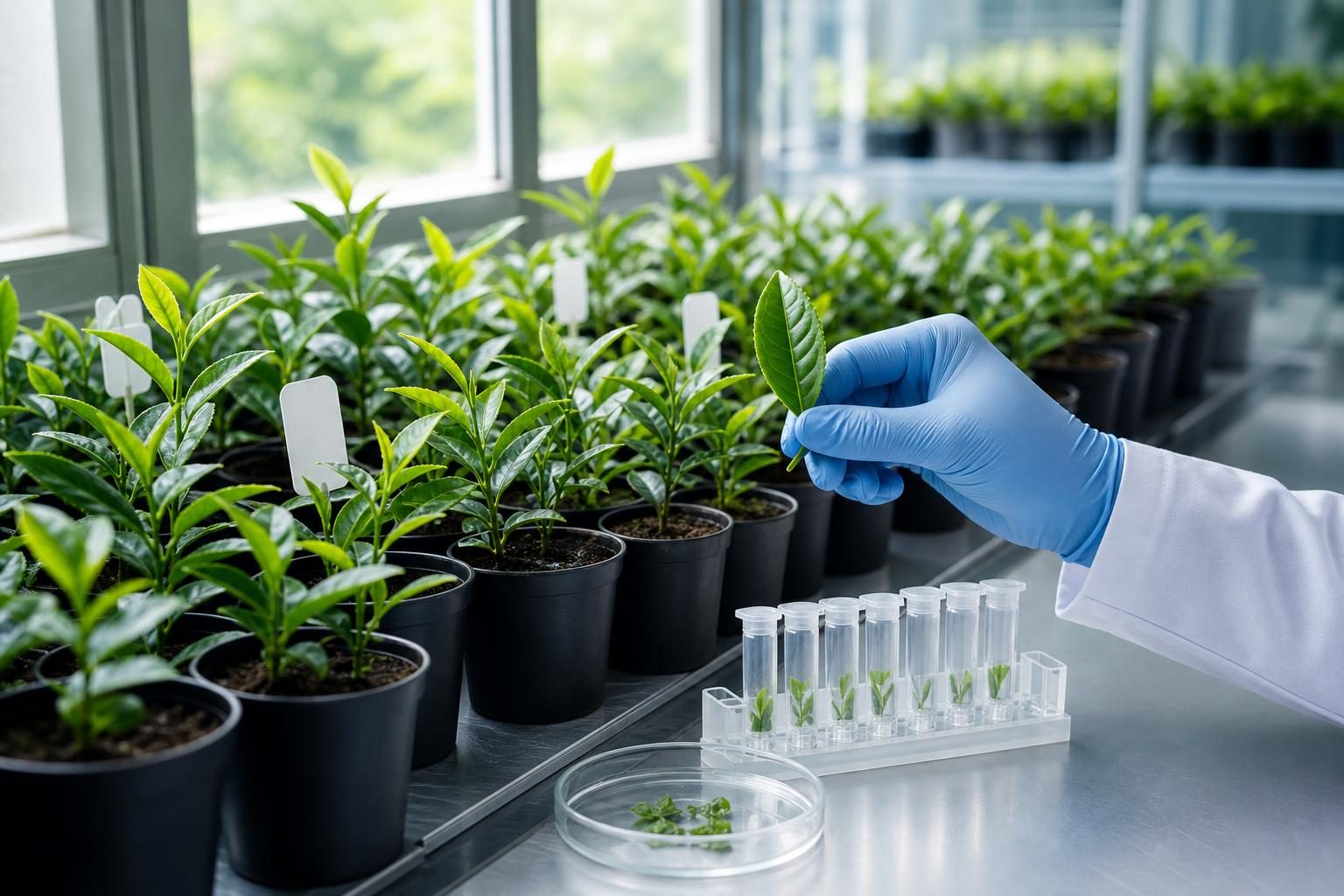
Researchers have identified a gene in tea plants that helps control both flavor and cold tolerance, according to Phys.org’s report on a study published in New Phytologist. The gene is called CsBBX19. A gene is a section of DNA that carries instructions a living thing uses to build and regulate itself. In this case, the gene responds to light and helps regulate chemicals in tea leaves that affect taste. It also turns on a biological pathway, meaning a chain of chemical steps inside the plant, that helps the plant handle cold stress.
That matters because tea quality is not just about what happens after leaves are picked. It starts in the plant. Tea leaves contain catechins, compounds that can add bitterness and astringency, and theanine, an amino acid linked with a smoother, savory quality. The study says CsBBX19 regulates the ratio between catechins and theanine. A ratio is the relationship between two amounts. Changing that balance can change the finished drink’s flavor profile, even before workers get to processing steps such as withering, rolling, oxidation, drying, or sorting.
The same gene also appears to help the plant tolerate cold. Cold tolerance is the ability of a plant to keep functioning when temperatures drop enough to stress its cells. For growers, cold is not an abstract problem. A plant that is damaged by low temperatures may produce fewer usable leaves or leaves with lower quality. The Phys.org article says the finding could help expand the possibility of growing better-tasting tea in a wider variety of locations. The study does not say a new commercial variety is ready now. It identifies a target that plant breeders may be able to use.
Plant breeding is the work of developing improved plant varieties by selecting parent plants with useful traits and testing their offspring. In older breeding programs, workers often judged plants mostly by visible traits: survival, leaf size, yield, plant shape, or taste after processing. Modern breeding can add molecular information. A molecular target is a specific gene, protein, or chemical pathway that scientists can track while they are trying to improve a crop. If CsBBX19 proves useful in breeding, it could help workers look for tea plants that combine two valuable traits: desirable flavor chemistry and stronger resistance to cold.
Several jobs touch this kind of work. A plant scientist or plant breeder designs the crosses and decides which traits matter. A greenhouse technician grows the trial plants, controls light and temperature, waters and fertilizes on schedule, watches for pests, and records plant performance. A lab technician may prepare leaf samples, extract DNA or plant chemicals, run tests, label samples, maintain equipment, and enter results without mixing up plant lines. A field technician may plant test plots, collect leaves at the right growth stage, and document how plants perform outdoors. None of those tasks works if the chain of custody for samples is sloppy.
The word “light-responsive” is important for the work itself. If a gene responds to light, then growing conditions can affect how strongly it acts. A research team or breeding program would need careful controls, meaning planned conditions that make comparisons fair. Plants grown under different light exposure, temperature, or stress conditions may not show the same chemistry. For technicians, that makes accurate records part of the science, not paperwork after the real job. A mislabeled tray, an unrecorded cold event, or a swapped sample can make good data useless.
The finding also shows why agriculture is becoming more technical without stopping being hands-on. Tea is still a crop grown in soil, harvested from living plants, and processed with equipment. But decisions about future varieties may depend on DNA, chemical analysis, and controlled experiments. A person hired into this work may need to understand plant care and also be comfortable with lab safety, measurement, spreadsheets, sample labels, and standard operating procedures. A standard operating procedure is a written method that tells workers exactly how to do a task so results can be repeated.
There are trade-offs. Breeding for cold tolerance might help growers in cooler places, but a plant also has to meet flavor, yield, disease resistance, and processing needs. A tea plant that survives cold but makes a poor cup will not solve the grower’s problem. A plant with excellent flavor that cannot survive local weather has the opposite problem. The value of CsBBX19 is that it may connect two important traits instead of treating them separately.
For CTE pathways, the main lesson is not that everyone needs a Ph.D. to work in plant science. Research like this depends on teams. Some people design the study, some grow the plants, some run the instruments, some maintain the facility, and some process the crop. The hiring edge is often reliability with living material and data at the same time. In agriculture technology, a worker may be trusted with thousands of plants, expensive equipment, and results that guide the next season’s decisions. A small gene can matter, but so can the person who labels the leaf sample correctly.
Written from reporting by Phys.org, “Targeting a particular gene may improve tea plants' flavor and cold tolerance”.
Discussion questions
- If a breeding program can improve either flavor or cold tolerance faster, but not both at once, which goal should it prioritize and why?
- How does adding gene-level information change the skills expected of agricultural workers who still do hands-on plant care?
- What information would a grower or processor still need before trusting this discovery enough to invest in a new tea variety?