
Swiss glacier loss turns climate data into field work
A new report shows rapid ice loss, and the job behind the numbers depends on careful measurement in difficult terrain.
Print it — all four files
The student packet has no answers in it. The teacher copy is the same pages plus a note on each question and the answer keys. Both languages carry the same story, the same picture and the same vocabulary.
Swiss glaciers lost 5.5% of their ice volume in 2026, the second-largest annual loss ever recorded there, according to reporting by Phys.org on a new study from Glacier Monitoring in Switzerland, or GLAMOS. Over the last five years, the country’s glaciers have lost nearly 20% of their mass. Mass means the amount of material in the glacier, while volume means how much space the ice takes up. Both matter because a glacier can thin, shrink back uphill, or disappear from a place that used to hold ice.
The reason this matters is not only that mountain scenery is changing. Glaciers store frozen freshwater, release meltwater during warm months, and affect hazards and infrastructure in mountain regions. Between July and September this year, Swiss glaciers lost about 2.2 trillion liters of water. GLAMOS chief Matthias Huss said that amount is more than four times the annual freshwater consumption of Swiss households. That does not mean the water can simply be captured and used like water from a tank. It means a major frozen reserve is being drawn down fast.
The report links the 2026 melt to a record-hot summer and a winter with little snowfall. Switzerland’s June, July, and August were each the hottest ever recorded in the country since measurements began in 1864, according to the Swiss Federal Office of Meteorology and Climatology. Snow cover matters because it acts like a protective layer on top of the ice. Bright snow reflects sunlight back into the atmosphere, while darker exposed ice and rock absorb more heat. This year, that cover had partly disappeared during June heat waves and was gone by September even at high elevations.
This story is also about a specific kind of work: environmental monitoring. GLAMOS based its findings on measurements taken in September at 23 reference glaciers. A reference glacier is a glacier used as a measuring site because scientists can track it carefully over time. The network then extrapolated those results to nearly 1,300 glacial formations in Switzerland. To extrapolate means to use data from measured locations to estimate conditions in similar places that were not all measured directly. That step requires judgment, math, and consistent data collection, not just a dramatic photograph of melting ice.
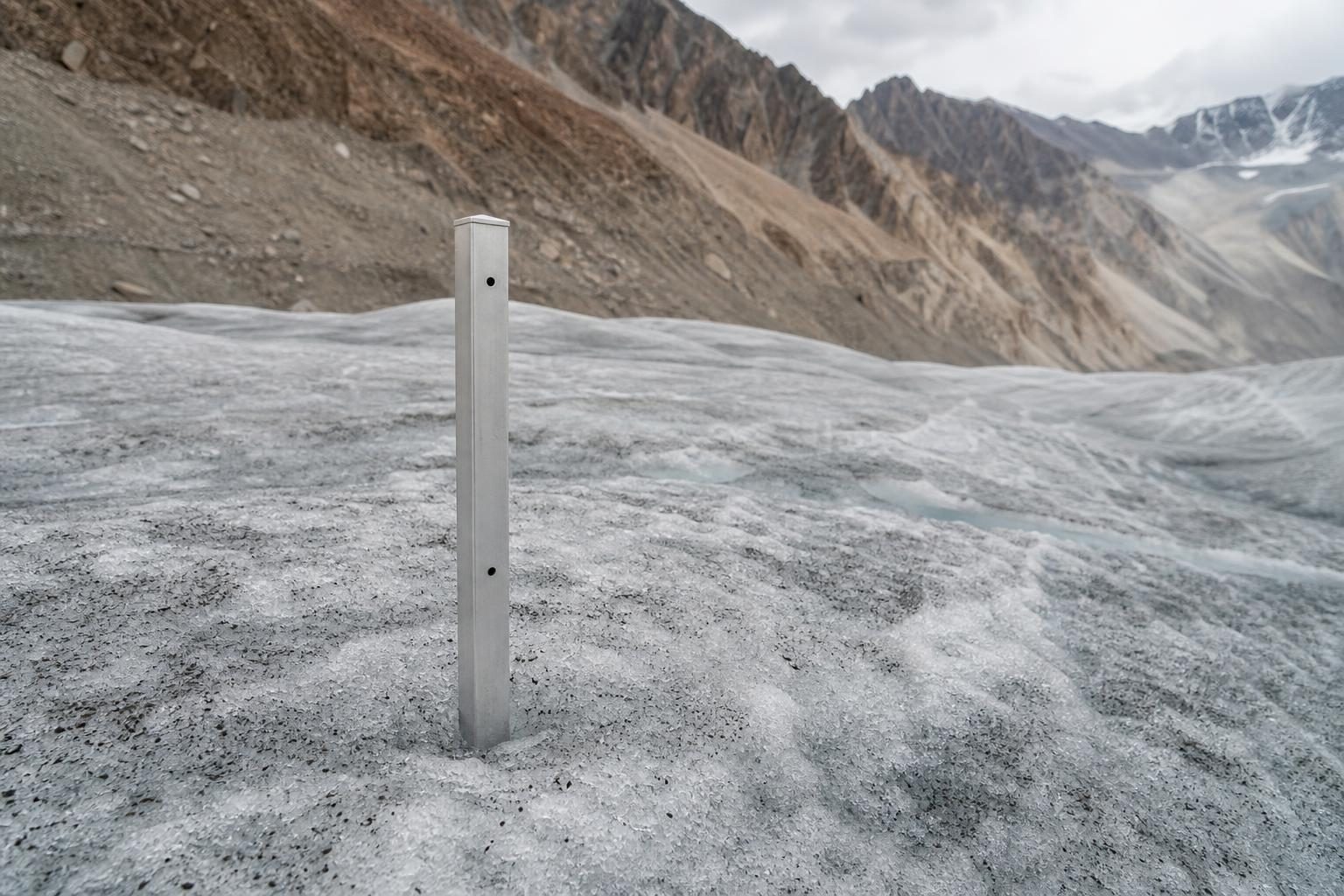
One field method in the article is simple in design but demanding in practice. Researchers place aluminum measurement stakes into glacier ice and return later to see how much of the stake is exposed. On the Scex Rouge glacier, at nearly 3,000 meters, a four-meter stake that had been fully embedded in late July had more than three meters sticking out by the time Huss removed it. In other words, the surface of the glacier had dropped around the stake. Some glaciers lost an average of 2.5 to 4 meters of thickness, while exposed glacier tongues, the lower ends of glaciers that extend down valleys, lost up to 10 meters over the summer.
The work is changing because the job site is changing. GLAMOS reported that researchers had to move some measurement stakes farther up the glaciers after the ice melted away at the original locations. That is a major practical problem for any monitoring program. If a long-term measuring point disappears, workers must keep the data useful while adapting the method. For a technician or field scientist, that means accuracy is not only about reading an instrument correctly. It is also about documenting where measurements were taken, why a station moved, and whether future data can still be compared to older data.
The article does not list a job posting or say what credentials GLAMOS requires for its workers, so it would be wrong to claim one exact path into this career. But the tasks shown in the reporting point to skills that employers in environmental monitoring often need: careful field measurement, instrument handling, data logging, basic climate and weather knowledge, and the ability to work from a written protocol. A protocol is a step-by-step procedure that keeps measurements consistent between workers and over time. In this kind of work, a sloppy note or a misplaced stake can weaken a whole dataset.
For CTE readers, the key takeaway is that climate science is not only debate, policy, or computer modeling. It includes people doing physical measurement work in cold, high-altitude, and changing environments, then turning those measurements into numbers that water managers, engineers, planners, and researchers can use. The Swiss glacier report is alarming because of the speed of the loss, but it is also a case study in why skilled technical work matters. If the measurements are not trustworthy, the warning is easier to ignore. If they are careful and repeatable, the data can shape real decisions.
Written from reporting by Phys.org, “'Catastrophic': Swiss glaciers lose fifth of mass in five years”.
Discussion questions
- When a long-term measurement site disappears because the environment has changed, should researchers prioritize keeping the old method as comparable as possible or redesigning the method for new conditions?
- What responsibilities do technicians and field crews have when their measurements may influence public decisions about water, infrastructure, or climate planning?
- If a CTE program wanted to prepare students for environmental monitoring work, what skills should it teach beyond general science knowledge?