
Trade Fight With Canada Hits Shop Floors and Fuel Lines
Broken talks over tariffs put pressure on automakers, refineries, and the technical workers who keep cross-border supply chains moving.
Print it — all four files
The student packet has no answers in it. The teacher copy is the same pages plus a note on each question and the answer keys. Both languages carry the same story, the same picture and the same vocabulary.
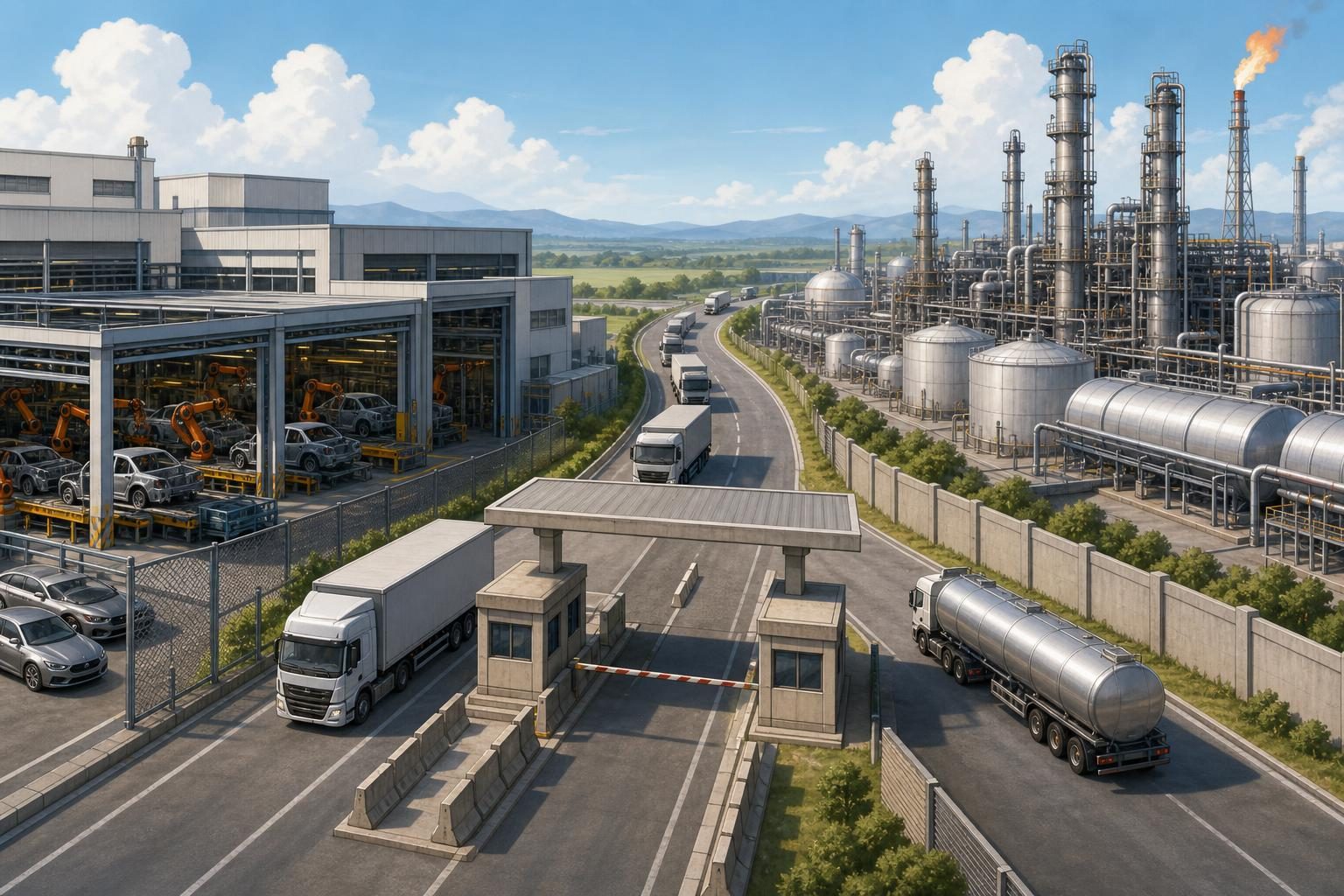
Negotiations in the U.S.-Canada trade dispute broke down over the weekend, and the conflict is now raising bigger questions about whether the two countries can keep doing business the way they have for decades, according to a PBS NewsHour interview with Peter Armstrong, a senior business correspondent for the CBC. Canadian Prime Minister Mark Carney said Canada had been preparing for a major shift in its relationship with the United States and no longer sees the U.S. as a fully reliable partner. That is a big statement because the two economies are tied together through factories, energy, transportation, retail, and services.
For a career and technical education classroom, the important part is not just the politics. It is the work. A tariff is a tax placed on goods that cross a border. When tariffs rise or rules change, the effects show up in purchasing departments, loading docks, machine shops, assembly plants, refineries, dealerships, and maintenance crews. People still have to quote jobs, order parts, inspect shipments, schedule production, and deliver finished products. The work may look the same from the outside, but the cost and timing behind each job can change.
The auto industry is one of the clearest examples in the PBS interview. Armstrong said North American automakers have paid about $110 billion in tariffs and disruption-related costs over the last 18 months. He also said U.S.-made cars going to Canada have dropped by 27 percent, which he connected to a roughly $7 billion loss for U.S. automakers. Canada is the number one export market for U.S. cars, and Armstrong said it is the top export market for the United States overall. An export market is a place where companies sell goods made somewhere else. If that market shrinks, it can affect how many vehicles need to be built, shipped, inspected, serviced, and sold.
That matters to more than executives. Vehicle production depends on technicians who maintain industrial equipment, electricians who troubleshoot controls, welders and fabricators, quality inspectors, parts specialists, truck drivers, rail workers, and dealership service departments. The PBS interview does not say that any specific plant is cutting jobs or changing hiring rules. But it does show why employers value workers who can handle change: reading work orders accurately, documenting materials, using measurement and inspection tools, following safety procedures, and communicating when a shipment, part, or schedule changes.
Energy is another job connection. Armstrong said 25 percent of refinery throughput in the United States comes from Canadian oil. Refinery throughput means the crude oil that goes into a refinery to be processed into fuels such as gasoline. A refinery is not just a tank farm; it is a highly controlled industrial site with pumps, valves, pipes, instruments, control rooms, pressure systems, and strict safety rules. Operators, instrument technicians, millwrights, pipefitters, lab technicians, and maintenance planners all help keep that system running. If a trade fight makes energy inputs more uncertain or more expensive, the pressure is not only on consumers at the pump. It can also land on the crews responsible for reliable operation.
The dispute also shows why the phrase “trade deficit” can be misleading if it is treated like a scoreboard. A trade deficit means one country buys more goods or services from another country than it sells to that country. Armstrong said the U.S. deficit with Canada is largely tied to oil, because the United States buys a lot of Canadian oil. He also said that when services such as consulting, software, and digital streaming are included, the deficit shrinks to about $40 billion. His point was that buying from another country is not automatically proof that one side is being cheated; it may mean that the buyer needs what the seller provides.
The bigger concern is trust. Armstrong pointed to the USMCA, the trade agreement among the United States, Mexico, and Canada that was signed during President Trump’s previous term. Trade agreements are supposed to give companies stable rules so they can decide where to build, what equipment to buy, which suppliers to use, and how many workers they may need. If businesses believe those rules can be changed quickly, long-term planning becomes harder. A manufacturer thinking about a new production line, for example, has to weigh not only labor and materials, but also whether parts can cross borders at a predictable cost.
Canada may be more exposed because its economy is smaller and heavily linked to the United States, Armstrong said. But he also argued that American businesses, producers, households, and consumers are already feeling the effects. That is the key takeaway for people preparing for technical careers: international trade is not far away from the shop floor. It can determine which parts arrive, what a repair costs, how much inventory a company carries, and whether a customer can afford the finished product.
The jobs most connected to this story are not only “international business” jobs. They include the skilled trades and technical roles that make trade real: building cars, refining fuel, moving freight, repairing equipment, checking quality, and keeping production safe. Getting hired into those jobs still depends on the basics employers can verify: attendance, safety habits, math, tool use, documentation, teamwork, and the ability to learn new procedures. A trade war does not replace those skills. It makes them more important, because when the business environment gets unstable, mistakes in cost, timing, or quality become harder to absorb.
Written from reporting by PBS NewsHour, “The potential economic fallout of Trump's trade war with Canada”.
Discussion questions
- If tariffs are meant to pressure another country but also raise costs for some domestic businesses, how should leaders decide whether the trade-off is worth it?
- Imagine a local manufacturer depends on parts or customers across a border; what technical and workplace skills would become more valuable during a trade dispute, and why?
- What information is missing from this interview that would help you judge the real impact on workers rather than only on companies or governments?